

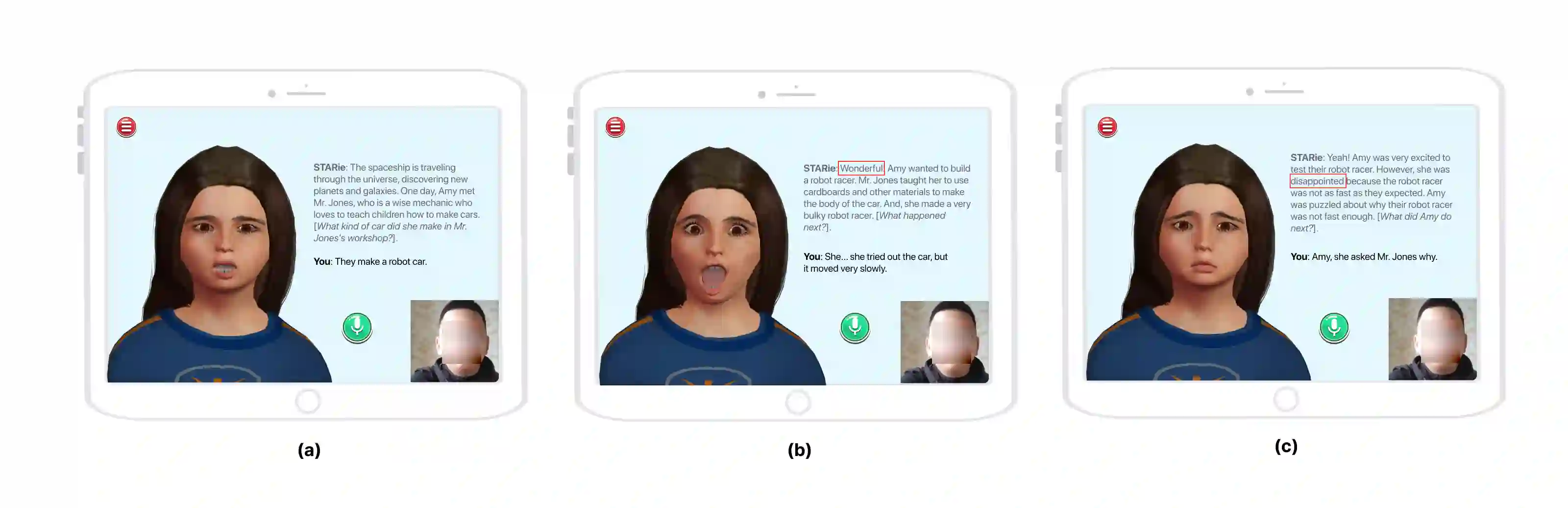
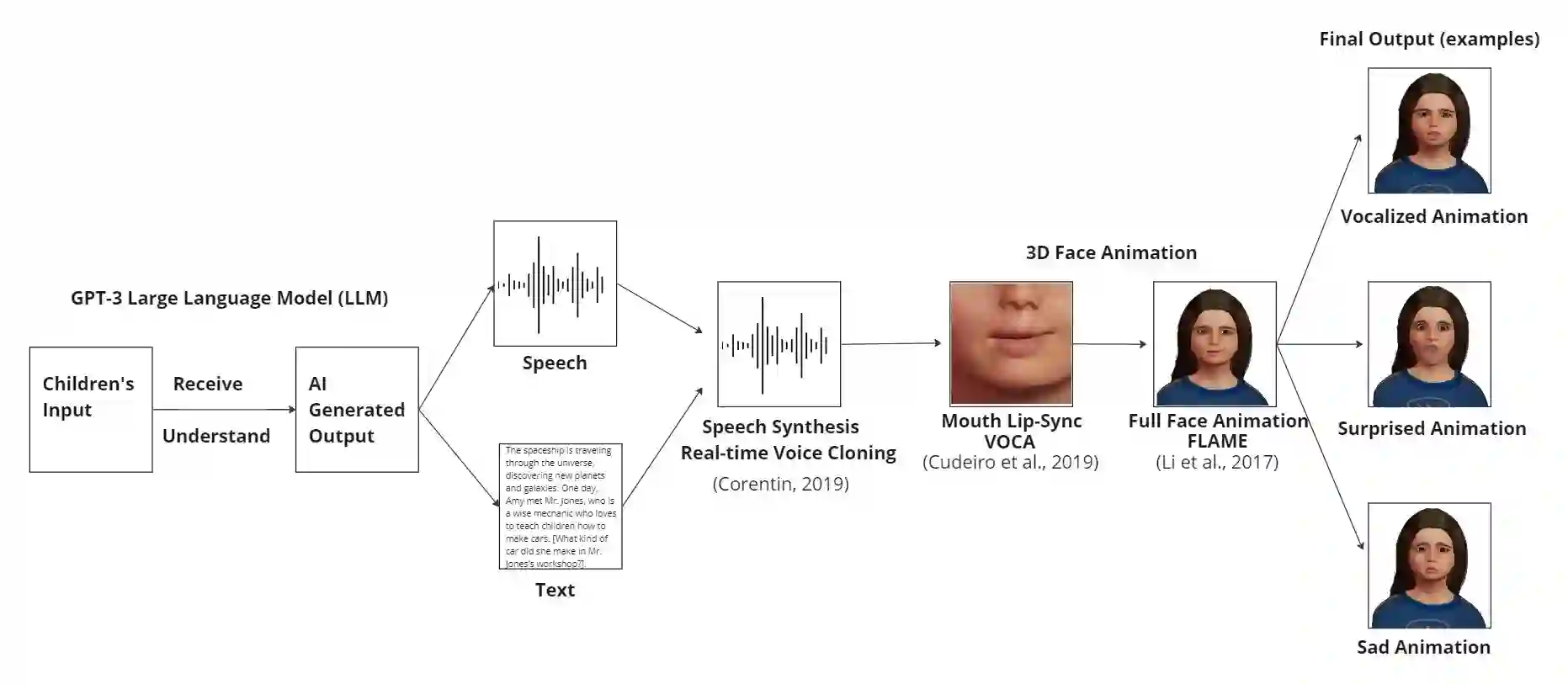
Advances in artificial intelligence have facilitated the use of large language models (LLMs) and AI-generated synthetic media in education, which may inspire HCI researchers to develop technologies, in particular, embodied conversational agents (ECAs) to simulate the kind of scaffolding children might receive from a human partner. In this paper, we will propose a design prototype of a peer-like ECA named STARie that integrates multiple AI models - GPT-3, Speech Synthesis (Real-time Voice Cloning), VOCA (Voice Operated Character Animation), and FLAME (Faces Learned with an Articulated Model and Expressions) that aims to support narrative production in collaborative storytelling, specifically for children aged 4-8. However, designing a child-centered ECA raises concerns about age appropriateness, children privacy, gender choices of ECAs, and the uncanny valley effect. Thus, this paper will also discuss considerations and ethical concerns that must be taken into account when designing such an ECA. This proposal offers insights into the potential use of AI-generated synthetic media in child-centered AI design and how peer-like AI embodiment may support children\textquotesingle s storytelling.
翻译:人工智能的进步促进了大型语言模型(LLMs)和AI生成合成媒体在教育中的应用,这可能启发人机交互研究人员开发技术,特别是具身对话代理人(ECAs),以模拟儿童从人类伙伴那里可能获得的支架式支持。本文提出一个名为STARie的同侪式ECA设计原型,它集成了多种AI模型——GPT-3、语音合成(实时语音克隆)、VOCA(语音驱动角色动画)和FLAME(基于铰接模型和表情的面部学习),旨在支持4-8岁儿童在协作式讲故事中的叙事生成。然而,设计以儿童为中心的ECA引发了关于年龄适宜性、儿童隐私、ECA性别选择以及恐怖谷效应的担忧。因此,本文还将讨论设计此类ECA时必须考虑的要点和伦理问题。本提案为AI生成合成媒体在以儿童为中心的AI设计中的潜在应用,以及同侪式AI具身如何支持儿童讲故事提供了见解。




相关内容




 微信扫码咨询专知VIP会员