

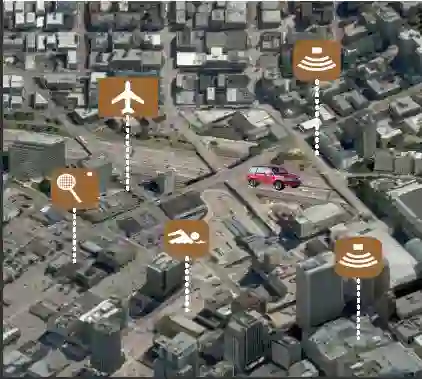
Urban computing has emerged as a multidisciplinary field that harnesses data-driven technologies to address challenges and improve urban living. Traditional approaches, while beneficial, often face challenges with generalization, scalability, and contextual understanding. The advent of Large Language Models (LLMs) offers transformative potential in this domain. This survey explores the intersection of LLMs and urban computing, emphasizing the impact of LLMs in processing and analyzing urban data, enhancing decision-making, and fostering citizen engagement. We provide a concise overview of the evolution and core technologies of LLMs. Additionally, we survey their applications across key urban domains, such as transportation, public safety, and environmental monitoring, summarizing essential tasks and prior works in various urban contexts, while highlighting LLMs' functional roles and implementation patterns. Building on this, we propose potential LLM-based solutions to address unresolved challenges. To facilitate in-depth research, we compile a list of available datasets and tools applicable to diverse urban scenarios. Finally, we discuss the limitations of current approaches and outline future directions for advancing LLMs in urban computing.
翻译:城市计算已发展成为一个多学科交叉领域,其通过数据驱动技术应对城市挑战并改善城市生活。传统方法虽具价值,但常面临泛化性、可扩展性及情境理解等方面的局限。大语言模型(LLMs)的出现为该领域带来了变革性潜力。本综述探讨LLMs与城市计算的交叉融合,重点阐述LLMs在处理分析城市数据、增强决策支持及促进公众参与方面的影响。我们首先简要概述LLMs的发展历程与核心技术,继而系统梳理其在交通、公共安全、环境监测等关键城市领域的应用,归纳不同城市场景下的核心任务与既有研究,并着重分析LLMs的功能角色与实现模式。在此基础上,我们提出基于LLMs的潜在解决方案以应对尚未解决的挑战。为支持深入研究,我们整理了适用于多样化城市场景的可用数据集与工具清单。最后,我们探讨现有方法的局限性,并展望LLMs在城市计算领域的未来发展方向。




相关内容




 微信扫码咨询专知VIP会员