

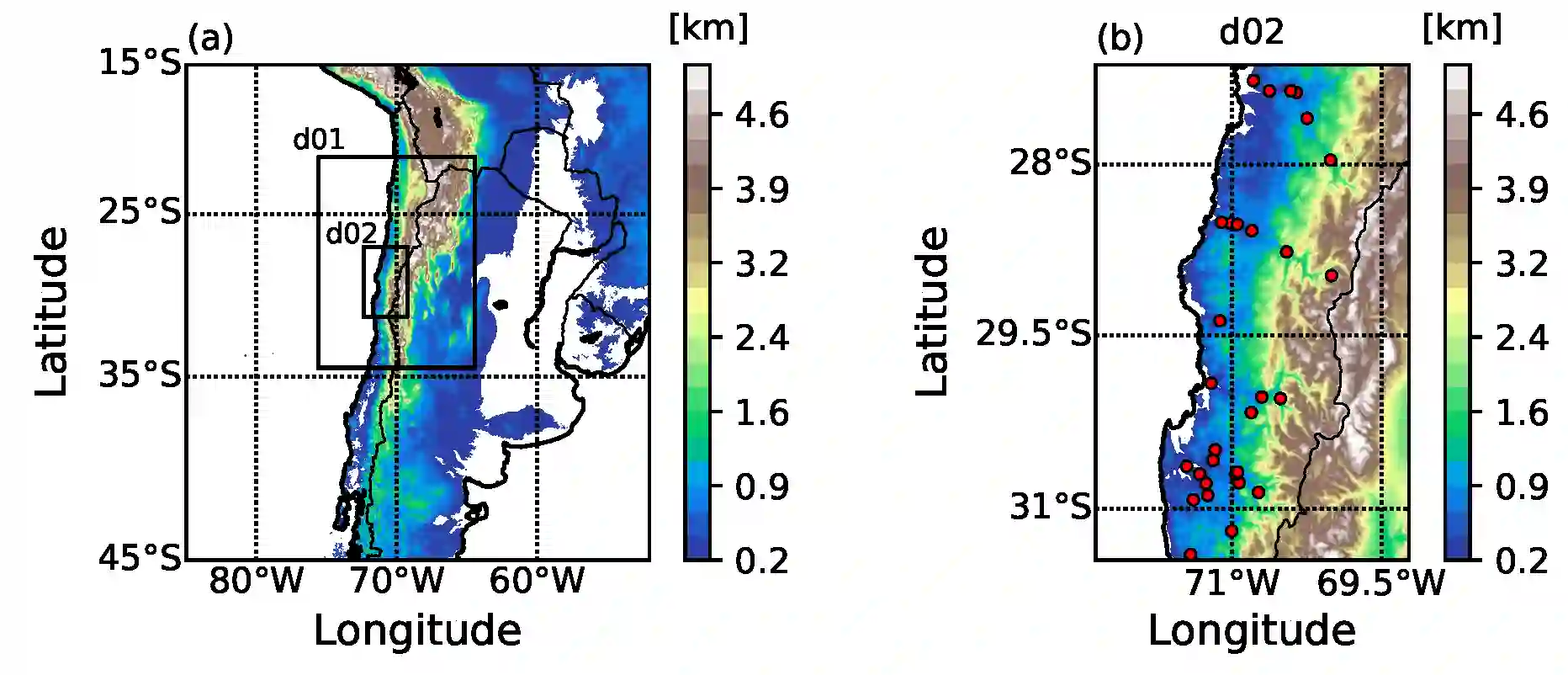
By the end of 2023, renewable sources cover 63.4% of the total electric power demand of Chile, and in line with the global trend, photovoltaic (PV) power shows the most dynamic increase. Although Chile's Atacama Desert is considered the sunniest place on Earth, PV power production, even in this area, can be highly volatile. Successful integration of PV energy into the country's power grid requires accurate short-term PV power forecasts, which can be obtained from predictions of solar irradiance and related weather quantities. Nowadays, in weather forecasting, the state-of-the-art approach is the use of ensemble forecasts based on multiple runs of numerical weather prediction models. However, ensemble forecasts still tend to be uncalibrated or biased, thus requiring some form of post-processing. The present work investigates probabilistic forecasts of solar irradiance for Regions III and IV in Chile. For this reason, 8-member short-term ensemble forecasts of solar irradiance for calendar year 2021 are generated using the Weather Research and Forecasting (WRF) model, which are then calibrated using the benchmark ensemble model output statistics (EMOS) method based on a censored Gaussian law, and its machine learning-based distributional regression network (DRN) counterpart. Furthermore, we also propose a neural network-based post-processing method resulting in improved 8-member ensemble predictions. All forecasts are evaluated against station observations for 30 locations, and the skill of post-processed predictions is compared to the raw WRF ensemble. Our case study confirms that all studied post-processing methods substantially improve both the calibration of probabilistic- and the accuracy of point forecasts. Among the methods tested, the corrected ensemble exhibits the best overall performance. Additionally, the DRN model generally outperforms the corresponding EMOS approach.
翻译:截至2023年底,可再生能源已满足智利总电力需求的63.4%,其中光伏发电与全球趋势一致,呈现出最强劲的增长势头。尽管智利的阿塔卡马沙漠被认为是地球上日照最充足的地区,但即使在该区域,光伏发电量仍可能表现出高度波动性。要将光伏能源成功并入国家电网,需要精确的短期光伏功率预测,这可通过预测太阳辐照度及相关气象量来实现。当前,在天气预报领域,最先进的方法是使用基于数值天气预报模型多次运行的集合预报。然而,集合预报往往仍存在未校准或偏差问题,因此需要进行某种形式的后处理。本研究针对智利第三和第四大区的太阳辐照度开展概率预测研究。为此,我们利用天气研究与预报(WRF)模型生成了2021日历年的8成员短期太阳辐照度集合预报,随后分别采用基于截断高斯分布的基准集合模型输出统计(EMOS)方法及其基于机器学习的分布回归网络(DRN)对应方法进行校准。此外,我们还提出了一种基于神经网络的后处理方法,从而获得了改进的8成员集合预测。所有预测均针对30个站点的观测数据进行了评估,并将后处理预测的效能与原始WRF集合预报进行了比较。本案例研究证实,所有研究的后处理方法均能显著提升概率预测的校准度与点预测的准确性。在测试的方法中,校正后的集合预报表现出最佳的综合性能。此外,DRN模型在多数情况下优于相应的EMOS方法。




相关内容





 微信扫码咨询专知VIP会员