

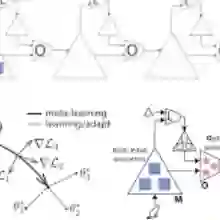
Recent advances in deep learning for physics have focused on discovering shared representations of target systems by incorporating physics priors or inductive biases into neural networks. While effective, these methods are limited to the system domain, where the type of system remains consistent and thus cannot ensure the adaptation to new, or unseen physical systems governed by different laws. For instance, a neural network trained on a mass-spring system cannot guarantee accurate predictions for the behavior of a two-body system or any other system with different physical laws. In this work, we take a significant leap forward by targeting cross domain generalization within the field of Hamiltonian dynamics. We model our system with a graph neural network and employ a meta learning algorithm to enable the model to gain experience over a distribution of tasks and make it adapt to new physics. Our approach aims to learn a unified Hamiltonian representation that is generalizable across multiple system domains, thereby overcoming the limitations of system-specific models. Our results demonstrate that the meta-trained model not only adapts effectively to new systems but also captures a generalized Hamiltonian representation that is consistent across different physical domains. Overall, through the use of meta learning, we offer a framework that achieves cross domain generalization, providing a step towards a unified model for understanding a wide array of dynamical systems via deep learning.
翻译:近期物理学深度学习的研究聚焦于通过将物理先验或归纳偏置融入神经网络,发现目标系统的共享表示。尽管这些方法行之有效,但局限于系统域内——即系统类型保持一致,因而无法确保模型能自适应遵循不同物理定律的新系统或未见过系统。例如,基于弹簧振子系统训练的神经网络,无法保证准确预测二体系统或任何其他遵循不同物理定律系统的行为。本文针对哈密顿动力学领域,在跨域泛化方向上取得重要突破。我们采用图神经网络对系统建模,并引入元学习算法,使模型能够在任务分布上积累经验,进而自适应新型物理系统。本方法旨在学习跨多系统域可泛化的统一哈密顿表示,突破系统特定模型的局限性。实验结果表明,经过元训练的模型不仅能有效适应新系统,还能捕获跨不同物理域保持一致的泛化哈密顿表示。总体而言,本研究通过元学习构建了一个实现跨域泛化的框架,为借助深度学习理解多样化动力学系统的统一模型迈出了关键一步。




相关内容




 微信扫码咨询专知VIP会员