

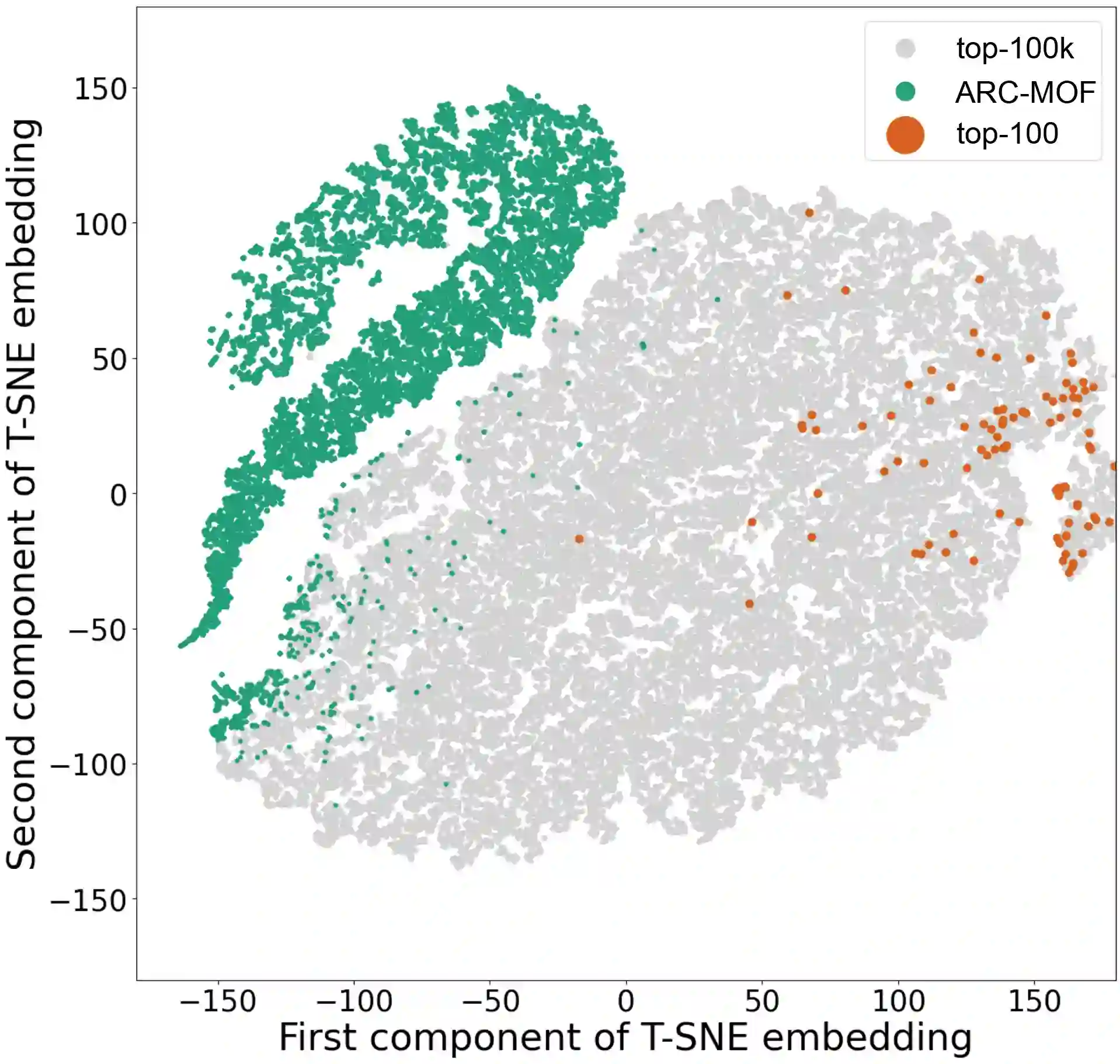
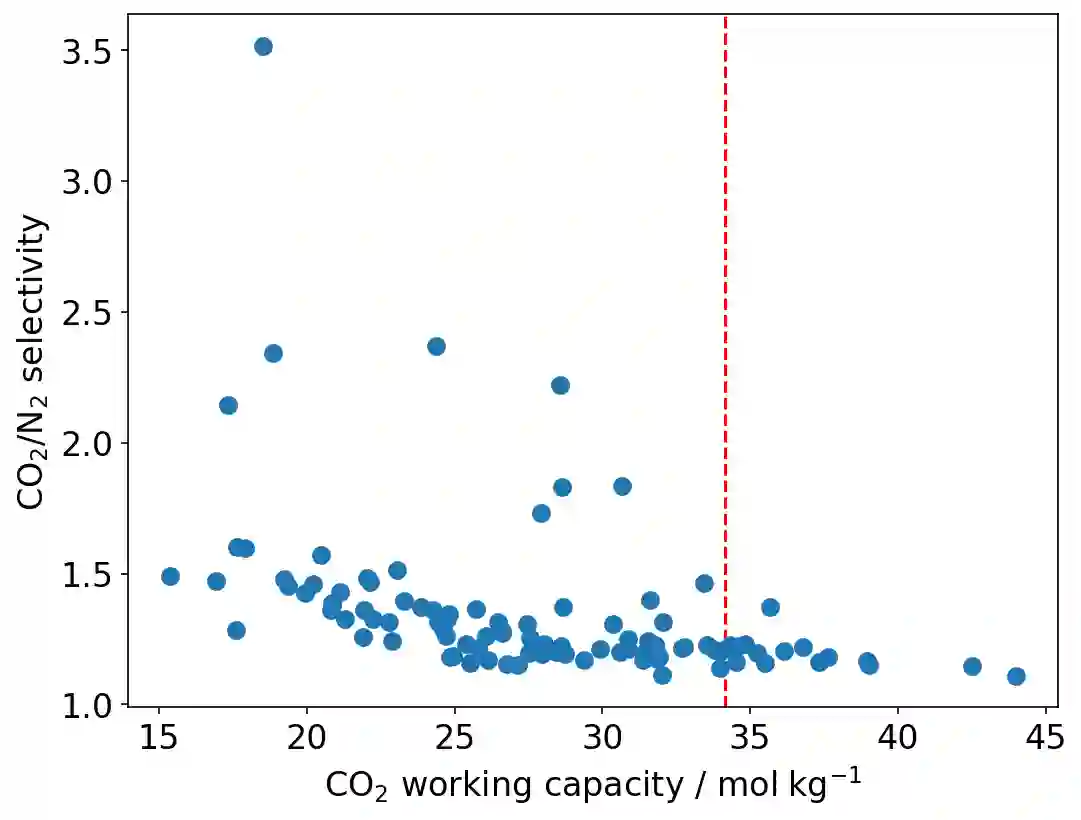
Artificial intelligence holds promise to improve materials discovery. GFlowNets are an emerging deep learning algorithm with many applications in AI-assisted discovery. By using GFlowNets, we generate porous reticular materials, such as metal organic frameworks and covalent organic frameworks, for applications in carbon dioxide capture. We introduce a new Python package (matgfn) to train and sample GFlowNets. We use matgfn to generate the matgfn-rm dataset of novel and diverse reticular materials with gravimetric surface area above 5000 m$^2$/g. We calculate single- and two-component gas adsorption isotherms for the top-100 candidates in matgfn-rm. These candidates are novel compared to the state-of-art ARC-MOF dataset and rank in the 90th percentile in terms of working capacity compared to the CoRE2019 dataset. We discover 15 materials outperforming all materials in CoRE2019.
翻译:人工智能有望改进材料发现过程。GFlowNets是一种新兴的深度学习算法,在人工智能辅助发现领域具有广泛应用。通过使用GFlowNets,我们生成了多孔网络材料,如金属有机框架和共价有机框架,用于二氧化碳捕获应用。我们引入了一个新的Python包(matgfn)来训练和采样GFlowNets。利用matgfn,我们生成了包含新型且多样性网络材料的matgfn-rm数据集,这些材料的重量比表面积超过5000 m²/g。我们计算了matgfn-rm中前100个候选材料的单组分和双组分气体吸附等温线。与先进水平的ARC-MOF数据集相比,这些候选材料具有新颖性,并且在工作容量方面相较于CoRE2019数据集排名处于第90百分位。我们发现了15种性能优于CoRE2019中所有材料的材料。




相关内容




 微信扫码咨询专知VIP会员