

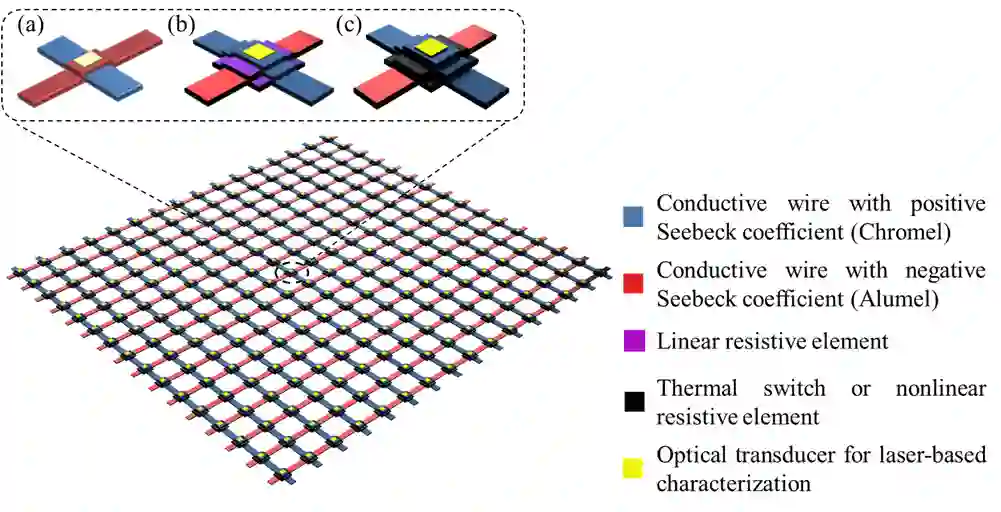
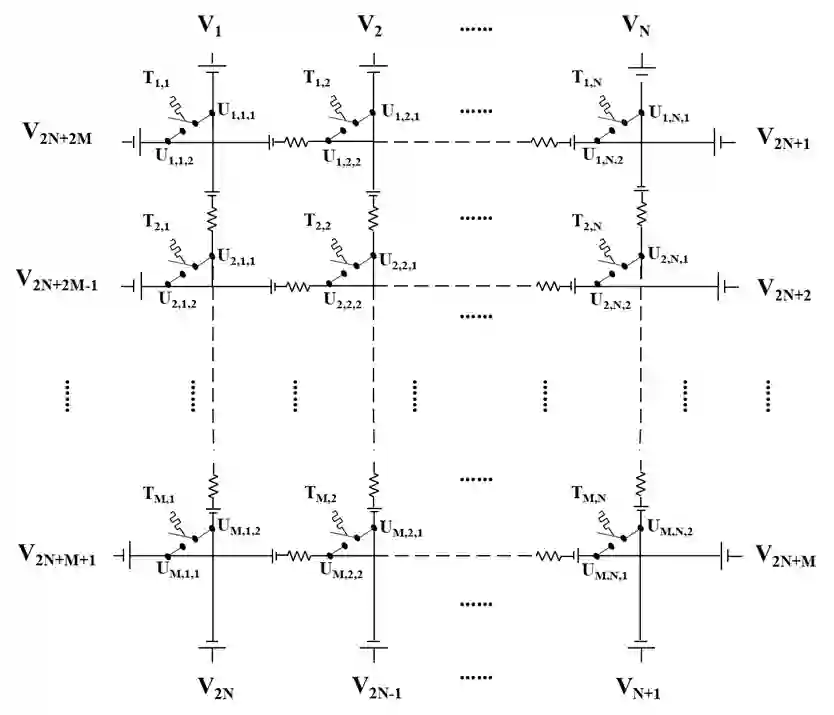
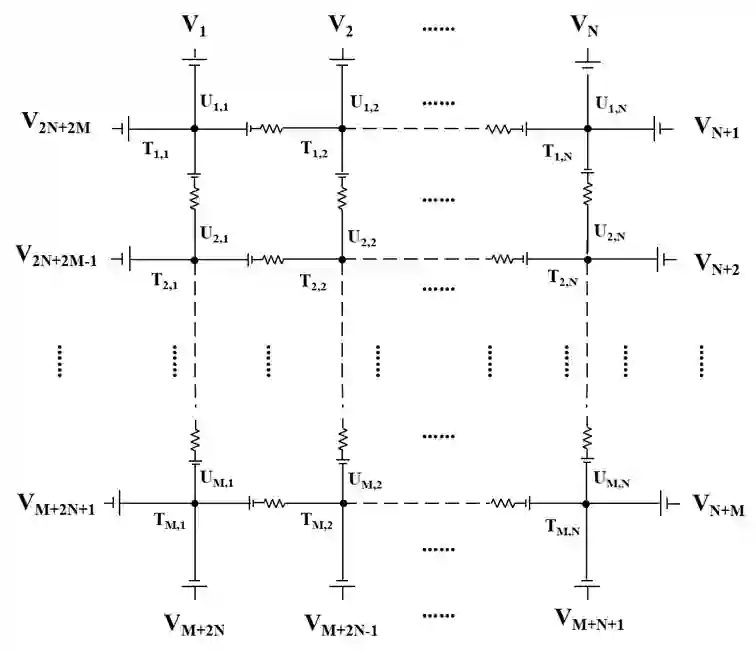
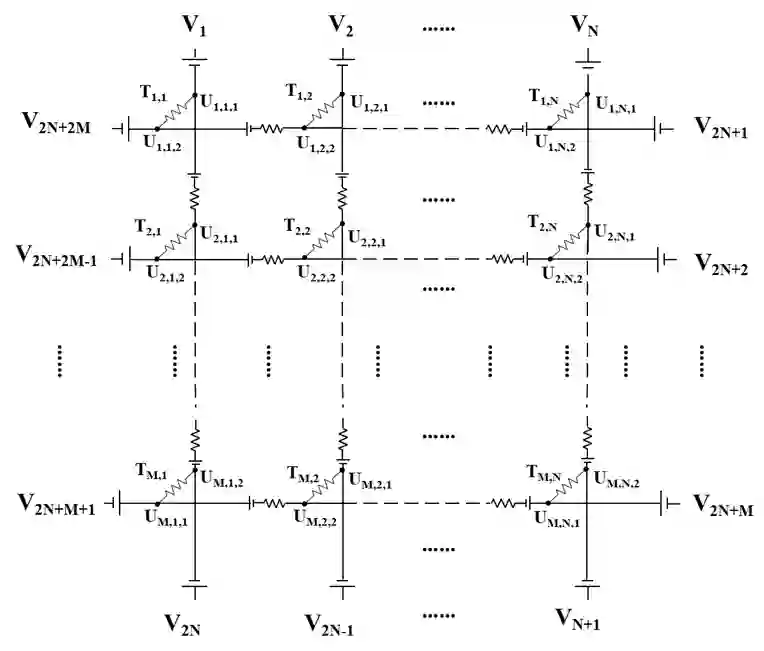
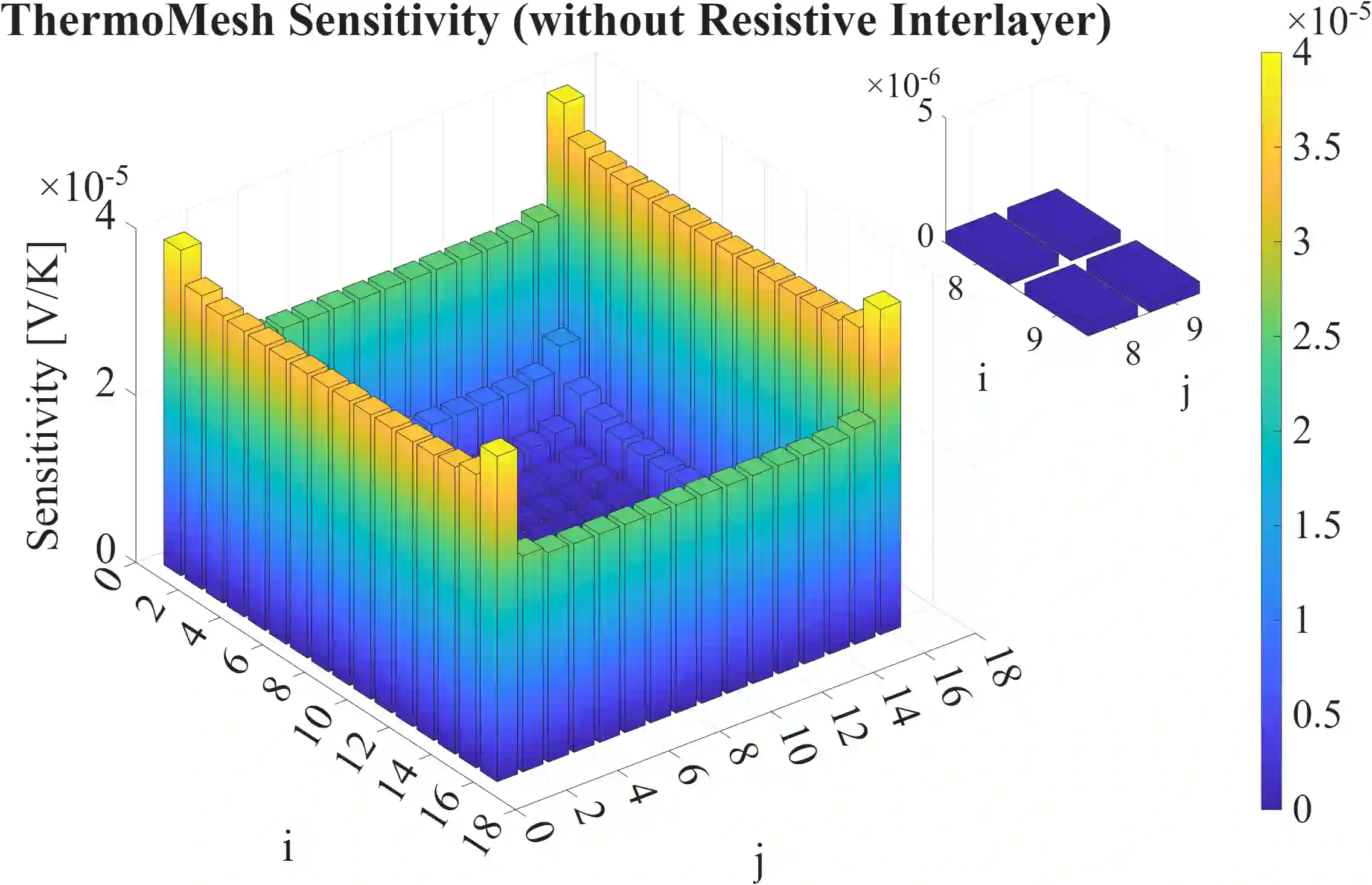
This work presents ThermoMesh, a passive thin-film thermoelectric mesh sensor designed to detect and characterize spatio-temporally sparse heat sources through conduction-based thermal imaging. The device integrates thermoelectric junctions with linear or nonlinear interlayer resistive elements to perform simultaneous sensing and in-sensor compression. We focus on the single-event (1-sparse) operation and define four performance metrics: range, efficiency, sensitivity, and accuracy. Numerical modeling shows that a linear resistive interlayer flattens the sensitivity distribution and improves minimum sensitivity by approximately tenfold for a $16\times16$ mesh. Nonlinear temperature-dependent interlayers further enhance minimum sensitivity at scale: a ceramic negative-temperature-coefficient (NTC) layer over 973-1273K yields a $\sim14{,}500\times$ higher minimum sensitivity than the linear design at a $200\times200$ mesh, while a VO$_2$ interlayer modeled across its metal-insulator transition (MIT) over 298-373K yields a $\sim24\times$ improvement. Using synthetic 1-sparse datasets with white boundary-channel noise at a signal-to-noise ratio of 40dB, the VO$_2$ case achieved $98\%$ localization accuracy, a mean absolute temperature error of $0.23$K, and a noise-equivalent temperature (NET) of $0.07$K. For the ceramic-NTC case no localization errors were observed under the tested conditions, with a mean absolute temperature error of $1.83$K and a NET of $1.49$K. These results indicate that ThermoMesh could enable energy-efficient embedded thermal sensing in scenarios where conventional infrared imaging is limited, such as molten-droplet detection or hot-spot monitoring in harsh environments.
翻译:本文提出ThermoMesh,一种无源薄膜热电网格传感器,旨在通过传导热成像检测并表征时空稀疏热源。该器件将热电结与线性或非线性层间电阻元件集成,实现同步传感与传感器内压缩。我们聚焦于单事件(1-稀疏)操作,并定义四个性能指标:范围、效率、灵敏度和精度。数值模拟表明,对于$16\times16$网格,线性电阻层间结构可平坦化灵敏度分布,并将最小灵敏度提升约十倍。非线性随温度变化的层间结构可进一步扩大规模下的最小灵敏度:在973-1273K范围内,陶瓷负温度系数(NTC)层在$200\times200$网格上的最小灵敏度比线性设计高出约$\sim14{,}500$倍;而VO$_2$层间结构在298-373K范围跨越其金属-绝缘体转变(MIT)建模时,最小灵敏度提升约$\sim24$倍。利用信噪比为40dB、含白边界信道噪声的合成1-稀疏数据集,VO$_2$案例实现了$98\%$的定位精度、$0.23$K的平均绝对温度误差和$0.07$K的噪声等效温度(NET)。对于陶瓷-NTC案例,在测试条件下未观察到定位误差,平均绝对温度误差为$1.83$K,NET为$1.49$K。这些结果表明,在传统红外成像受限的场景(如熔滴检测或恶劣环境下的热点监测)中,ThermoMesh可实现高能效的嵌入式热传感。




相关内容


 微信扫码咨询专知VIP会员