

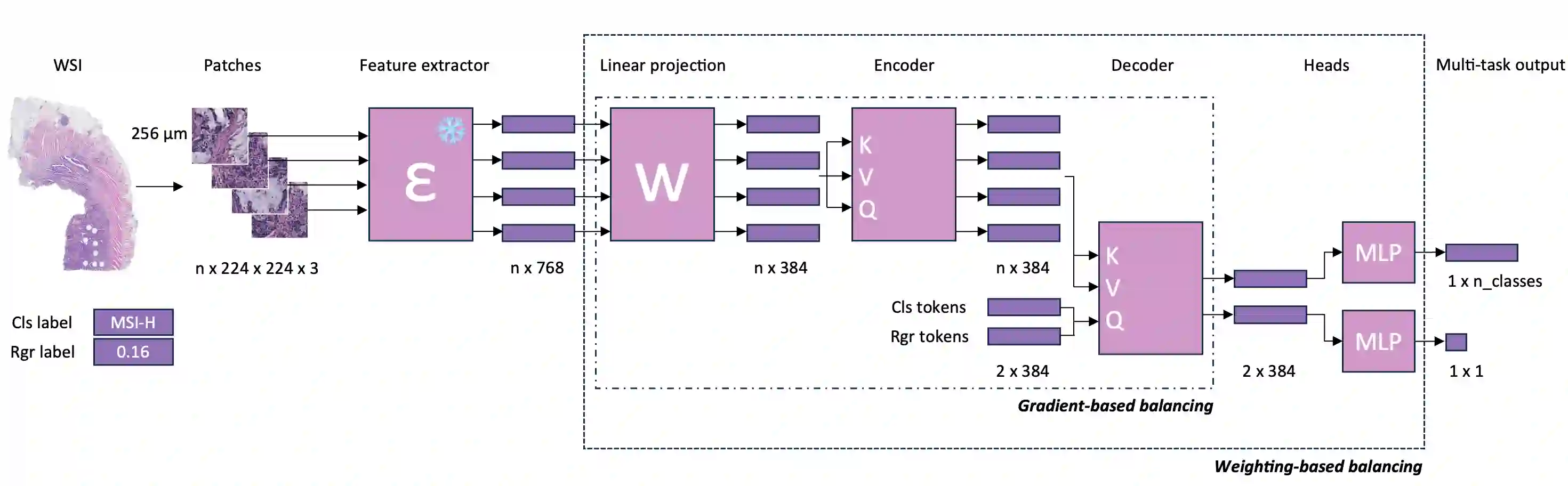
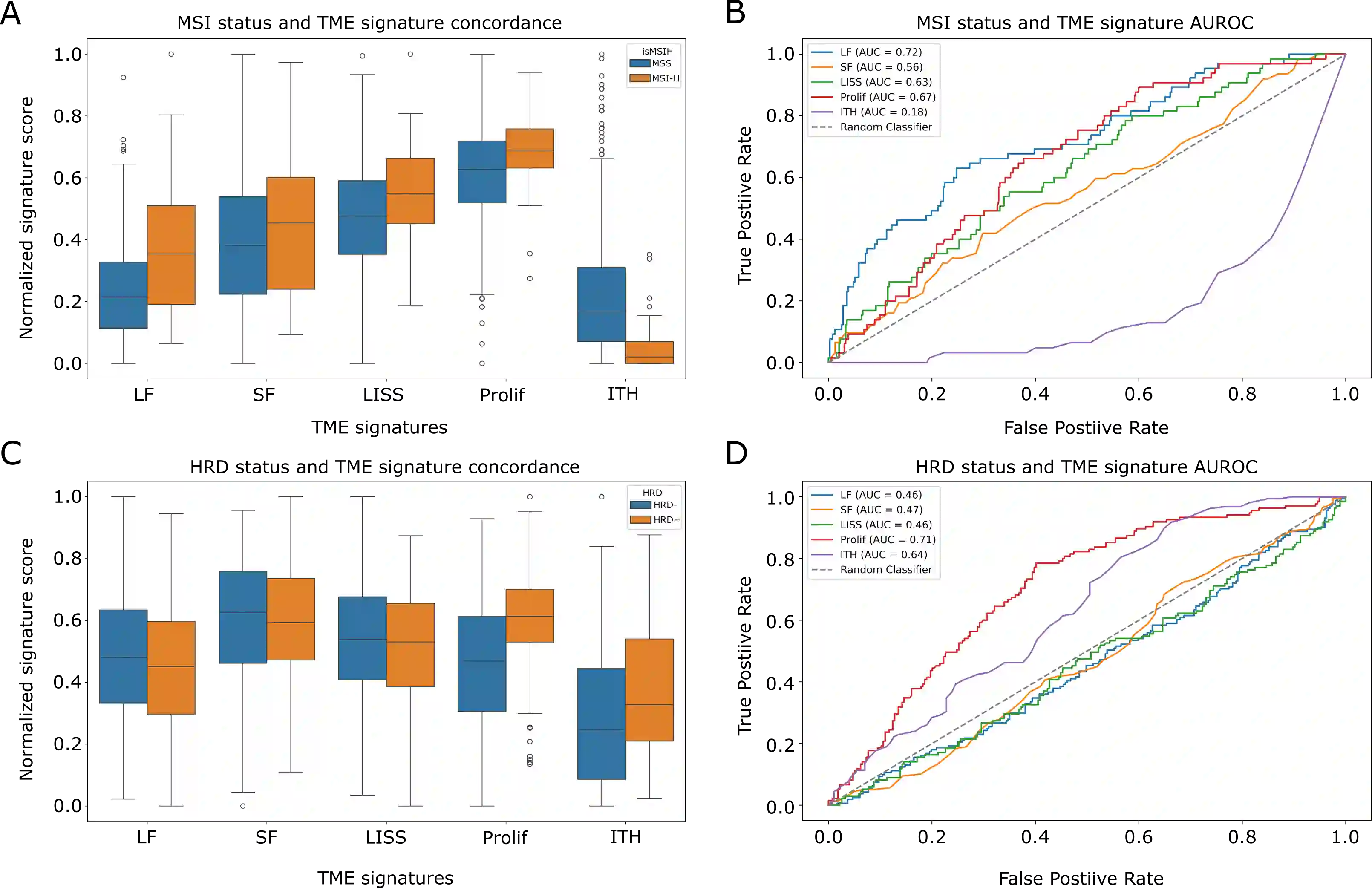
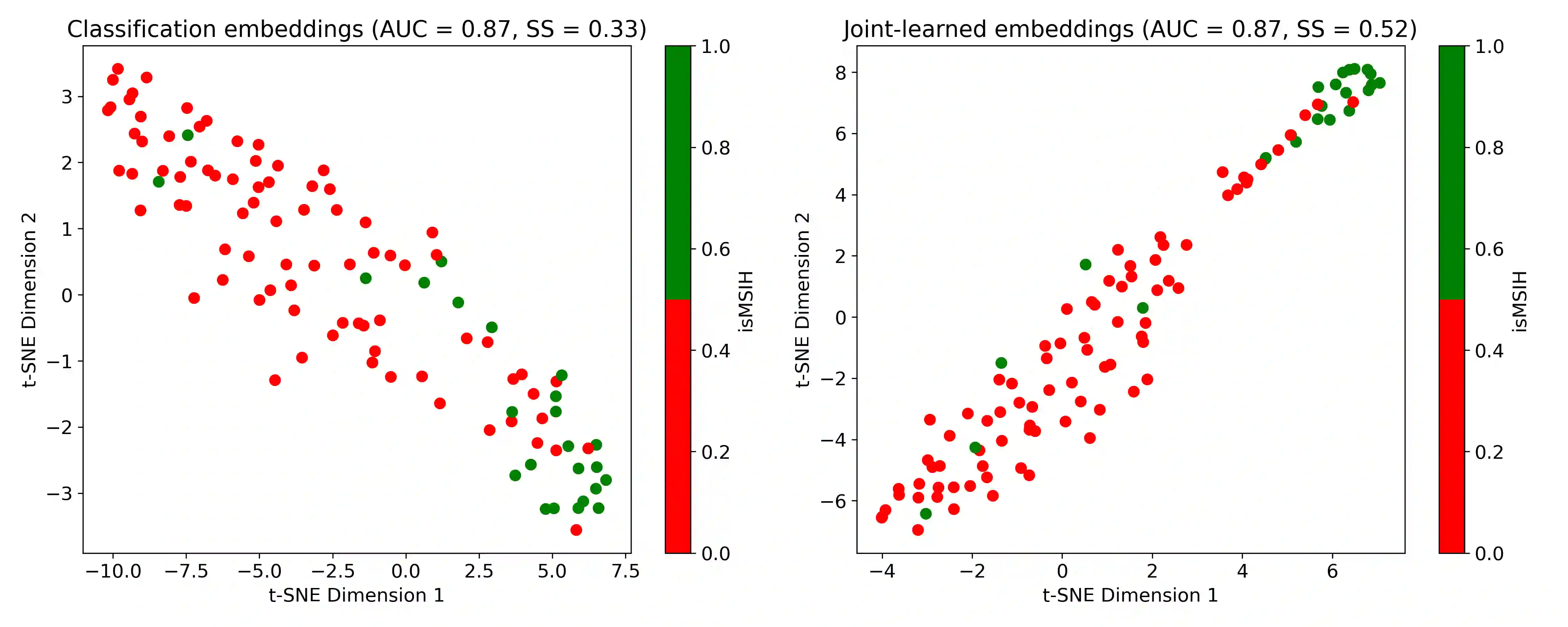
Deep Learning (DL) can predict biomarkers directly from digitized cancer histology in a weakly-supervised setting. Recently, the prediction of continuous biomarkers through regression-based DL has seen an increasing interest. Nonetheless, clinical decision making often requires a categorical outcome. Consequently, we developed a weakly-supervised joint multi-task Transformer architecture which has been trained and evaluated on four public patient cohorts for the prediction of two key predictive biomarkers, microsatellite instability (MSI) and homologous recombination deficiency (HRD), trained with auxiliary regression tasks related to the tumor microenvironment. Moreover, we perform a comprehensive benchmark of 16 approaches of task balancing for weakly-supervised joint multi-task learning in computational pathology. Using our novel approach, we improve over the state-of-the-art area under the receiver operating characteristic by +7.7% and +4.1%, as well as yielding better clustering of latent embeddings by +8% and +5% for the prediction of MSI and HRD in external cohorts, respectively.
翻译:深度学习可在弱监督设置下直接从数字化的癌症组织学图像预测生物标志物。近年来,通过基于回归的深度学习预测连续型生物标志物日益受到关注。然而临床决策通常需要分类结果。为此,我们提出一种弱监督联合多任务Transformer架构,在四个公开患者队列中训练并评估其对两种关键预测性生物标志物——微卫星不稳定性与同源重组缺陷——的预测性能,并辅以与肿瘤微环境相关的回归任务进行训练。此外,我们系统评估了16种任务平衡策略在计算病理学弱监督联合多任务学习中的表现。采用我们的新方法,受试者工作特征曲线下面积分别提升7.7%和4.1%,潜在嵌入聚类性能在外部队列中对微卫星不稳定性与同源重组缺陷的预测分别提升8%和5%,均超越现有最优方法水平。




相关内容



 微信扫码咨询专知VIP会员