

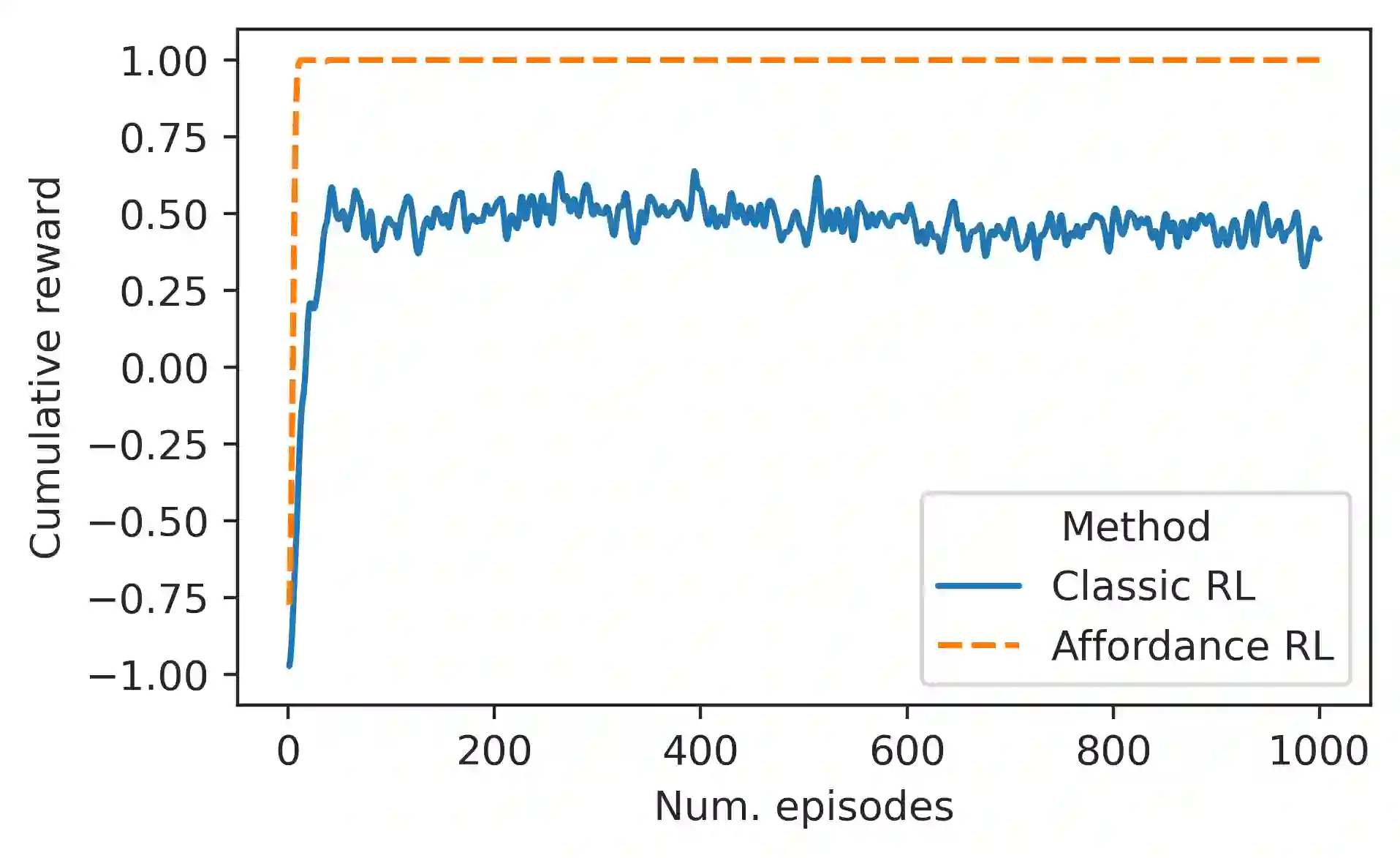
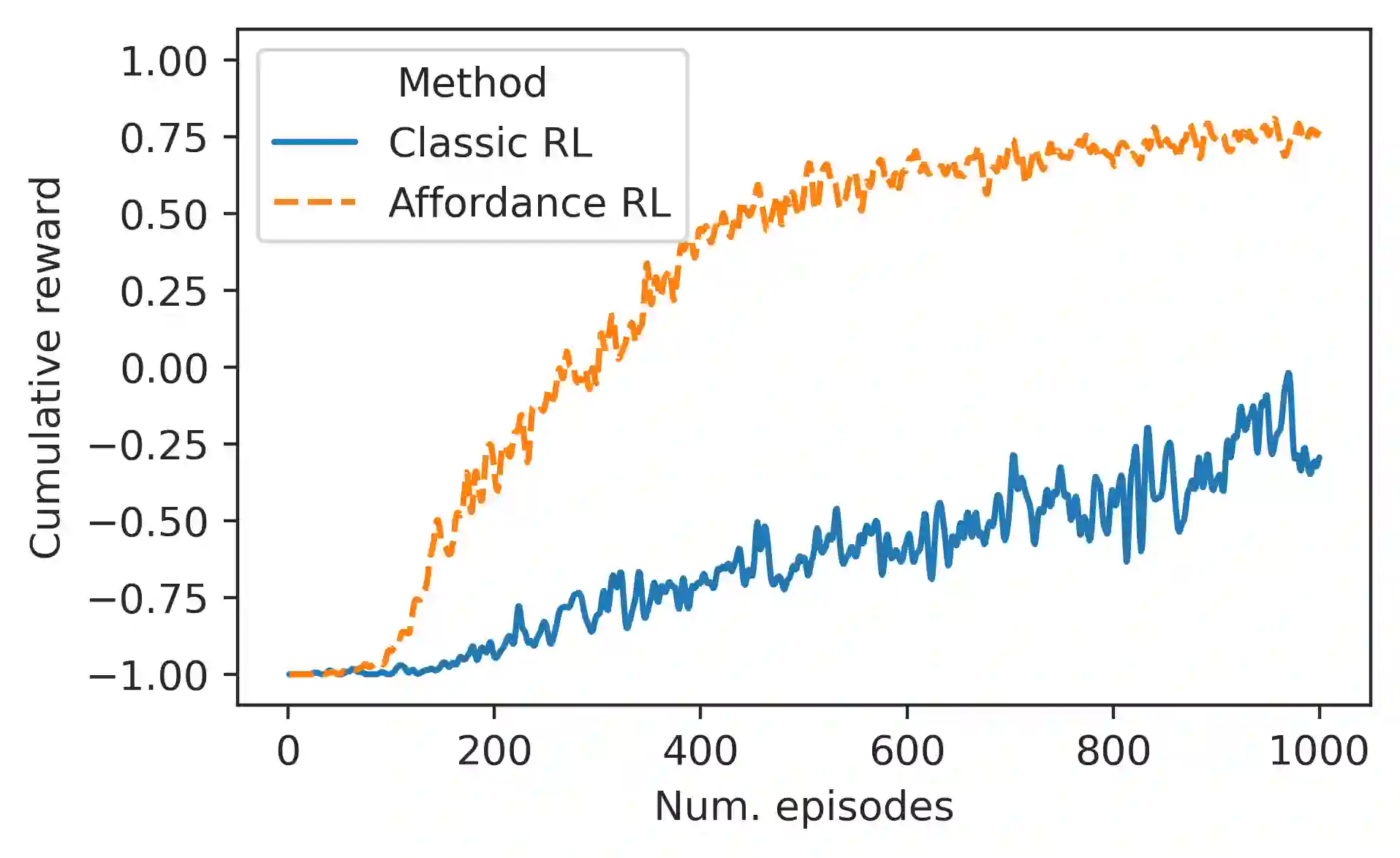
Robotics has been a popular field of research in the past few decades, with much success in industrial applications such as manufacturing and logistics. This success is led by clearly defined use cases and controlled operating environments. However, robotics has yet to make a large impact in domestic settings. This is due in part to the difficulty and complexity of designing mass-manufactured robots that can succeed in the variety of homes and environments that humans live in and that can operate safely in close proximity to humans. This paper explores the use of contextual affordances to enable safe exploration and learning in robotic scenarios targeted in the home. In particular, we propose a simple state representation that allows us to extend contextual affordances to larger state spaces and showcase how affordances can improve the success and convergence rate of a reinforcement learning algorithm in simulation. Our results suggest that after further iterations, it is possible to consider the implementation of this approach in a real robot manipulator. Furthermore, in the long term, this work could be the foundation for future explorations of human-robot interactions in complex domestic environments. This could be possible once state-of-the-art robot manipulators achieve the required level of dexterity for the described affordances in this paper.
翻译:机器人学是过去几十年中广受关注的研究领域,在制造和物流等工业应用中取得了显著成功。这一成功得益于明确定义的使用场景和受控的操作环境。然而,机器人技术在家庭环境中仍未产生重大影响。这在一定程度上归因于设计能够适应人类居住的多样化家庭环境、并在人类附近安全操作的大规模量产机器人存在难度与复杂性。本文探索了利用情境可性度(contextual affordances)实现面向家庭环境的机器人安全探索与学习。具体而言,我们提出了一种简单的状态表示方法,使情境可性度能够扩展至更大的状态空间,并通过仿真实验展示了可性度如何提升强化学习算法的成功率和收敛速度。实验结果表明,经过进一步迭代迭代后,该方法有望在真实机器人操作臂上实现。从长远来看,这项工作可为未来复杂家庭环境中人机交互探索奠定基础。一旦现有最先进的机器人操作臂达到本文所述可性度所需的灵巧性水平,这一目标便可能实现。







相关内容





 微信扫码咨询专知VIP会员