

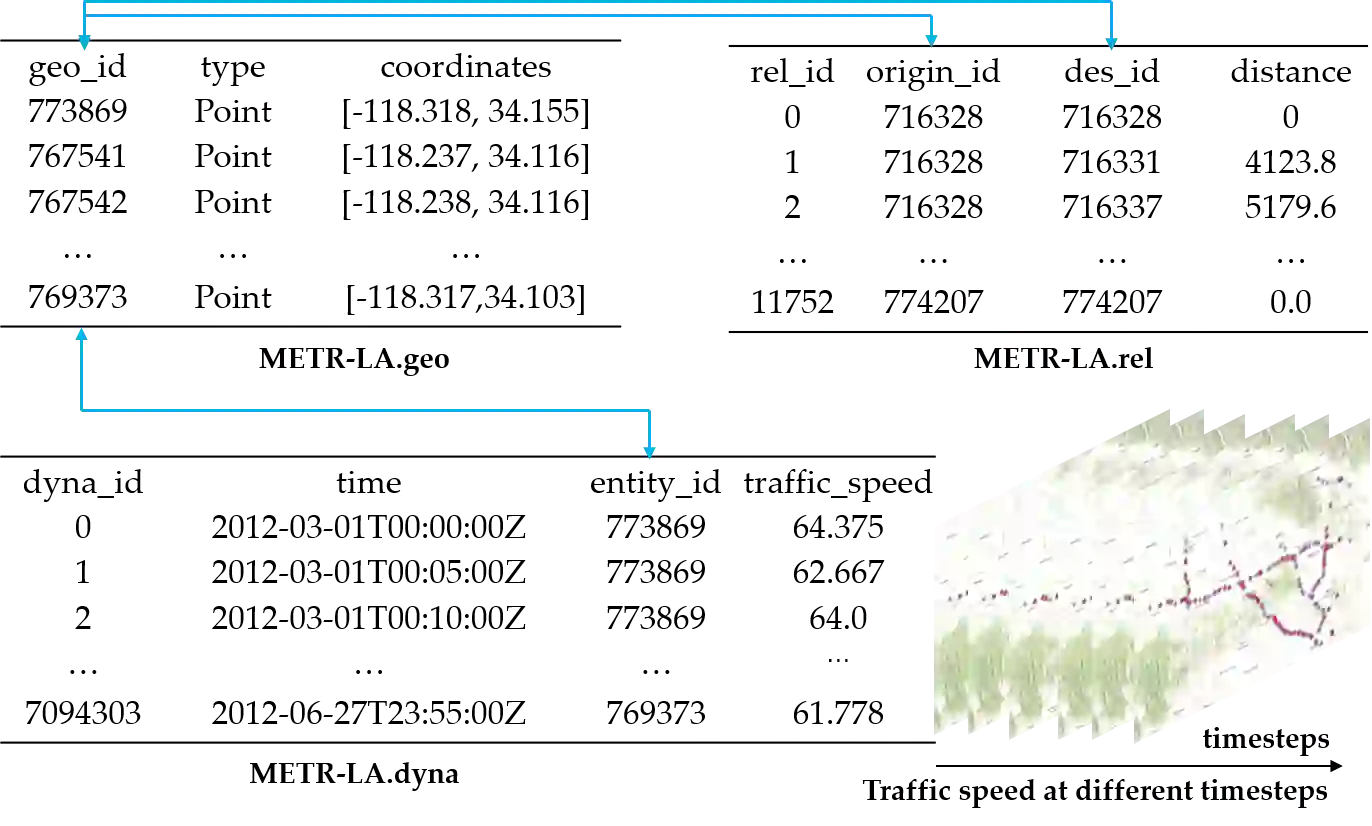
The field of urban spatial-temporal prediction is advancing rapidly with the development of deep learning techniques and the availability of large-scale datasets. However, challenges persist in accessing and utilizing diverse urban spatial-temporal datasets from different sources and stored in different formats, as well as determining effective model structures and components with the proliferation of deep learning models. This work addresses these challenges and provides three significant contributions. Firstly, we introduce "atomic files", a unified storage format designed for urban spatial-temporal big data, and validate its effectiveness on 40 diverse datasets, simplifying data management. Secondly, we present a comprehensive overview of technological advances in urban spatial-temporal prediction models, guiding the development of robust models. Thirdly, we conduct extensive experiments using diverse models and datasets, establishing a performance leaderboard and identifying promising research directions. Overall, this work effectively manages urban spatial-temporal data, guides future efforts, and facilitates the development of accurate and efficient urban spatial-temporal prediction models. It can potentially make long-term contributions to urban spatial-temporal data management and prediction, ultimately leading to improved urban living standards.
翻译:城市时空预测领域随着深度学习技术的发展和大规模数据集的可用性而迅速发展。然而,在获取和利用来自不同来源、以不同格式存储的多样化城市时空数据集,以及在深度学习模型 proliferating 的背景下确定有效的模型结构和组件方面,仍存在挑战。本研究应对这些挑战,并做出三项重要贡献。首先,我们引入“原子文件”——一种专为城市时空大数据设计的统一存储格式,并在40个多样化数据集上验证其有效性,简化了数据管理。其次,我们全面综述了城市时空预测模型的技术进展,为开发稳健模型提供指导。第三,我们利用多种模型和数据集开展了广泛实验,建立了性能排行榜并指出了有前景的研究方向。总体而言,本研究有效管理了城市时空数据,指导了未来工作,并促进了精确高效的城市时空预测模型的开发。它有望在城市时空数据管理与预测领域产生长期贡献,最终提升城市生活水平。




相关内容



 微信扫码咨询专知VIP会员