

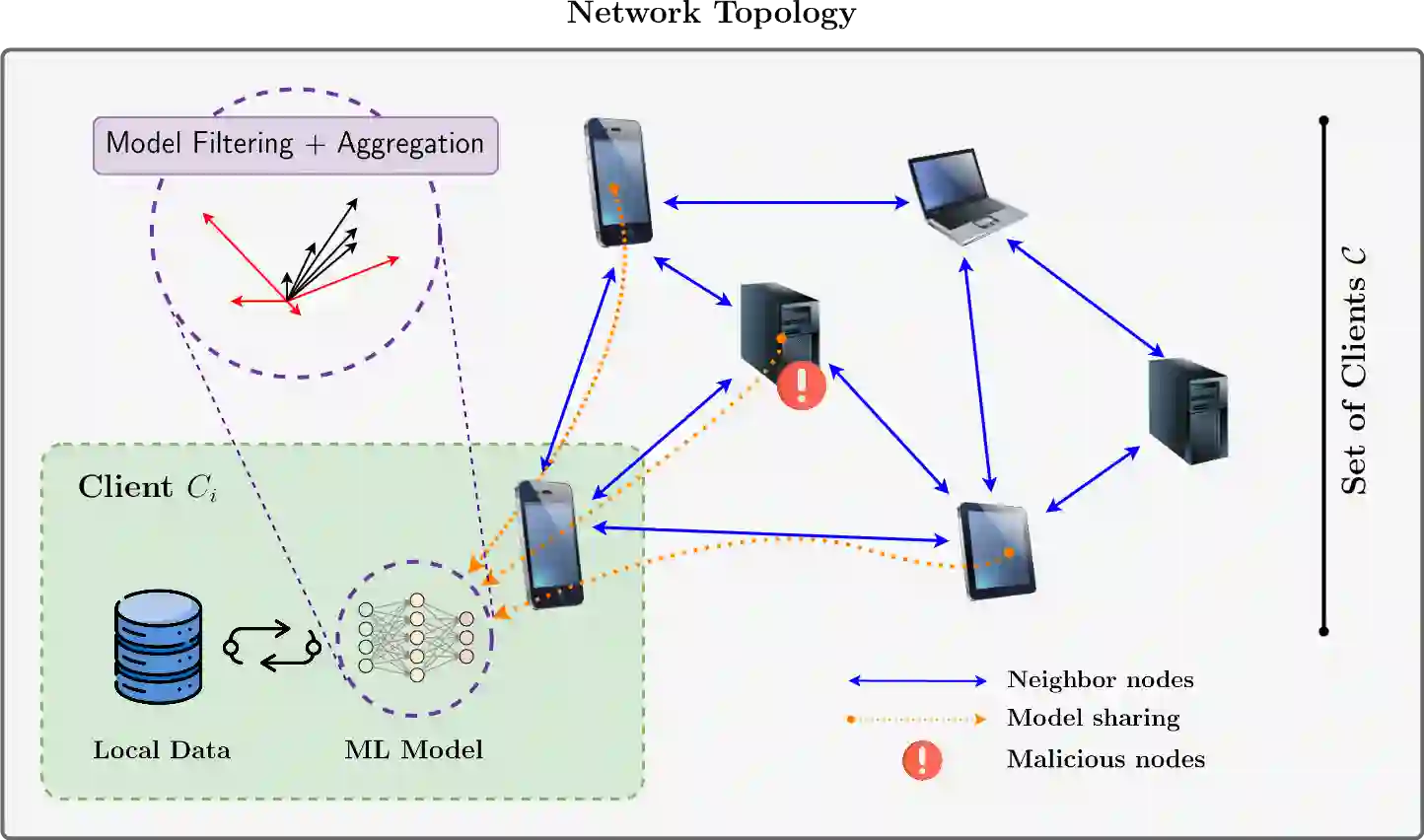
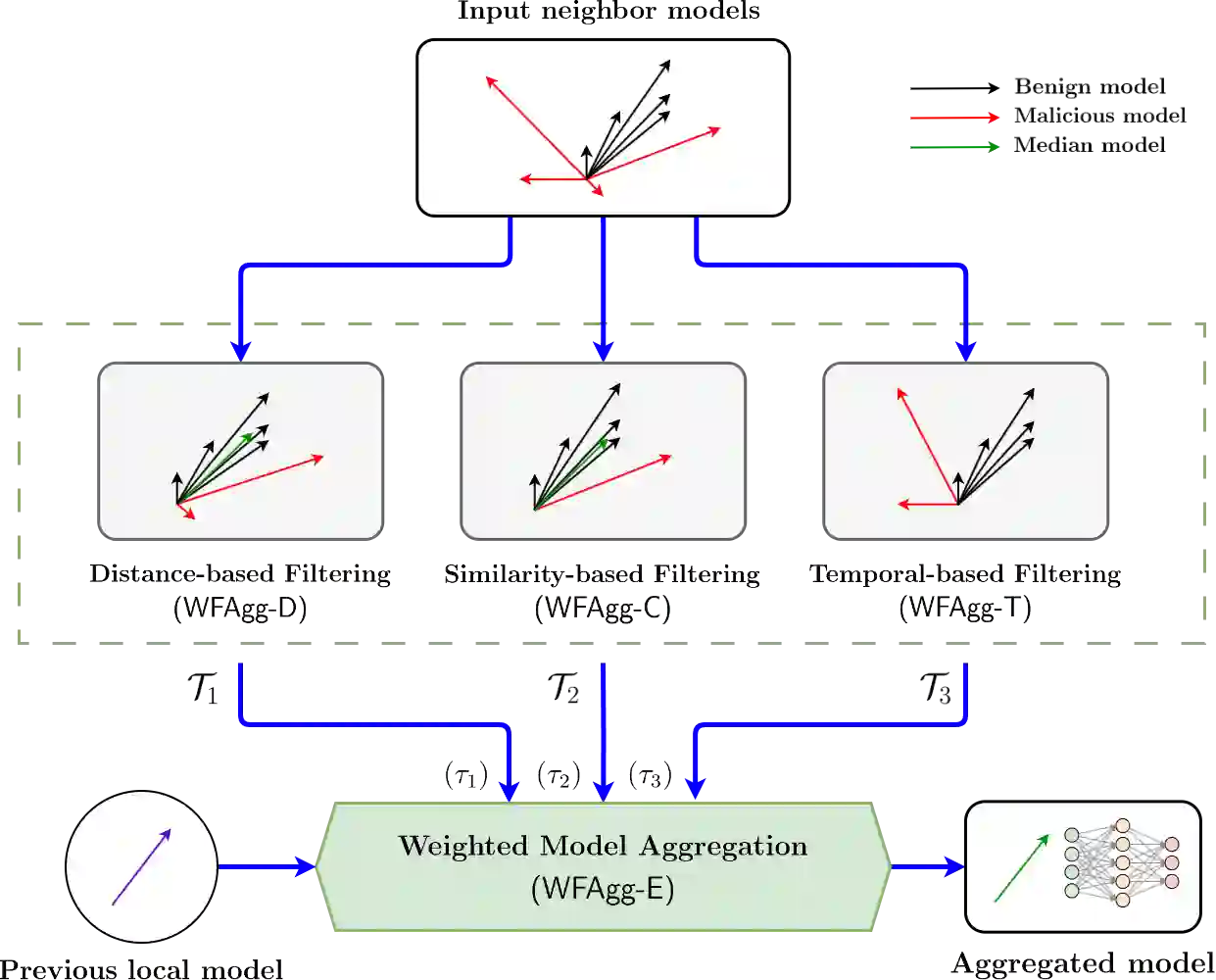
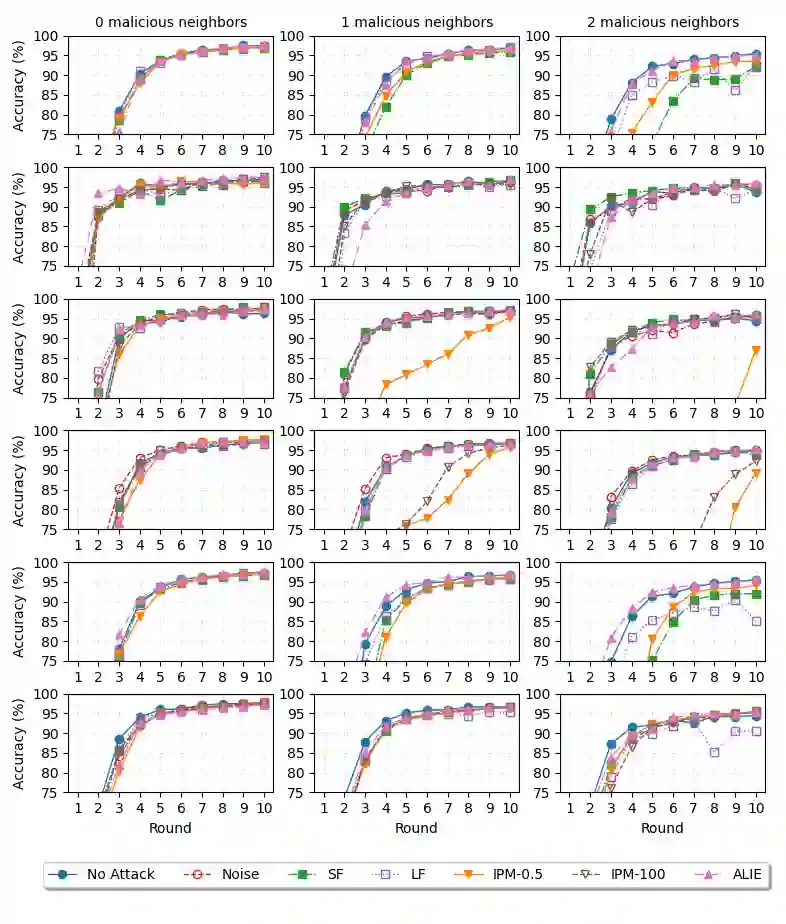
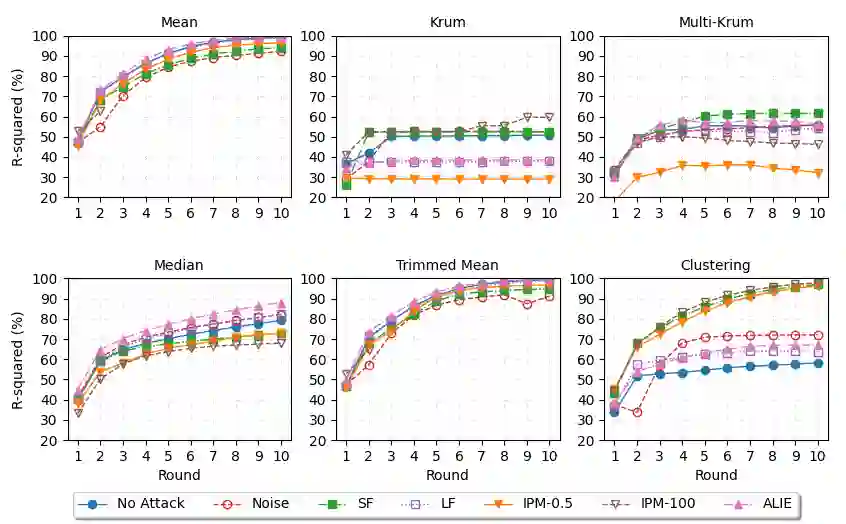
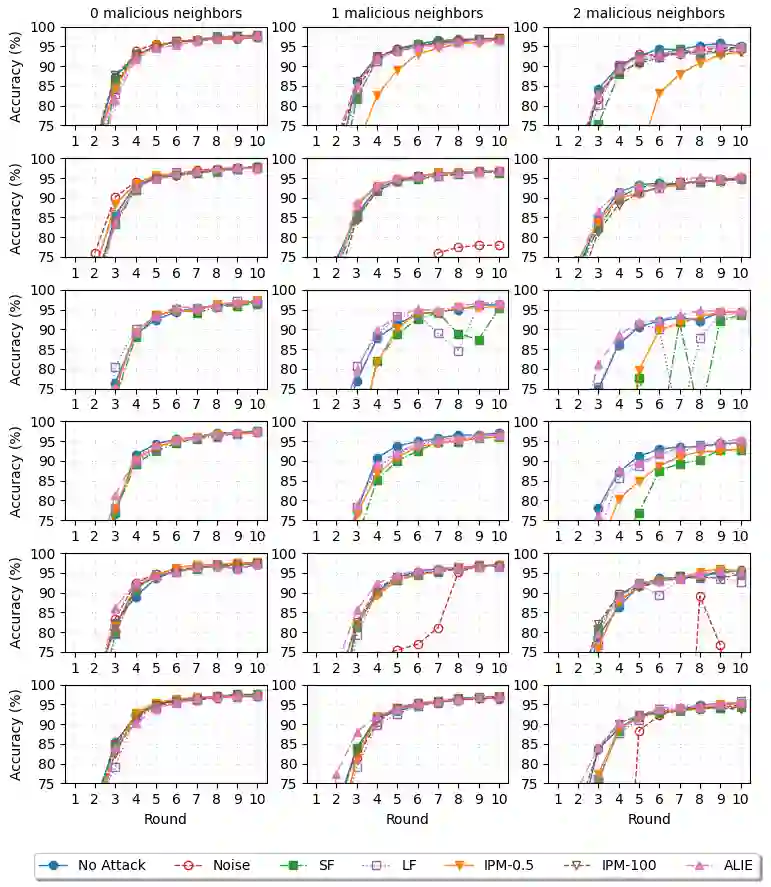
Federated Learning (FL) emerges as a distributed machine learning approach that addresses privacy concerns by training AI models locally on devices. Decentralized Federated Learning (DFL) extends the FL paradigm by eliminating the central server, thereby enhancing scalability and robustness through the avoidance of a single point of failure. However, DFL faces significant challenges in optimizing security, as most Byzantine-robust algorithms proposed in the literature are designed for centralized scenarios. In this paper, we present a novel Byzantine-robust aggregation algorithm to enhance the security of Decentralized Federated Learning environments, coined WFAgg. This proposal handles the adverse conditions and strength robustness of dynamic decentralized topologies at the same time by employing multiple filters to identify and mitigate Byzantine attacks. Experimental results demonstrate the effectiveness of the proposed algorithm in maintaining model accuracy and convergence in the presence of various Byzantine attack scenarios, outperforming state-of-the-art centralized Byzantine-robust aggregation schemes (such as Multi-Krum or Clustering). These algorithms are evaluated on an IID image classification problem in both centralized and decentralized scenarios.
翻译:联邦学习(FL)作为一种分布式机器学习方法,通过在设备本地训练AI模型来解决隐私问题。去中心化联邦学习(DFL)通过消除中心服务器扩展了FL范式,从而通过避免单点故障提高了可扩展性和鲁棒性。然而,DFL在优化安全性方面面临重大挑战,因为文献中提出的大多数拜占庭鲁棒性算法都是为集中式场景设计的。本文提出了一种新颖的拜占庭鲁棒性聚合算法WFAgg,以增强去中心化联邦学习环境的安全性。该方案通过采用多重过滤器来识别和缓解拜占庭攻击,同时处理动态去中心化拓扑结构的不利条件和强度鲁棒性。实验结果表明,在存在各种拜占庭攻击场景的情况下,所提出的算法在保持模型准确性和收敛性方面具有有效性,优于最先进的集中式拜占庭鲁棒性聚合方案(如Multi-Krum或Clustering)。这些算法在集中式和去中心化场景下的IID图像分类问题上进行了评估。




相关内容





 微信扫码咨询专知VIP会员