

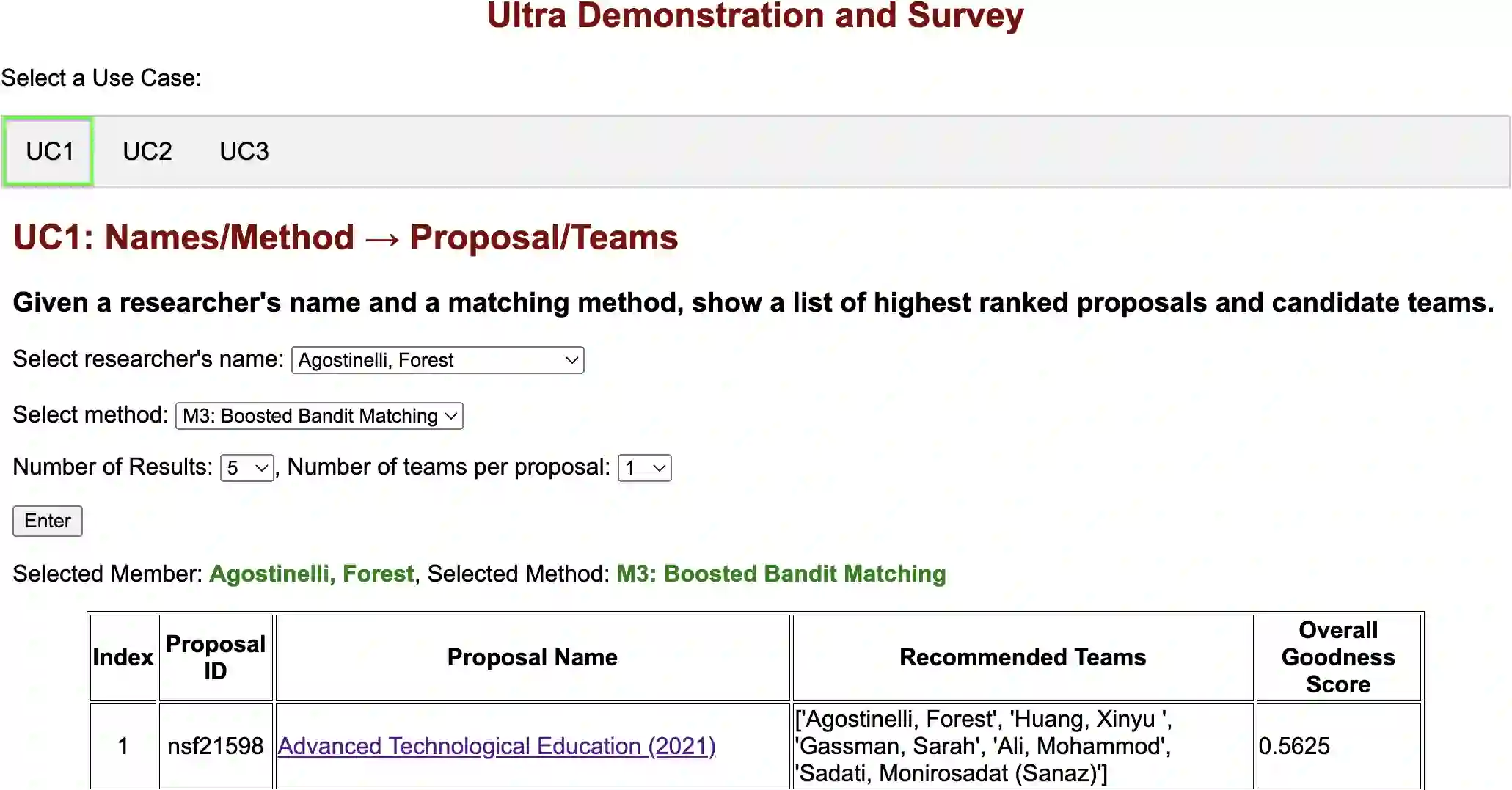
Building teams and promoting collaboration are two very common business activities. An example of these are seen in the TeamingForFunding problem, where research institutions and researchers are interested to identify collaborative opportunities when applying to funding agencies in response to latter's calls for proposals. We describe a novel system to recommend teams using a variety of AI methods, such that (1) each team achieves the highest possible skill coverage that is demanded by the opportunity, and (2) the workload of distributing the opportunities is balanced amongst the candidate members. We address these questions by extracting skills latent in open data of proposal calls (demand) and researcher profiles (supply), normalizing them using taxonomies, and creating efficient algorithms that match demand to supply. We create teams to maximize goodness along a novel metric balancing short- and long-term objectives. We validate the success of our algorithms (1) quantitatively, by evaluating the recommended teams using a goodness score and find that more informed methods lead to recommendations of smaller number of teams but higher goodness, and (2) qualitatively, by conducting a large-scale user study at a college-wide level, and demonstrate that users overall found the tool very useful and relevant. Lastly, we evaluate our system in two diverse settings in US and India (of researchers and proposal calls) to establish generality of our approach, and deploy it at a major US university for routine use.
翻译:团队组建与协作促进是两项常见的商业活动。在"为资金而组队"问题中,研究机构与学者在申请资助机构发布的课题指南时,需识别潜在合作机会。我们提出一种融合多种人工智能方法的新型团队推荐系统,旨在实现:(1)每个团队满足课题所需的最优技能覆盖;(2)机会分配的工作量在候选成员间均衡分布。通过从开放数据中提取课题指南中的技能需求与研究者画像中的技能供给,利用分类体系进行归一化处理,并设计匹配供需的高效算法。提出的团队组建策略基于兼顾短期与长期目标的新型度量指标,最大化团队效能。我们从两方面验证算法有效性:(1)定量评估:采用适配度评分对推荐团队进行评价,发现信息更充分的方法虽推荐团队数量更少,但适配度更高;(2)定性评估:在学院层面开展大规模用户研究,证实用户普遍认为该工具极具实用性与相关性。最后,我们在美国与印度两个不同场景(研究者与课题指南存在差异)中验证方法的普适性,并在美国某重点大学部署系统用于日常运作。





相关内容




 微信扫码咨询专知VIP会员