

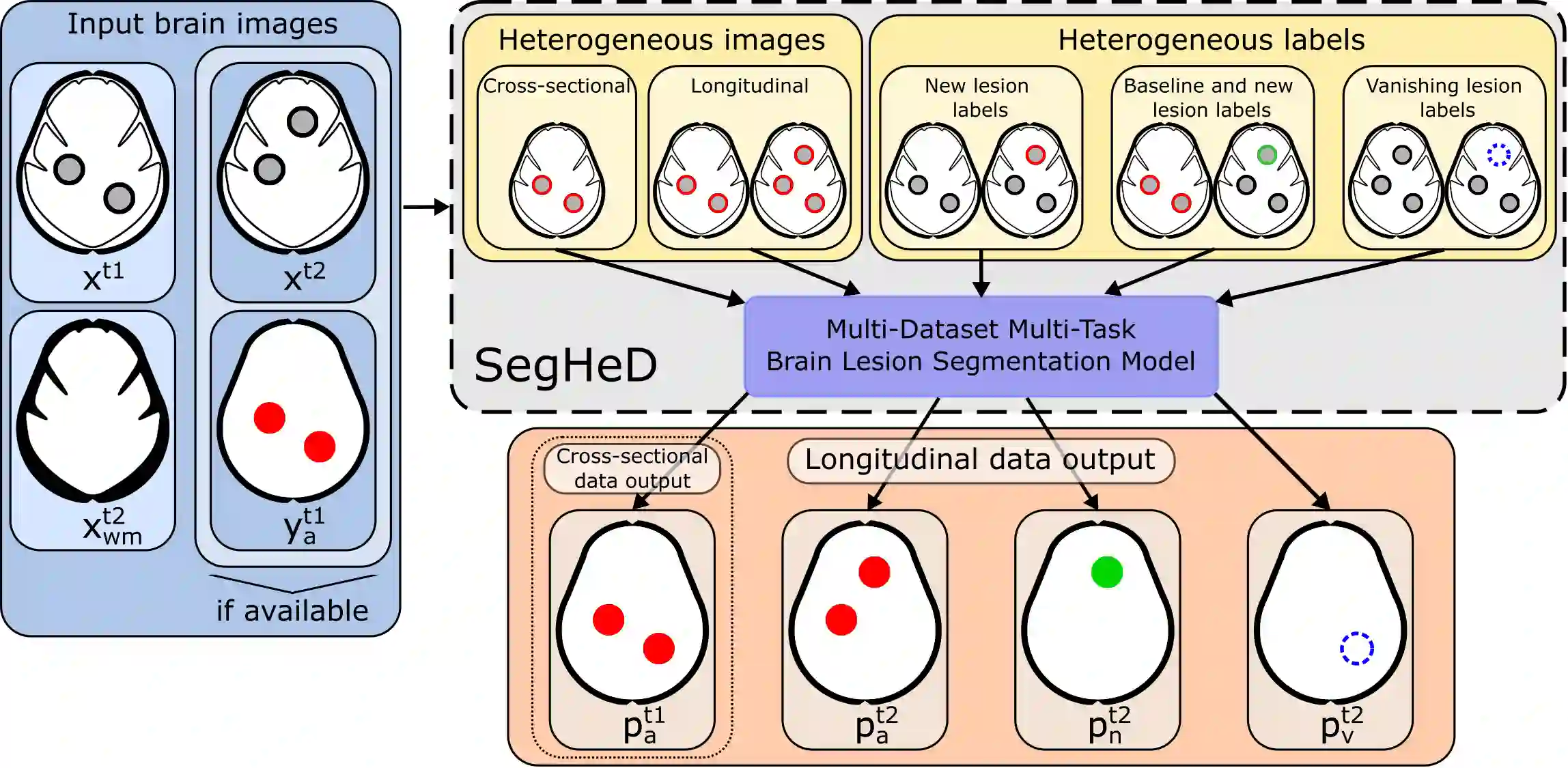
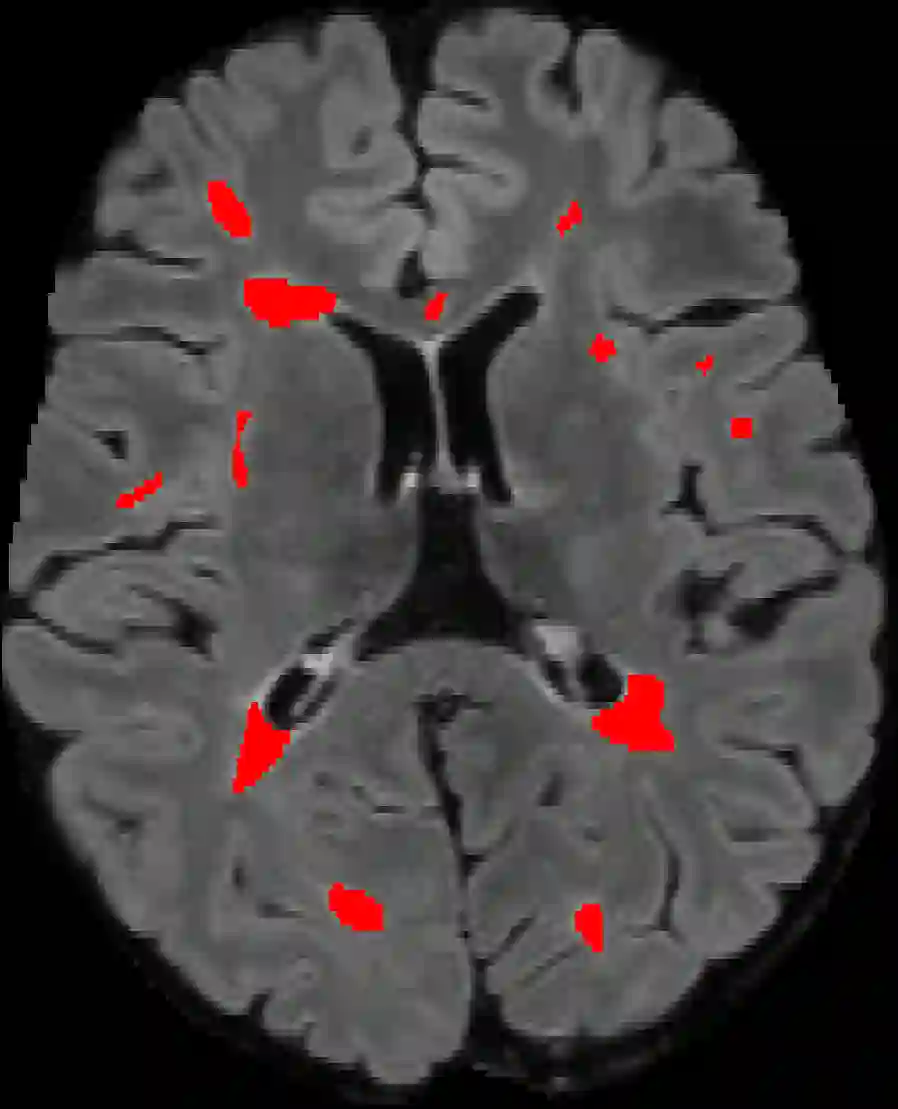
Assessment of lesions and their longitudinal progression from brain magnetic resonance (MR) images plays a crucial role in diagnosing and monitoring multiple sclerosis (MS). Machine learning models have demonstrated a great potential for automated MS lesion segmentation. Training such models typically requires large-scale high-quality datasets that are consistently annotated. However, MS imaging datasets are often small, segregated across multiple sites, with different formats (cross-sectional or longitudinal), and diverse annotation styles. This poses a significant challenge to train a unified MS lesion segmentation model. To tackle this challenge, we present SegHeD, a novel multi-dataset multi-task segmentation model that can incorporate heterogeneous data as input and perform all-lesion, new-lesion, as well as vanishing-lesion segmentation. Furthermore, we account for domain knowledge about MS lesions, incorporating longitudinal, spatial, and volumetric constraints into the segmentation model. SegHeD is assessed on five MS datasets and achieves a high performance in all, new, and vanishing-lesion segmentation, outperforming several state-of-the-art methods in this field.
翻译:从脑磁共振(MR)影像中评估病灶及其纵向进展,对多发性硬化症(MS)的诊断与监测具有关键作用。机器学习模型在自动化MS病灶分割方面展现出巨大潜力。此类模型的训练通常需要大规模、高质量且标注一致的数据集。然而,MS影像数据集通常规模较小,分散于多个采集中心,具有不同格式(横断面或纵向)及多样化的标注风格,这为训练统一的MS病灶分割模型带来了显著挑战。为应对这一挑战,我们提出SegHeD——一种新颖的多数据集多任务分割模型,能够整合异质性数据作为输入,并执行全病灶、新发病灶以及消退病灶的分割。此外,我们结合了关于MS病灶的领域知识,将纵向、空间及体积约束整合到分割模型中。SegHeD在五个MS数据集上进行了评估,在全病灶、新发病灶及消退病灶分割任务中均取得了优异性能,超越了该领域多种先进方法。




相关内容





 微信扫码咨询专知VIP会员