

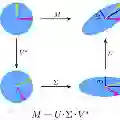
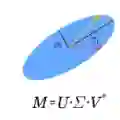
This paper aims to develop a simple procedure to reduce and control the condition number of random matrices, and investigate the effect on the persistent homology (PH) of point clouds of well- and ill-conditioned matrices. For a square matrix generated randomly using Gaussian/Uniform distribution, the SVD-Surgery procedure works by: (1) computing its singular value decomposition (SVD), (2) replacing the diagonal factor by changing a list of the smaller singular values by a convex linear combination of the entries in the list, and (3) compute the new matrix by reversing the SVD. Applying SVD-Surgery on a matrix often results in having different diagonal factor to those of the input matrix. The spatial distribution of random square matrices are known to be correlated to the distribution of their condition numbers. The persistent homology (PH) investigations, therefore, are focused on comparing the effect of SVD-Surgery on point clouds of large datasets of randomly generated well-conditioned and ill-conditioned matrices, as well as that of the point clouds formed by their inverses. This work is motivated by the desire to stabilise the impact of Deep Learning (DL) training on medical images in terms of the condition numbers of their sets of convolution filters as a mean of reducing overfitting and improving robustness against tolerable amounts of image noise. When applied to convolution filters during training, the SVD-Surgery acts as a spectral regularisation of the DL model without the need for learning extra parameters. We shall demonstrate that for several point clouds of sufficiently large convolution filters our simple strategy preserve filters norm and reduces the norm of its inverse depending on the chosen linear combination parameters. Moreover, our approach showed significant improvements towards the well-conditioning of matrices and stable topological behaviour.
翻译:本文旨在开发一种简化策略,用于降低和控制随机矩阵的条件数,并探究该操作对良态与病态矩阵点云持续同调(PH)的影响。对于通过高斯/均匀分布随机生成的方阵,SVD外科手术的流程如下:(1) 计算其奇异值分解(SVD);(2) 通过将对角线因子中较小的奇异值列表替换为该列表元素的凸线性组合,更新对角线因子;(3) 逆用奇异值分解计算新矩阵。对矩阵应用SVD外科手术后,其对角线因子往往与输入矩阵不同。已知随机方阵的空间分布与其条件数分布相关。因此,持续同调研究聚焦于比较SVD外科手术对大规模随机生成的良态与病态矩阵点云,以及其逆矩阵点云的影响。本研究的动机源于通过控制卷积滤波器集合的条件数来稳定深度学习(DL)训练对医学图像的影响,从而减少过拟合并提升对可容忍图像噪声的鲁棒性。在训练过程中对卷积滤波器应用SVD外科手术时,该方法无需学习额外参数即成为深度学习模型的谱正则化手段。我们将证明,对于若干由足够大卷积滤波器构成的点云,该简单策略能保持滤波器范数,并根据所选线性组合参数降低其逆矩阵的范数。此外,我们的方法显著改善了矩阵的良态性并实现了稳定的拓扑行为。




相关内容


 微信扫码咨询专知VIP会员