

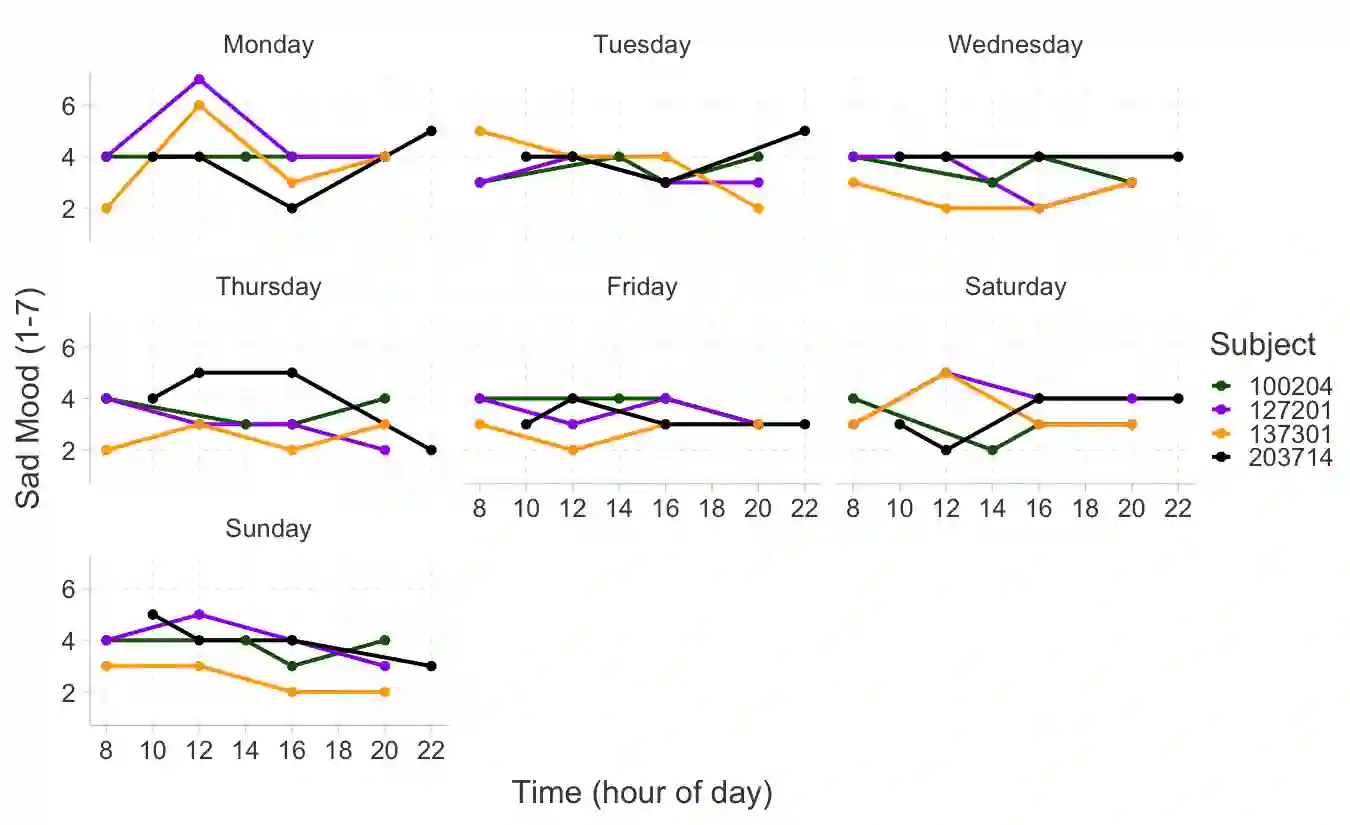
Mobile health studies often collect multiple within-day self-reported assessments of participants' behavior and well-being on different scales such as physical activity (continuous), pain levels (truncated), mood states (ordinal), and life events (binary). These assessments, when indexed by time of day, can be treated as functional data of different types - continuous, truncated, ordinal, and binary. We develop a functional principal component analysis that deals with all four types of functional data in a unified manner. It employs a semiparametric Gaussian copula model, assuming a generalized latent non-paranormal process as the underlying mechanism for these four types of functional data. We specify latent temporal dependence using a covariance estimated through Kendall's tau bridging method, incorporating smoothness during the bridging process. Simulation studies demonstrate the method's competitive performance under both dense and sparse sampling conditions. We then apply this approach to data from 497 participants in the National Institute of Mental Health Family Study of the Mood Disorder Spectrum to characterize within-day temporal patterns of mood differences among individuals with major mood disorder subtypes, including Major Depressive Disorder, Type 1, and Type 2 Bipolar Disorder.
翻译:移动健康研究常收集参与者日内多次自我报告的多种尺度行为与健康状况评估,包括身体活动(连续型)、疼痛程度(截断型)、情绪状态(有序型)及生活事件(二分类型)。这些按日间时间索引的评估数据可被视作不同类型的功能数据——连续型、截断型、有序型及二分类型。我们提出一种功能主成分分析方法,以统一方式处理所有四类功能数据。该方法采用半参数高斯连接函数模型,假设广义潜在非抛物线过程作为这四类功能数据的底层生成机制。通过Kendall tau桥接方法估计协方差来刻画潜变量时间依赖性,并在桥接过程中融入平滑性约束。模拟实验表明,该方法在密集采样与稀疏采样条件下均具有竞争力。我们将该方法应用于美国国家精神卫生研究所心境障碍谱系家族研究中497名参与者的数据,以刻画主要心境障碍亚型(包括重度抑郁障碍、I型双相障碍及II型双相障碍)患者的日内情绪差异时间模式。





相关内容




 微信扫码咨询专知VIP会员