

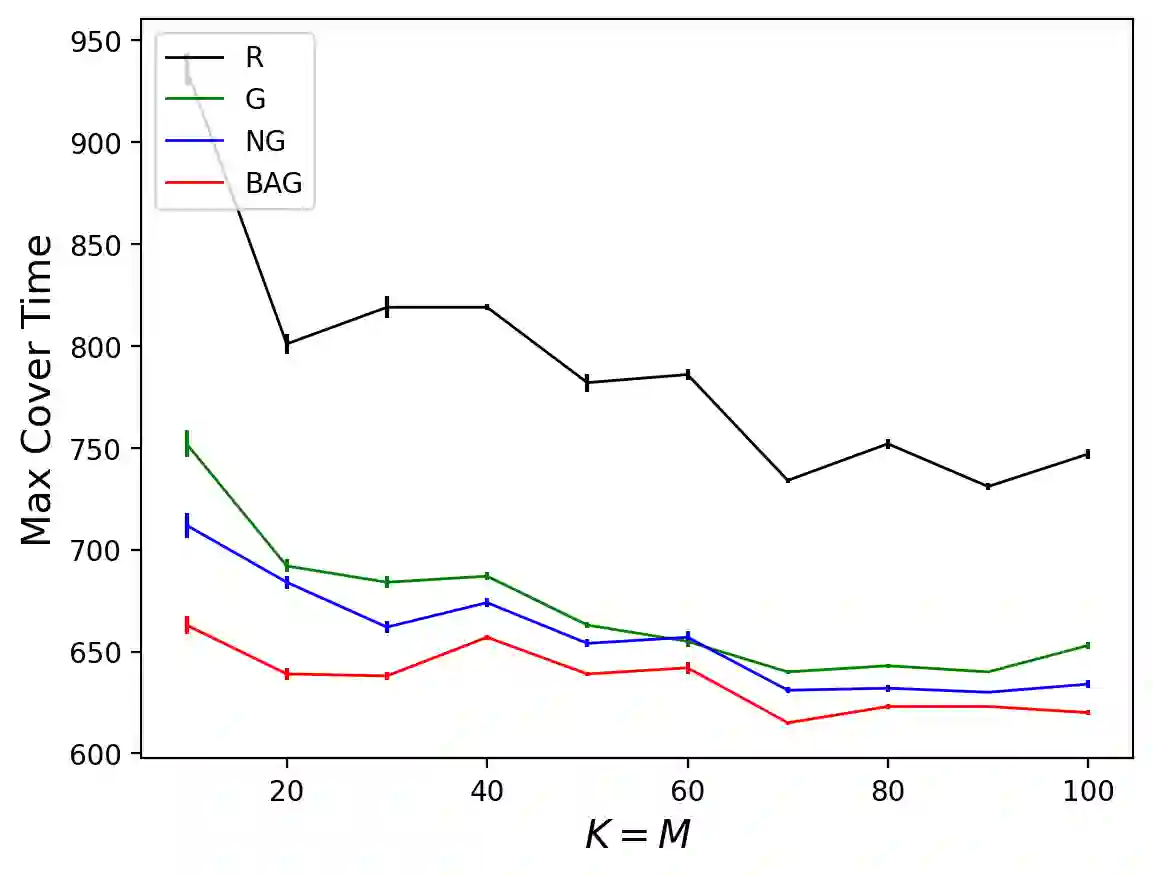
In the submodular ranking (SR) problem, the input consists of a set of submodular functions defined on a ground set of elements. The goal is to order elements for all the functions to have value above a certain threshold as soon on average as possible, assuming we choose one element per time. The problem is flexible enough to capture various applications in machine learning, including decision trees. This paper considers the min-max version of SR where multiple instances share the ground set. With the view of each instance being associated with an agent, the min-max problem is to order the common elements to minimize the maximum objective of all agents -- thus, finding a fair solution for all agents. We give approximation algorithms for this problem and demonstrate their effectiveness in the application of finding a decision tree for multiple agents.
翻译:子模排序问题中,输入包含定义在元素基集上的一组子模函数。其目标是在每次选择一个元素的条件下,为所有函数找到元素排序顺序,使得各函数值尽快达到给定阈值。该问题具有足够的灵活性,可涵盖机器学习中的多种应用场景,包括决策树。本文考虑子模排序的最小最大版本,其中多个实例共享同一基集。将每个实例视为一个智能体,该最小最大问题旨在对所有公共元素进行排序,以最小化所有智能体的最大目标值——从而为所有智能体寻找公平解。我们针对该问题给出近似算法,并在多智能体决策树应用中验证了算法的有效性。




相关内容



 微信扫码咨询专知VIP会员