

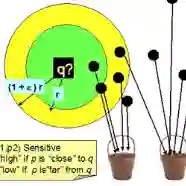
For a metric space $(X, d)$, a family $\mathcal{H}$ of locality sensitive hash functions is called $(r, cr, p_1, p_2)$ sensitive if a randomly chosen function $h\in \mathcal{H}$ has probability at least $p_1$ (at most $p_2$) to map any $a, b\in X$ in the same hash bucket if $d(a, b)\leq r$ (or $d(a, b)\geq cr$). Locality Sensitive Hashing (LSH) is one of the most popular techniques for approximate nearest-neighbor search in high-dimensional spaces, and has been studied extensively for Hamming, Euclidean, and spherical geometries. An $(r, cr, p_1, p_2)$-sensitive hash function enables approximate nearest neighbor search (i.e., returning a point within distance $cr$ from a query $q$ if there exists a point within distance $r$ from $q$) with space $O(n^{1+ρ})$ and query time $O(n^ρ)$ where $ρ=\frac{\log 1/p_1}{\log 1/p_2}$. But LSH for hyperbolic spaces $\mathbb{H}^d$ remains largely unexplored. In this work, we present the first LSH construction native to hyperbolic space. For the hyperbolic plane $(d=2)$, we show a construction achieving $ρ\leq 1/c$, based on the hyperplane rounding scheme. For general hyperbolic spaces $(d \geq 3)$, we use dimension reduction from $\mathbb{H}^d$ to $\mathbb{H}^2$ and the 2D hyperbolic LSH to get $ρ\leq 1.59/c$. On the lower bound side, we show that the lower bound on $ρ$ of Euclidean LSH extends to the hyperbolic setting via local isometry, therefore giving $ρ\geq 1/c^2$.
翻译:对于度量空间 $(X, d)$,一族局部敏感哈希函数 $\mathcal{H}$ 被称为 $(r, cr, p_1, p_2)$ 敏感的,若随机选取的函数 $h\in \mathcal{H}$ 满足:当 $d(a, b)\leq r$ 时,将任意 $a, b\in X$ 映射到同一哈希桶的概率至少为 $p_1$;当 $d(a, b)\geq cr$ 时,该概率至多为 $p_2$。局部敏感哈希(LSH)是高维空间中近似最近邻搜索最流行的技术之一,已在汉明、欧几里得和球面几何中得到广泛研究。$(r, cr, p_1, p_2)$ 敏感的哈希函数能以空间复杂度 $O(n^{1+ρ})$ 和查询时间复杂度 $O(n^ρ)$ 实现近似最近邻搜索(即若存在距离查询点 $q$ 不超过 $r$ 的点,则返回距 $q$ 在 $cr$ 范围内的点),其中 $ρ=\frac{\log 1/p_1}{\log 1/p_2}$。然而,双曲空间 $\mathbb{H}^d$ 中的LSH仍基本未被探索。本文首次提出原生基于双曲空间的LSH构造。对于双曲平面 $(d=2)$,我们基于超平面舍入方案给出一种构造,实现 $ρ\leq 1/c$。对于一般双曲空间 $(d \geq 3)$,我们通过从 $\mathbb{H}^d$ 到 $\mathbb{H}^2$ 的降维以及二维双曲LSH,得到 $ρ\leq 1.59/c$。在下界方面,我们证明欧几里得LSH的 $ρ$ 下界可通过局部等距映射延拓至双曲情形,从而得到 $ρ\geq 1/c^2$。




相关内容

 微信扫码咨询专知VIP会员