

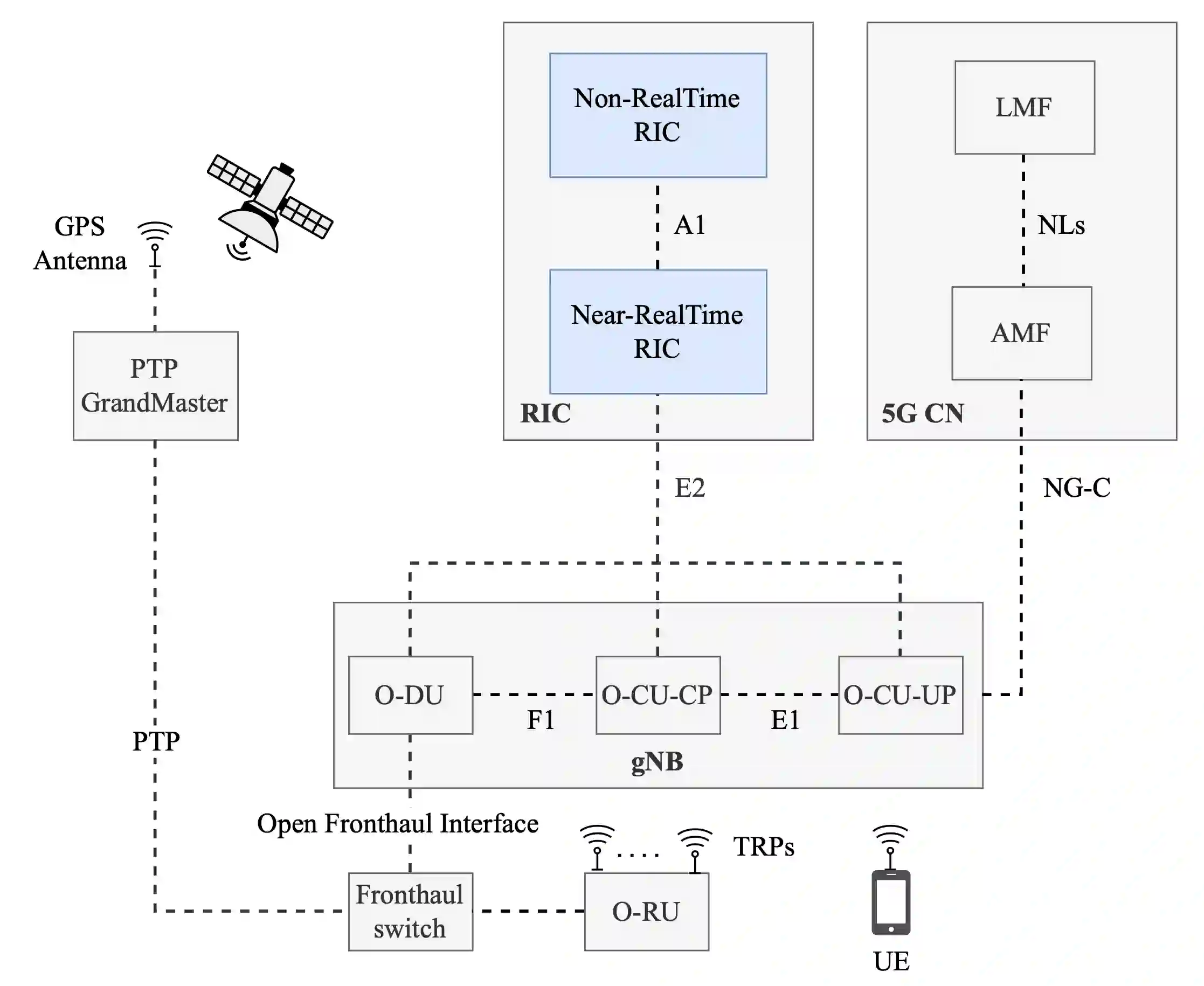
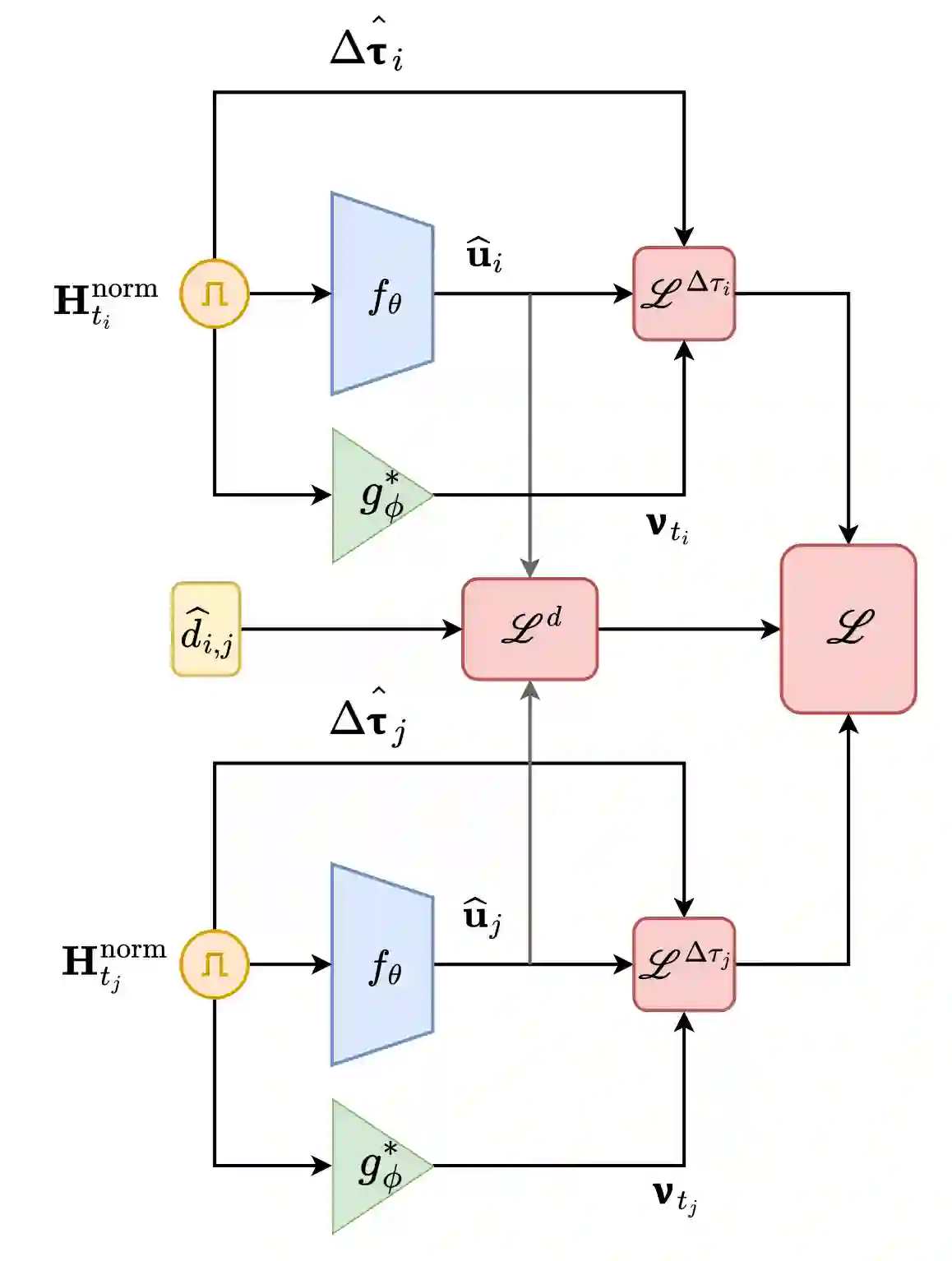
Channel Charting (CC) has emerged as a promising framework for data-driven radio localization, yet existing approaches often struggle to scale globally and to handle the distortions introduced by non-line-of-sight (NLoS) conditions. In this work, we propose a novel CC method that leverages Channel Impulse Response (CIR) data enriched with practical features such as Time Difference of Arrival (TDoA) and Transmission Reception Point (TRP) locations, enabling a TDoA-based self-supervised localization function on a global scale. The proposed framework is further enhanced with short-interval User Equipment (UE) displacement measurements, which improve the continuity and robustness of the learned positioning function. Our algorithm incorporates a mechanism to identify and mask NLoS-induced noisy measurements, leading to significant performance gains. We present the evaluation of our proposed models in a real 5G testbed, benchmarked against centimeter-accurate Real-Time Kinematic (RTK) positioning, in an O-RAN-based 5G network using OpenAirInterface (OAI) software at EURECOM. It demonstrates results that outperform state-of-the-art semi-supervised and self-supervised CC approaches in a real-world scenario. The results show localization accuracies of 2--4 meters in 90\% of cases, across varying NLoS ratios. Furthermore, we provide public datasets of CIR recordings, along with the true position labels used in this paper's evaluation.
翻译:信道图构建(CC)已成为数据驱动无线电定位领域一种前景广阔的框架,但现有方法在全局扩展及应对非视距(NLoS)条件引入的畸变方面仍存在困难。本文提出一种新型CC方法,利用信道冲激响应(CIR)数据,并融合到达时间差(TDoA)与传输接收点(TRP)位置等实用特征,从而在全局尺度上实现基于TDoA的自监督定位功能。该框架进一步通过短间隔用户设备(UE)位移测量进行增强,提升了学习定位函数的连续性与鲁棒性。我们的算法融合了识别与掩蔽非视距引入噪声测量的机制,从而获得显著的性能提升。我们在EURECOM基于OpenAirInterface(OAI)软件的O-RAN架构5G网络中,以厘米级精度的实时动态差分(RTK)定位为基准,在真实5G测试平台上对所提模型进行了评估。结果表明,在真实场景下,其性能优于当前最先进的半监督与自监督CC方法。在不同非视距比例下,90%案例的定位精度达到2-4米。此外,我们提供了本论文评估所使用的CIR记录公开数据集及其对应的真实位置标签。




相关内容


 微信扫码咨询专知VIP会员