

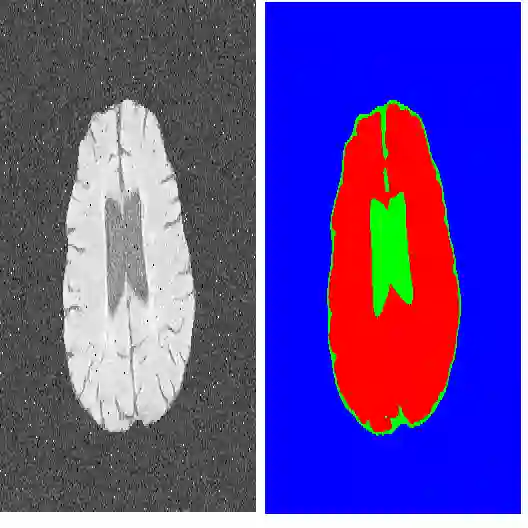
Image segmentation is a challenging task influenced by multiple sources of uncertainty, such as the data labeling process or the sampling of training data. In this paper we focus on binary segmentation and address these challenges using conformal prediction, a family of model- and data-agnostic methods for uncertainty quantification that provide finite-sample theoretical guarantees and applicable to any pretrained predictor. Our approach involves computing nonconformity scores, a type of prediction residual, on held-out calibration data not used during training. We use dilation, one of the fundamental operations in mathematical morphology, to construct a margin added to the borders of predicted segmentation masks. At inference, the predicted set formed by the mask and its margin contains the ground-truth mask with high probability, at a confidence level specified by the user. The size of the margin serves as an indicator of predictive uncertainty for a given model and dataset. We work in a regime of minimal information as we do not require any feedback from the predictor: only the predicted masks are needed for computing the prediction sets. Hence, our method is applicable to any segmentation model, including those based on deep learning; we evaluate our approach on several medical imaging applications.
翻译:图像分割是一项受多种不确定性来源影响的挑战性任务,例如数据标注过程或训练数据采样。本文聚焦于二值分割,并采用保形预测方法应对这些挑战。保形预测是一类模型无关且数据无关的不确定性量化方法,能提供有限样本的理论保证,并适用于任何预训练的预测器。我们的方法涉及在训练阶段未使用的校准数据上计算非保形分数,这是一种预测残差。我们利用数学形态学中的基本操作之一——膨胀,构建一个添加到预测分割掩码边界的裕度。在推理时,由掩码及其裕度构成的预测集将以用户指定的置信水平高概率包含真实掩码。裕度的大小可作为给定模型和数据集预测不确定性的指标。我们在最小信息条件下开展工作,因为无需预测器提供任何反馈:仅需预测掩码即可计算预测集。因此,我们的方法适用于任何分割模型,包括基于深度学习的模型;我们在多个医学影像应用中评估了该方法。




相关内容


 微信扫码咨询专知VIP会员