

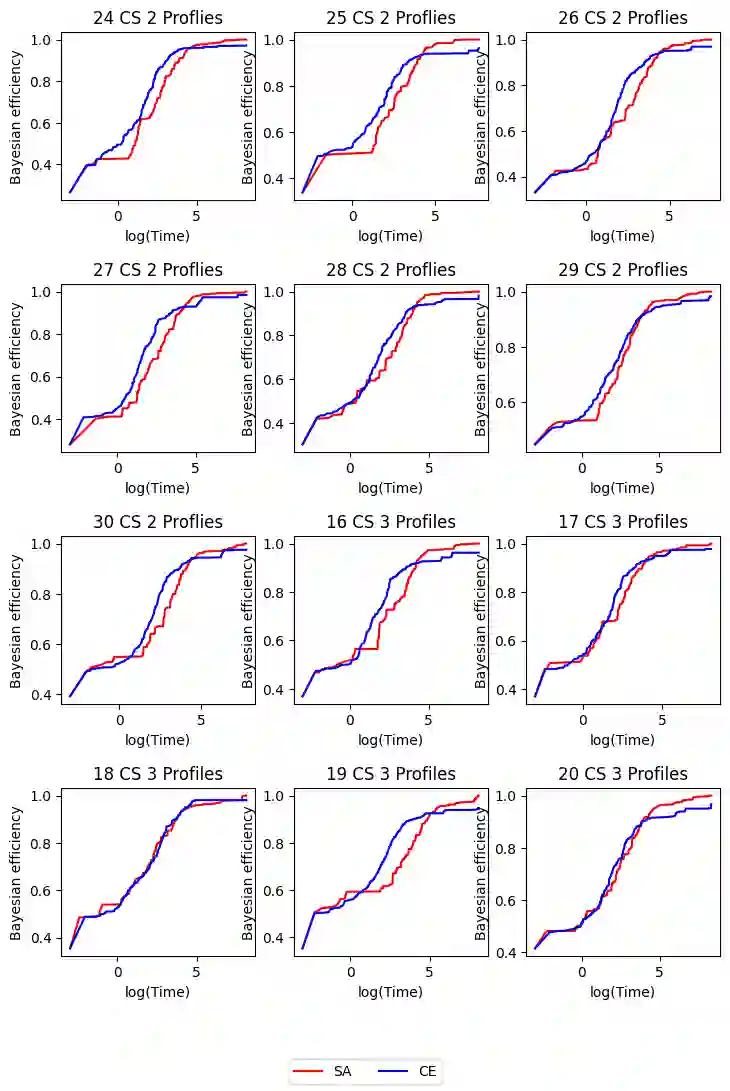
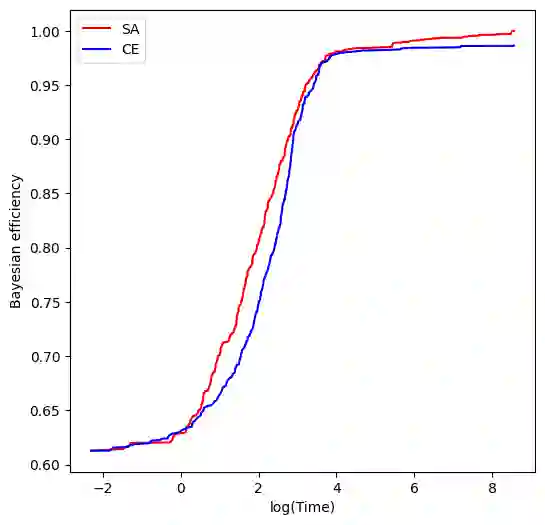
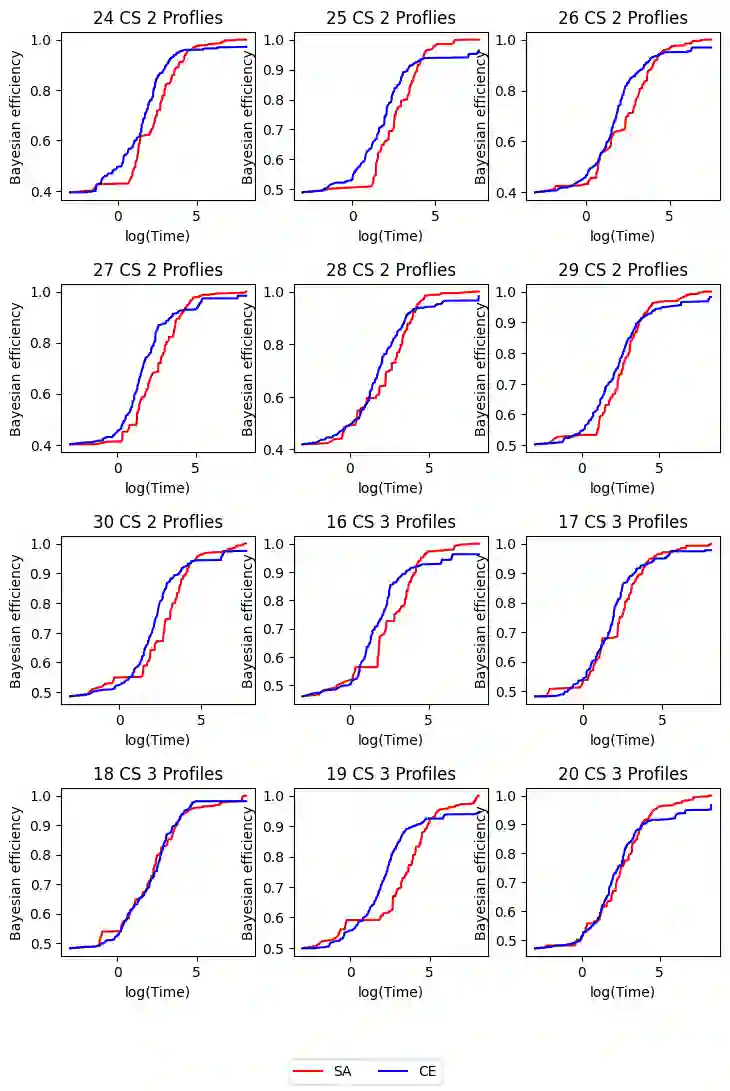
Discrete Choice Experiments (DCEs) investigate the attributes that influence individuals' choices when selecting among various options. To enhance the quality of the estimated choice models, researchers opt for Bayesian optimal designs that utilize existing information about the attributes' preferences. Given the nonlinear nature of choice models, the construction of an appropriate design requires efficient algorithms. Among these, the Coordinate-Exchange (CE) algorithm is most commonly employed for constructing designs based on the multinomial logit model. Since this is a hill-climbing algorithm, obtaining better designs necessitates multiple random starting designs. This approach increases the algorithm's run-time, but may not lead to a significant improvement in results. We propose the use of a Simulated Annealing (SA) algorithm to construct Bayesian D-optimal designs. This algorithm accepts both superior and inferior solutions, avoiding premature convergence and allowing a more thorough exploration of potential designs. Consequently, it ultimately obtains higher-quality choice designs within the same time-frame. Our work represents the first application of an SA algorithm in constructing Bayesian optimal designs for DCEs. Through computational experiments and a real-life case study, we demonstrate that the SA designs consistently outperform the CE designs in terms of Bayesian D-efficiency, especially when the prior preference information is highly uncertain.
翻译:离散选择实验(DCEs)研究影响个体在多种选项中进行选择时决策的属性。为提升估计选择模型的质量,研究者倾向于采用贝叶斯最优设计,该设计利用了关于属性偏好的现有信息。鉴于选择模型的非线性特性,构建合适的设计需要高效的算法。其中,坐标交换(CE)算法最常被用于基于多项逻辑模型构建设计。由于这是一种爬山算法,要获得更优设计需采用多个随机起始设计。该方法虽增加了算法运行时间,却未必能显著改善结果。我们提出使用模拟退火(SA)算法构建贝叶斯D最优设计。该算法同时接受优劣解,避免过早收敛,从而更充分地探索潜在设计空间。因此,它在相同时间框架内最终能获得更高质量的选择设计。本研究首次将SA算法应用于构建DCEs的贝叶斯最优设计。通过计算实验和真实案例研究,我们证明SA设计在贝叶斯D效率上始终优于CE设计,尤其是在先验偏好信息高度不确定的情况下。





相关内容




 微信扫码咨询专知VIP会员