

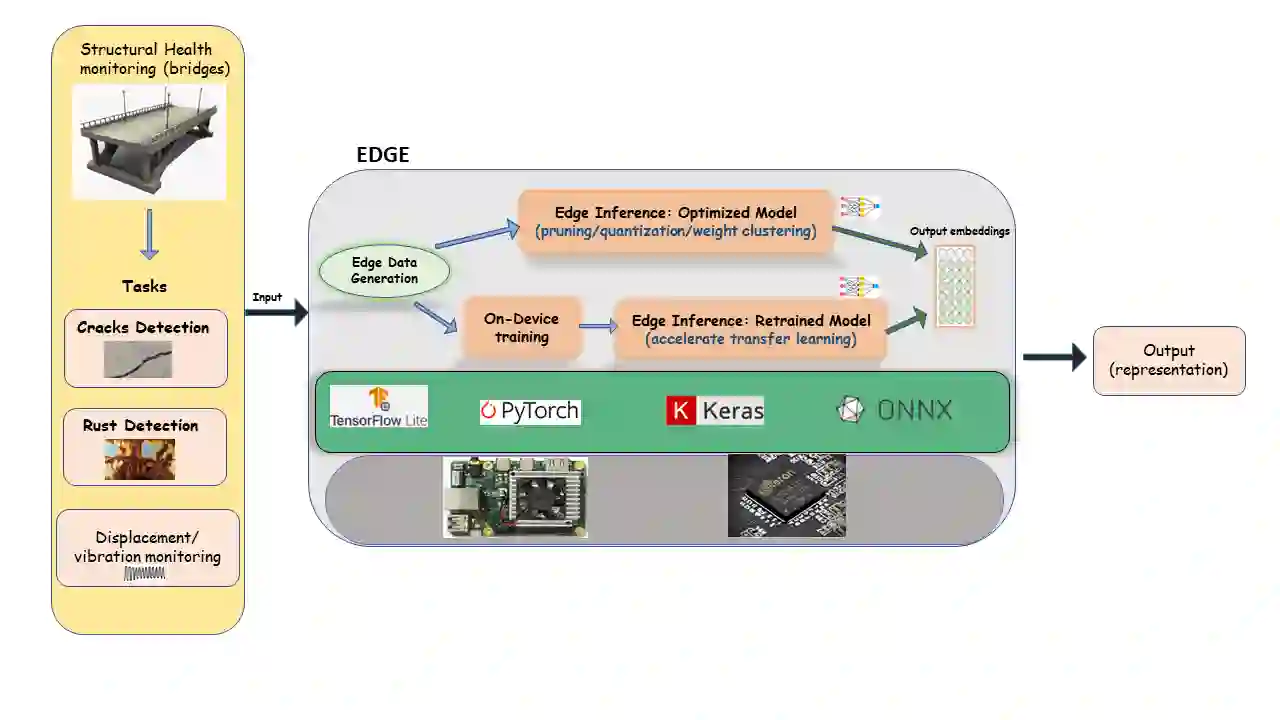
Structural health monitoring (SHM) tasks like damage detection are crucial for decision-making regarding maintenance and deterioration. For example, crack detection in SHM is crucial for bridge maintenance as crack progression can lead to structural instability. However, most AI/ML models in the literature have low latency and late inference time issues while performing in real-time environments. This study aims to explore the integration of edge-AI in the SHM domain for real-time bridge inspections. Based on edge-AI literature, its capabilities will be valuable integration for a real-time decision support system in SHM tasks such that real-time inferences can be performed on physical sites. This study will utilize commercial edge-AI platforms, such as Google Coral Dev Board or Kneron KL520, to develop and analyze the effectiveness of edge-AI devices. Thus, this study proposes an edge AI framework for the structural health monitoring domain. An edge-AI-compatible deep learning model is developed to validate the framework to perform real-time crack classification. The effectiveness of this model will be evaluated based on its accuracy, the confusion matrix generated, and the inference time observed in a real-time setting.
翻译:结构健康监测(SHM)任务(如损伤检测)对于维护和退化相关的决策至关重要。例如,SHM中的裂缝检测对桥梁维护具有关键意义,因为裂缝扩展可能导致结构失稳。然而,现有文献中的大多数AI/ML模型在实时环境下运行时存在低延迟和后期推理时间问题。本研究旨在探索将边缘AI集成到SHM领域,用于实时桥梁检测。基于边缘AI文献,其能力对于SHM任务中的实时决策支持系统具有重要集成价值,从而可在物理现场执行实时推理。本研究将利用商用边缘AI平台(如Google Coral Dev Board或Kneron KL520)来开发和分析边缘AI设备的有效性。因此,本研究提出了一种适用于结构健康监测领域的边缘AI框架。为验证该框架,开发了一种兼容边缘AI的深度学习模型,用于执行实时裂缝分类。该模型的有效性将基于其准确率、生成的混淆矩阵以及实时环境下观测到的推理时间进行评估。








相关内容

 微信扫码咨询专知VIP会员