

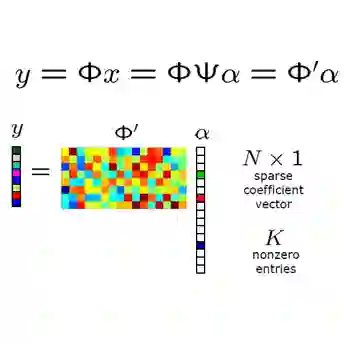
Coherent Ising Machine (CIM) is a network of optical parametric oscillators that solves combinatorial optimization problems by finding the ground state of an Ising Hamiltonian. As a practical application of CIM, Aonishi et al. proposed a quantum-classical hybrid system to solve optimization problems of L0-regularization-based compressed sensing (L0RBCS). Gunathilaka et al. has further enhanced the accuracy of the system. However, the computationally expensive CIM's stochastic differential equations (SDEs) limit the use of digital hardware implementations. As an alternative to Gunathilaka et al.'s CIM SDEs used previously, we propose using the mean-field CIM (MF-CIM) model, which is a physics-inspired heuristic solver without quantum noise. MF-CIM surmounts the high computational cost due to the simple nature of the differential equations (DEs). Furthermore, our results indicate that the proposed model has similar performance to physically accurate SDEs in both artificial and magnetic resonance imaging data, paving the way for implementing CIM-based L0RBCS on digital hardware such as Field Programmable Gate Arrays (FPGAs).
翻译:相干伊辛机(CIM)是一种由光学参量振荡器组成的网络,通过寻找伊辛哈密顿量的基态来解决组合优化问题。作为CIM的实际应用,Aonishi等人提出了一种量子-经典混合系统来解决基于L0正则化的压缩感知(L0RBCS)优化问题。Gunathilaka等人进一步提升了该系统的精度。然而,计算开销高昂的CIM随机微分方程(SDEs)限制了其在数字硬件实现中的应用。作为对先前使用的Gunathilaka等人CIM SDEs的替代方案,我们提出采用平均场CIM(MF-CIM)模型,这是一种受物理学启发的启发式求解器,不含量子噪声。MF-CIM凭借其微分方程(DEs)的简洁性克服了高计算成本问题。此外,我们的结果表明,所提模型在人工数据和磁共振成像数据上均表现出与物理精确SDEs相近的性能,这为在诸如现场可编程门阵列(FPGAs)等数字硬件上实现基于CIM的L0RBCS铺平了道路。




相关内容



 微信扫码咨询专知VIP会员