

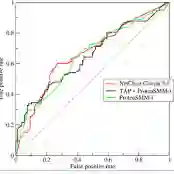
Objective. We establish a principled method for inferring mental health related psychometric variables from neural and behavioral data using the Implicit Association Test (IAT) as the data generation engine, aiming to overcome the limited predictive performance (typically under 0.7 AUC) of the gold-standard D-score method, which relies solely on reaction times. Approach. We propose a sparse hierarchical Bayesian model that leverages multi-modal data to predict experiences related to mental illness symptoms in new participants. The model is a multivariate generalization of the D-score with trainable parameters, engineered for parameter efficiency in the small-cohort regime typical of IAT studies. Data from two IAT variants were analyzed: a suicidality-related E-IAT ($n=39$) and a psychosis-related PSY-IAT ($n=34$). Main Results. Our approach overcomes a high inter-individual variability and low within-session effect size in the dataset, reaching AUCs of 0.73 (E-IAT) and 0.76 (PSY-IAT) in the best modality configurations, though corrected 95% confidence intervals are wide ($\pm 0.18$) and results are marginally significant after FDR correction ($q=0.10$). Restricting the E-IAT to MDD participants improves AUC to 0.79 $[0.62, 0.97]$ (significant at $q=0.05$). Performance is on par with the best reference methods (shrinkage LDA and EEGNet) for each task, even when the latter were adapted to the task, while the proposed method was not. Accuracy was substantially above near-chance D-scores (0.50-0.53 AUC) in both tasks, with more consistent cross-task performance than any single reference method. Significance. Our framework shows promise for enhancing IAT-based assessment of experiences related to entrapment and psychosis, and potentially other mental health conditions, though further validation on larger and independent cohorts will be needed to establish clinical utility.
翻译:目的。我们建立了一种基于原则的方法,从神经和行为数据中推断与心理健康相关的心理测量变量,以隐含关联测验(IAT)作为数据生成引擎,旨在克服仅依赖反应时的金标准D分数方法有限的预测性能(通常低于0.7 AUC)。方法。我们提出了一种稀疏分层贝叶斯模型,该模型利用多模态数据来预测新参与者与精神疾病症状相关的体验。该模型是D分数的多变量泛化形式,具有可训练参数,专为IAT研究中典型的小样本队列场景下的参数效率而设计。分析了两种IAT变体的数据:与自杀倾向相关的E-IAT($n=39$)和与精神病性症状相关的PSY-IAT($n=34$)。主要结果。我们的方法克服了数据集中较高的个体间变异性和较低的会话内效应量,在最佳模态配置下达到了0.73(E-IAT)和0.76(PSY-IAT)的AUC,尽管校正后的95%置信区间较宽($\pm 0.18$),且经过FDR校正($q=0.10$)后结果仅具有边缘显著性。将E-IAT限制在MDD参与者中可将AUC提高至0.79 $[0.62, 0.97]$(在$q=0.05$水平上显著)。该方法在每个任务上的性能与最佳参考方法(收缩LDA和EEGNet)相当,即使后者针对任务进行了调整,而所提方法并未调整。在两个任务中,其准确率均显著高于接近随机水平的D分数(0.50-0.53 AUC),并且跨任务性能比任何单一参考方法都更稳定。意义。我们的框架显示出在增强基于IAT的、与受困感和精神病性症状以及其他潜在心理健康状况相关体验的评估方面具有前景,尽管仍需在更大规模的独立队列上进行进一步验证以确立其临床实用性。




相关内容



 微信扫码咨询专知VIP会员