

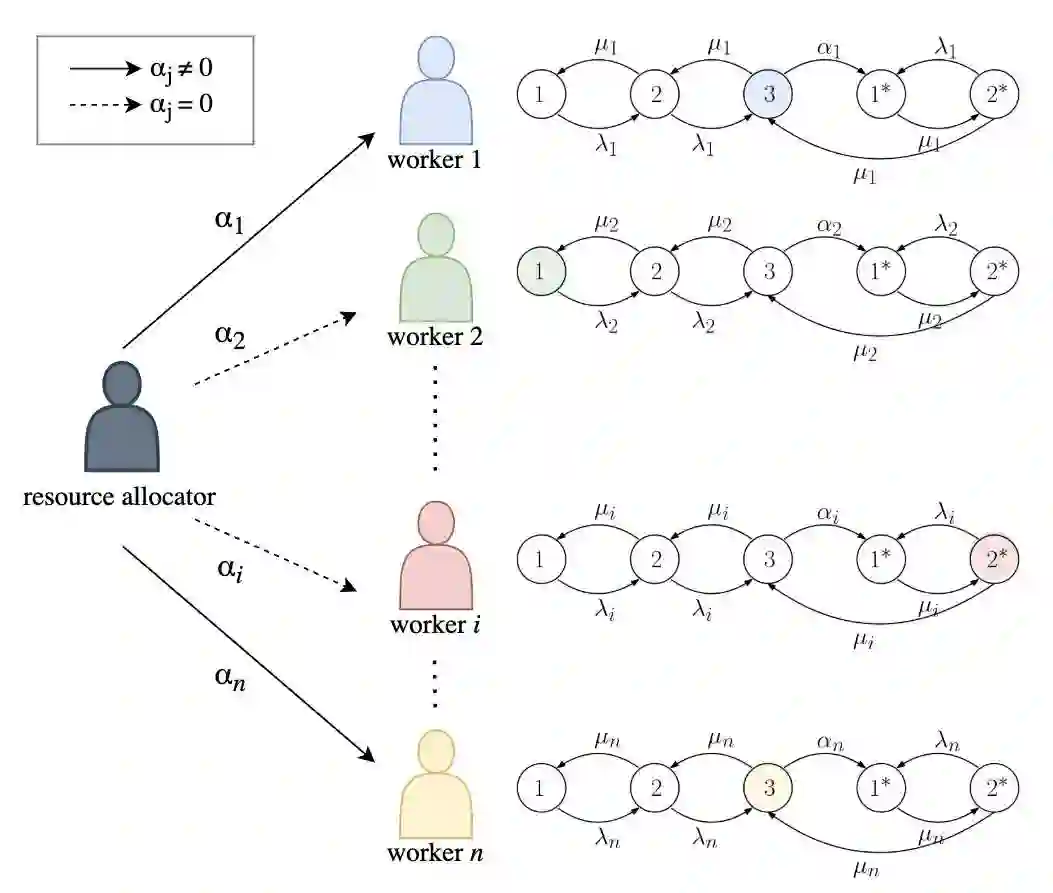
We consider the problem of assigning tasks efficiently to a set of workers that can exhaust themselves as a result of processing tasks. If a worker is exhausted, it will take a longer time to recover. To model efficiency of workers with exhaustion, we use a continuous-time Markov chain (CTMC). By taking samples from the internal states of the workers, the source assigns tasks to the workers when they are found to be in their efficient states. We consider two different settings where (i) the source can assign tasks to the workers only when they are in their most efficient state, and (ii) it can assign tasks to workers when they are also moderately efficient in spite of a potentially reduced success probability. In the former case, we find the optimal policy to be a threshold-based sampling policy where the thresholds depend on the workers' recovery and exhaustion rates. In the latter case, we solve a non-convex sum-of-ratios problem using a branch-and-bound approach which performs well compared with the globally optimal solution.
翻译:我们研究如何高效地将任务分配给一组可能因处理任务而疲劳的工人。如果工人疲劳,其恢复时间将显著延长。为建模具有疲劳效应的工人效率,我们采用连续时间马尔可夫链(CTMC)。通过采样工人的内部状态,当发现工人处于高效状态时,任务源会向其分配任务。我们考虑两种不同场景:(i)仅当工人处于最高效状态时任务源才可分配任务;(ii)即使工人处于中等效率状态(尽管可能降低成功概率)也可分配任务。在前一种情况下,我们发现最优策略为基于阈值的采样策略,其阈值取决于工人的恢复率与疲劳率。在后一种情况下,我们通过分支定界法求解非凸比例求和问题,该方法相较于全局最优解表现出良好性能。




相关内容


 微信扫码咨询专知VIP会员