

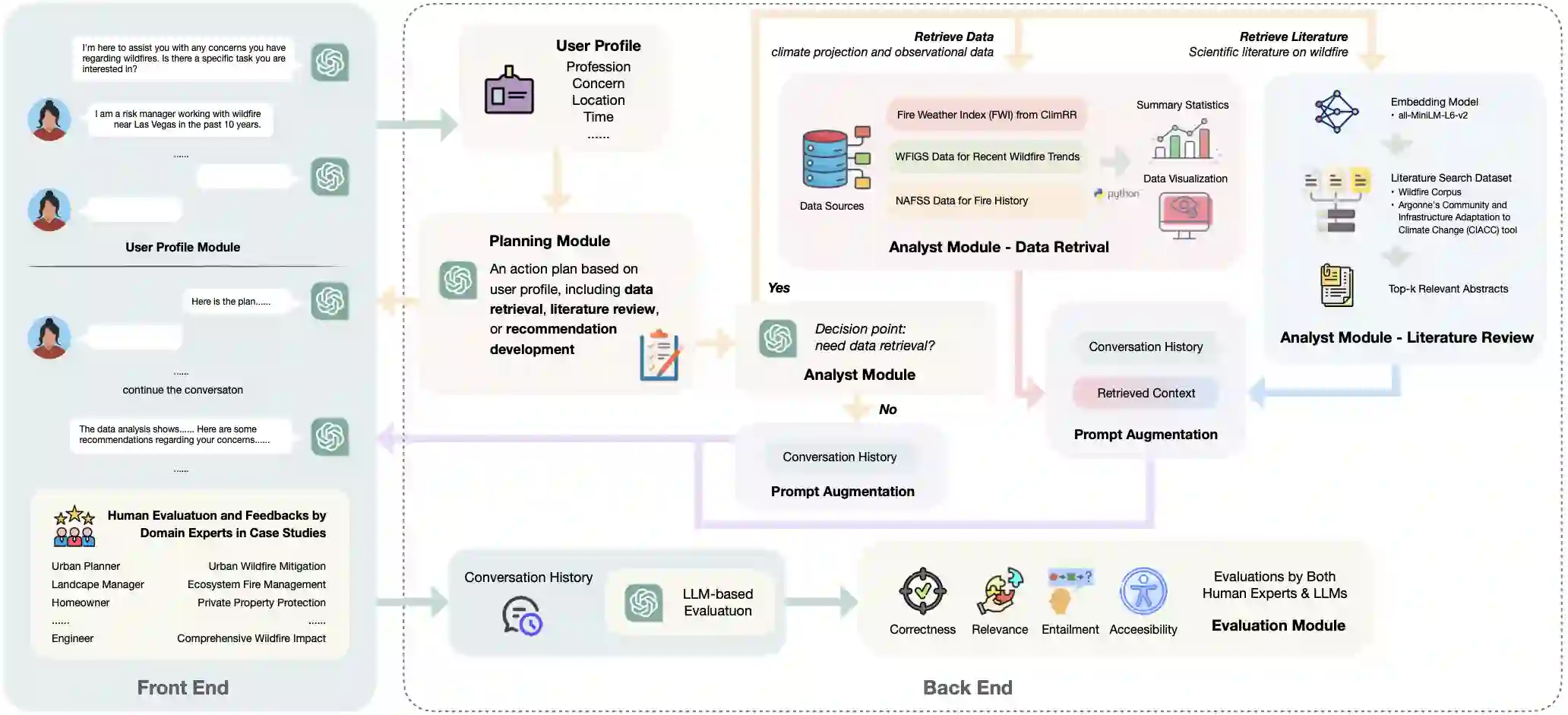
Large language models (LLMs) are a transformational capability at the frontier of artificial intelligence and machine learning that can support decision-makers in addressing pressing societal challenges such as extreme natural hazard events. As generalized models, LLMs often struggle to provide context-specific information, particularly in areas requiring specialized knowledge. In this work, we propose a Retrieval-Augmented Generation (RAG)-based multi-agent LLM system to support analysis and decision-making in the context of natural hazards and extreme weather events. As a proof of concept, we present WildfireGPT, a specialized system focused on wildfire scenarios. The architecture employs a user-centered, multi-agent design to deliver tailored risk insights across diverse stakeholder groups. By integrating domain-specific projection data, observational datasets, and scientific literature through a RAG framework, the system ensures both accuracy and contextual relevance of the information it provides. Evaluation across ten expert-led case studies demonstrates that WildfireGPT significantly outperforms existing LLM-based solutions for decision support in natural hazard and extreme weather contexts.
翻译:大语言模型(LLM)是处于人工智能和机器学习前沿的变革性能力,能够支持决策者应对极端自然灾害事件等紧迫的社会挑战。作为通用模型,LLM通常难以提供特定情境的信息,尤其是在需要专业知识的领域。在本研究中,我们提出了一种基于检索增强生成(RAG)的多智能体LLM系统,以支持在自然灾害和极端天气事件背景下的分析与决策。作为概念验证,我们展示了WildfireGPT——一个专注于野火场景的专用系统。该架构采用以用户为中心的多智能体设计,为不同的利益相关者群体提供定制化的风险洞察。通过RAG框架整合特定领域的预测数据、观测数据集和科学文献,该系统确保了所提供信息的准确性和情境相关性。在十个专家主导的案例研究中的评估表明,在自然灾害和极端天气背景下的决策支持方面,WildfireGPT显著优于现有基于LLM的解决方案。




相关内容





 微信扫码咨询专知VIP会员