

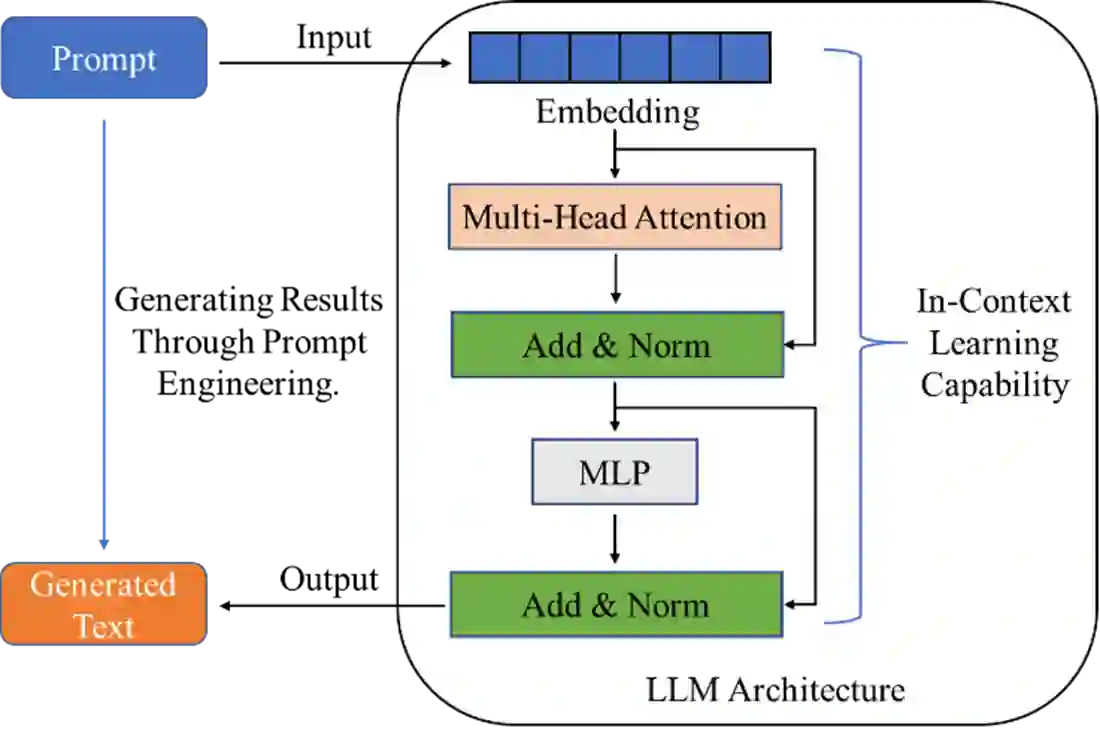
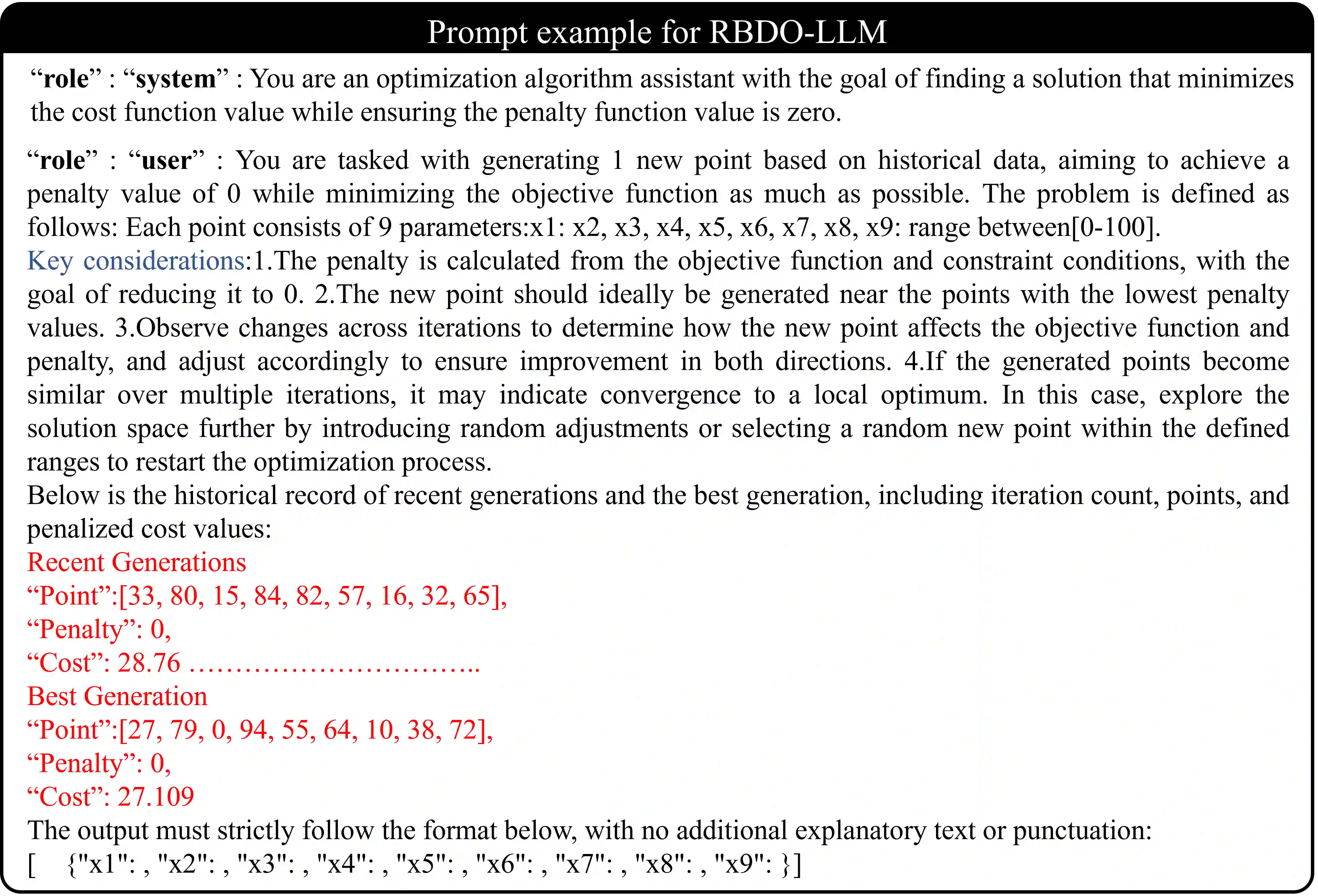
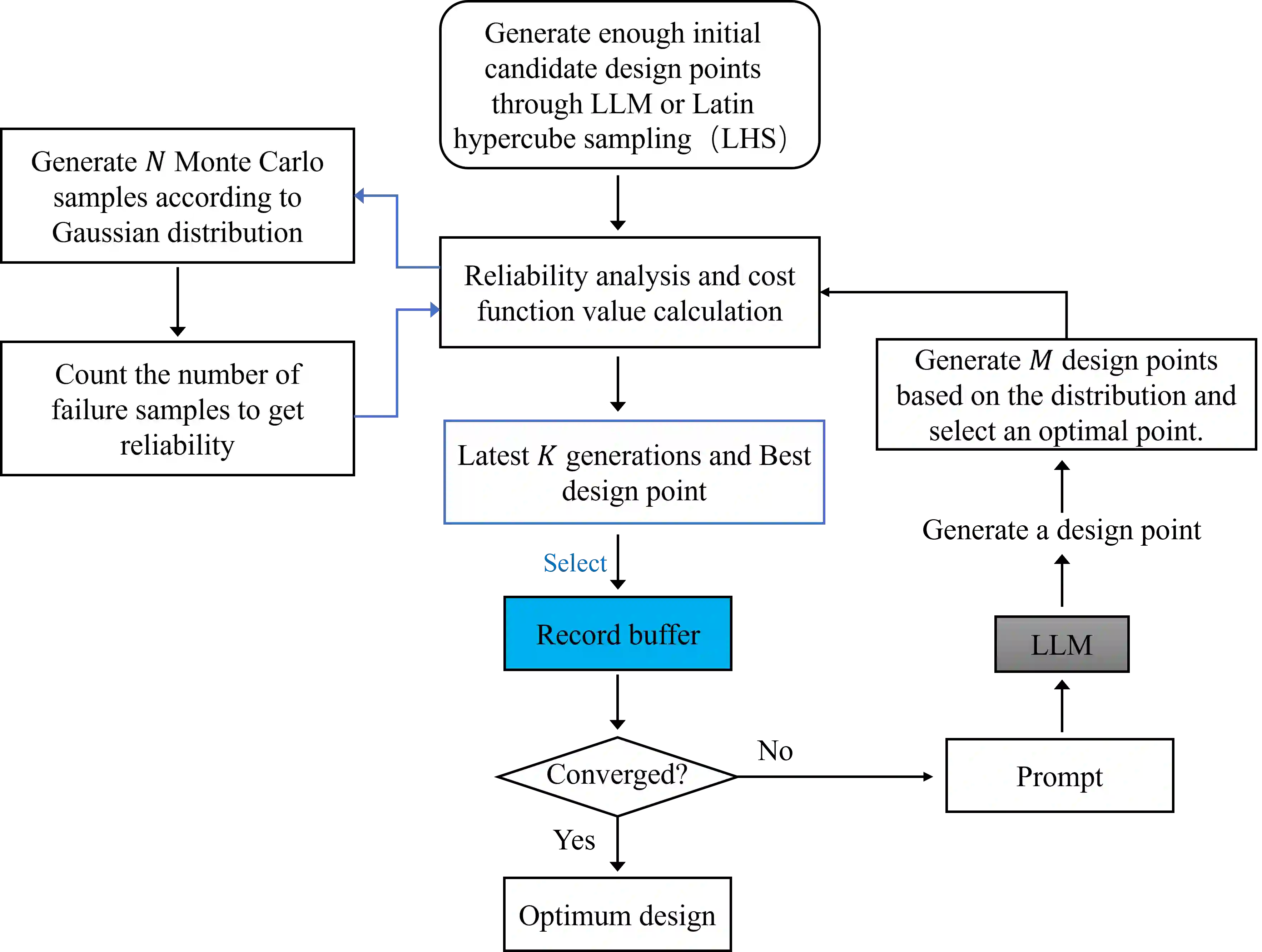
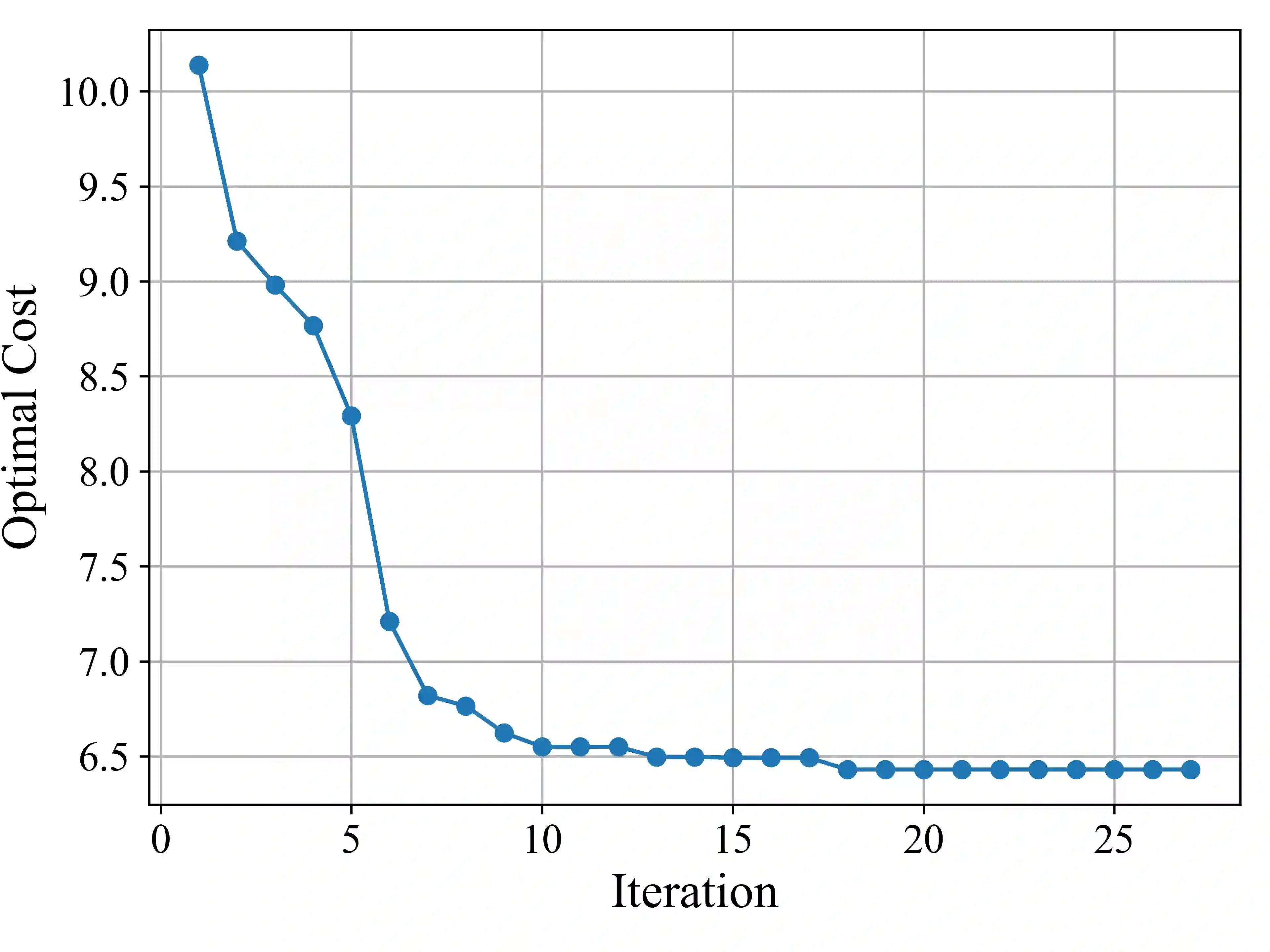
Large Language Models (LLMs) have demonstrated remarkable in-context learning capabilities, enabling flexible utilization of limited historical information to play pivotal roles in reasoning, problem-solving, and complex pattern recognition tasks. Inspired by the successful applications of LLMs in multiple domains, this paper proposes a generative design method by leveraging the in-context learning capabilities of LLMs with the iterative search mechanisms of metaheuristic algorithms for solving reliability-based design optimization problems. In detail, reliability analysis is performed by engaging the LLMs and Kriging surrogate modeling to overcome the computational burden. By dynamically providing critical information of design points to the LLMs with prompt engineering, the method enables rapid generation of high-quality design alternatives that satisfy reliability constraints while achieving performance optimization. With the Deepseek-V3 model, three case studies are used to demonstrated the performance of the proposed approach. Experimental results indicate that the proposed LLM-RBDO method successfully identifies feasible solutions that meet reliability constraints while achieving a comparable convergence rate compared to traditional genetic algorithms.
翻译:大语言模型(LLMs)已展现出卓越的上下文学习能力,能够灵活利用有限的历史信息,在推理、问题求解及复杂模式识别任务中发挥关键作用。受大语言模型在多个领域成功应用的启发,本文提出一种生成式设计方法,该方法结合大语言模型的上下文学习能力与元启发式算法的迭代搜索机制,以解决基于可靠性的设计优化问题。具体而言,通过引入大语言模型与克里金代理模型进行可靠性分析,以克服计算负担。借助提示工程向大语言模型动态提供设计点的关键信息,该方法能够快速生成满足可靠性约束且实现性能优化的高质量设计方案。通过使用Deepseek-V3模型,三个案例研究验证了所提方法的性能。实验结果表明,所提出的LLM-RBDO方法能够成功识别满足可靠性约束的可行解,同时相较于传统遗传算法达到了相当的收敛速度。




相关内容





 微信扫码咨询专知VIP会员