

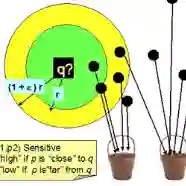
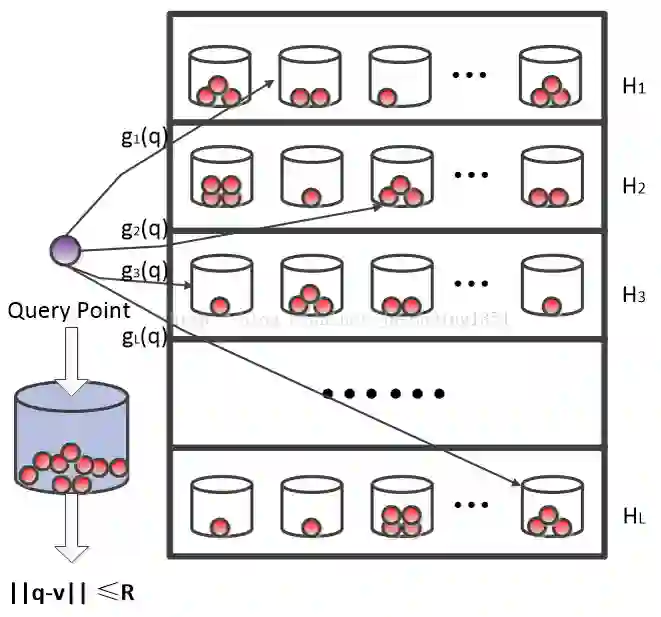
From healing wounds to maintaining homeostasis in cyclically loaded tissue, living systems have a phenomenal ability to sense, store, and respond to mechanical stimuli. Broadly speaking, there is significant interest in designing engineered systems to recapitulate this incredible functionality. In engineered systems, we have seen significant recent computationally driven advances in sensing and control. And, there has been a growing interest - inspired in part by the incredible distributed and emergent functionality observed in the natural world - in exploring the ability of engineered systems to perform computation through mechanisms that are fundamentally driven by physical laws. In this work, we focus on a small segment of this broad and evolving field: locality sensitive hashing via mechanical behavior. Specifically, we will address the question: can mechanical information (i.e., loads) be transformed by mechanical systems (i.e., converted into sensor readouts) such that the mechanical system meets the requirements for a locality sensitive hash function? Overall, we not only find that mechanical systems are able to perform this function, but also that different mechanical systems vary widely in their efficacy at this task. Looking forward, we view this work as a starting point for significant future investigation into the design and optimization of mechanical systems for conveying mechanical information for downstream computing.
翻译:从伤口愈合到循环加载组织中的稳态维持,生命系统具有感知、存储和响应机械刺激的非凡能力。广义而言,设计工程系统以复现这种卓越功能具有重大研究价值。在工程系统中,近年来基于计算驱动的传感与控制技术取得了显著进展。同时,受自然界中分布式涌现功能现象的启发,探索工程系统通过物理定律驱动的基本机制来执行计算的研究兴趣日益增长。本工作聚焦于这一广阔且不断发展的领域中的一个小分支:基于力学行为的局部敏感哈希。具体而言,我们将探讨以下问题:能否通过机械系统将力学信息(即载荷)转换为传感器读数,使得该系统满足局部敏感哈希函数的要求?总体而言,我们不仅发现机械系统能够执行该功能,而且不同机械系统在此任务中的效能存在显著差异。展望未来,我们将此工作视为后续重要研究(聚焦于优化设计用于下游计算的力学信息传递机械系统)的起点。




相关内容



 微信扫码咨询专知VIP会员