

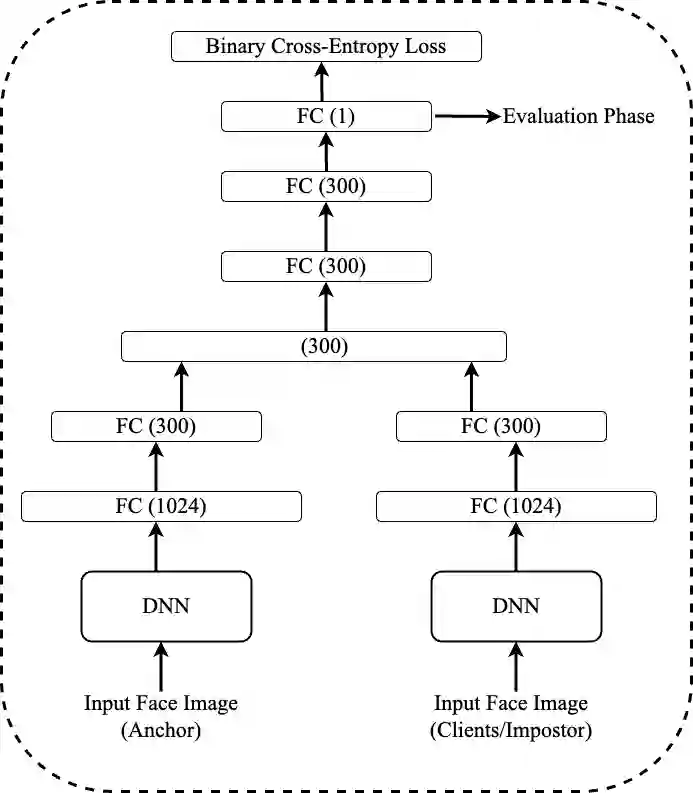
Achieving state-of-the-art results in face verification systems typically hinges on the availability of labeled face training data, a resource that often proves challenging to acquire in substantial quantities. In this research endeavor, we proposed employing Siamese networks for face recognition, eliminating the need for labeled face images. We achieve this by strategically leveraging negative samples alongside nearest neighbor counterparts, thereby establishing positive and negative pairs through an unsupervised methodology. The architectural framework adopts a VGG encoder, trained as a double branch siamese network. Our primary aim is to circumvent the necessity for labeled face image data, thus proposing the generation of training pairs in an entirely unsupervised manner. Positive training data are selected within a dataset based on their highest cosine similarity scores with a designated anchor, while negative training data are culled in a parallel fashion, though drawn from an alternate dataset. During training, the proposed siamese network conducts binary classification via cross-entropy loss. Subsequently, during the testing phase, we directly extract face verification scores from the network's output layer. Experimental results reveal that the proposed unsupervised system delivers a performance on par with a similar but fully supervised baseline.
翻译:在面部验证系统中实现最先进的结果通常依赖于标注人脸训练数据的可用性,然而大规模获取此类数据往往面临挑战。本研究提出采用孪生网络进行人脸识别,无需标注人脸图像。通过策略性地利用负样本与最近邻对应样本,我们以无监督方式构建正负样本对。架构采用VGG编码器,训练为双分支孪生网络。主要目标是规避对标注人脸图像数据的需求,因此提出完全无监督的训练样本对生成方法:基于与指定锚点的最高余弦相似度得分,从数据集中选取正训练样本;负训练样本则以类似方式从另一数据集中筛选。训练阶段,所提出的孪生网络通过交叉熵损失执行二分类任务。测试阶段,我们直接从网络输出层提取人脸验证分数。实验结果表明,该无监督系统达到了与全监督基线方法相当的性能。




相关内容



 微信扫码咨询专知VIP会员