

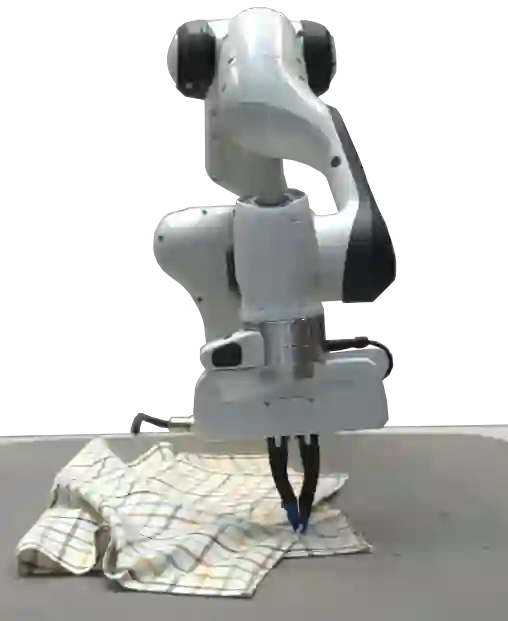
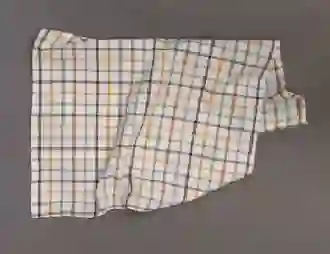
Pre-defined manipulation primitives are widely used for cloth manipulation. However, cloth properties such as its stiffness or density can highly impact the performance of these primitives. Although existing solutions have tackled the parameterisation of pick and place locations, the effect of factors such as the velocity or trajectory of quasi-static and dynamic manipulation primitives has been neglected. Choosing appropriate values for these parameters is crucial to cope with the range of materials present in house-hold cloth objects. To address this challenge, we introduce the Quasi-Dynamic Parameterisable (QDP) method, which optimises parameters such as the motion velocity in addition to the pick and place positions of quasi-static and dynamic manipulation primitives. In this work, we leverage the framework of Sequential Reinforcement Learning to decouple sequentially the parameters that compose the primitives. To evaluate the effectiveness of the method we focus on the task of cloth unfolding with a robotic arm in simulation and real-world experiments. Our results in simulation show that by deciding the optimal parameters for the primitives the performance can improve by 20% compared to sub-optimal ones. Real-world results demonstrate the advantage of modifying the velocity and height of manipulation primitives for cloths with different mass, stiffness, shape and size. Supplementary material, videos, and code, can be found at https://sites.google.com/view/qdp-srl.
翻译:预定义操控基元广泛应用于布料操作任务。然而,布料属性(如刚度或密度)会显著影响这些基元的性能。尽管现有方案已解决抓取与放置位置的参数化问题,但准静态与动态操控基元的运动速度或轨迹等因素的影响仍被忽视。为应对家居布料物体中存在的材料多样性,合理选择这些参数至关重要。针对这一挑战,本文提出准动态可参数化(QDP)方法,在优化准静态与动态操控基元的抓取位置与放置位置之外,进一步优化运动速度等参数。本研究利用序列强化学习框架,对构成基元的参数进行序列化解耦。为评估方法有效性,我们聚焦机器人臂的布料展开任务,在仿真与真实场景中开展实验。仿真结果表明,通过确定基元的最优参数,性能较次优参数可提升20%。真实场景实验验证了为不同质量、刚度、形状和尺寸的布料调整操控基元速度与高度的优势。补充材料、视频及代码详见 https://sites.google.com/view/qdp-srl。







相关内容




 微信扫码咨询专知VIP会员