

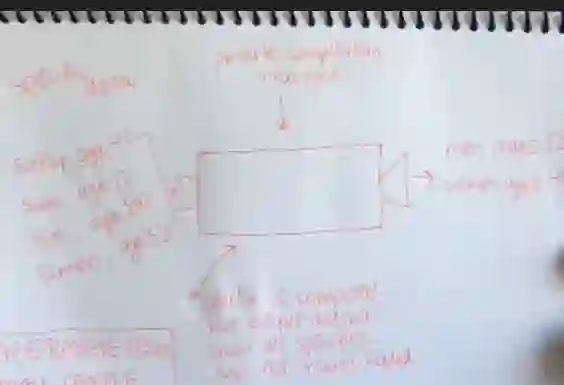
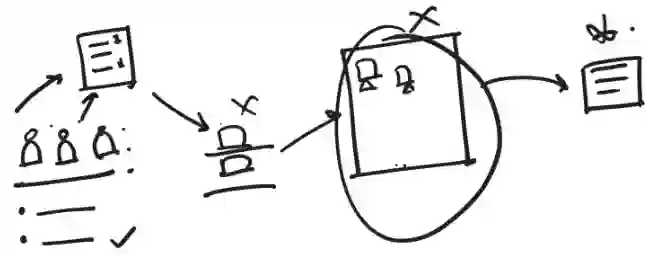
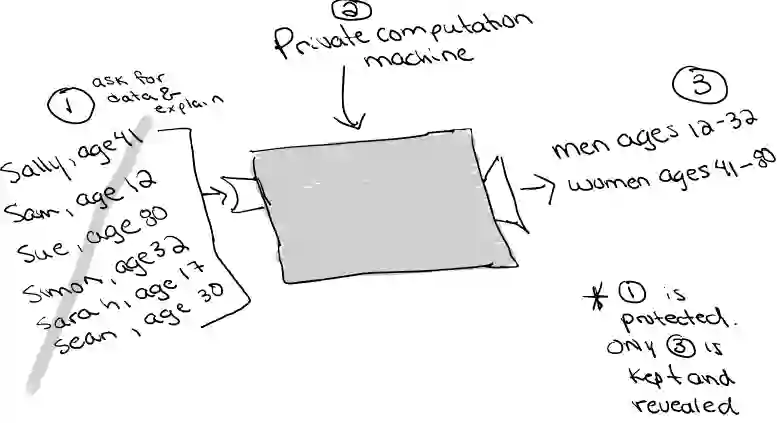
Private computation, which includes techniques like multi-party computation and private query execution, holds great promise for enabling organizations to analyze data they and their partners hold while maintaining data subjects' privacy. Despite recent interest in communicating about differential privacy, end users' perspectives on private computation have not previously been studied. To fill this gap, we conducted 22 semi-structured interviews investigating users' understanding of, and expectations for, private computation over data about them. Interviews centered on four concrete data-analysis scenarios (e.g., ad conversion analysis), each with a variant that did not use private computation and another that did (private set intersection, multi-party computation, and privacy preserving query procedures). While participants struggled with abstract definitions of private computation, they found the concrete scenarios enlightening and plausible even though we did not explain the complex cryptographic underpinnings. Private computation increased participants' acceptance of data sharing, but not unconditionally; the purpose of data sharing and analysis was the primary driver of their attitudes. Through collective activities, participants emphasized the importance of detailing the purpose of a computation and clarifying that inputs to private computation are not shared across organizations when describing private computation to end users.
翻译:隐私计算涵盖多方计算、隐私查询执行等技术,有望在保护数据主体隐私的同时,使组织能够分析自身及其合作伙伴持有的数据。尽管近年来关于差分隐私的传播引起了广泛关注,但终端用户对隐私计算的观点尚未得到系统研究。为填补这一空白,我们开展了22项半结构化访谈,调查用户对涉及其数据的隐私计算的理解与期望。访谈聚焦于四个具体数据分析场景(如广告转化分析),每个场景均包含非隐私计算变体与隐私计算变体(私有集合交集、多方计算及隐私保护查询流程)。尽管参与者难以理解隐私计算的抽象定义,但在未解释复杂密码学原理的情况下,他们仍认为具体场景具有启发性和合理性。隐私计算提升了参与者对数据共享的接受度,但这种接受并非无条件的;数据共享和分析的目的才是他们态度形成的主要驱动力。通过集体活动,参与者强调,在向终端用户描述隐私计算时,需详细说明计算目的,并明确隐私计算的输入信息不会在组织间共享。





相关内容



 微信扫码咨询专知VIP会员