

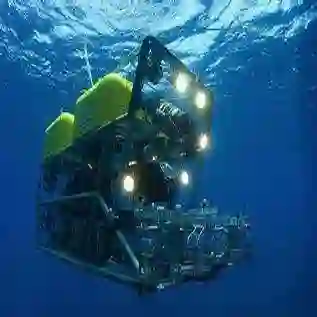
Efficient and intuitive Human-Robot interfaces are crucial for expanding the user base of operators and enabling new applications in critical areas such as precision agriculture, automated construction, rehabilitation, and environmental monitoring. In this paper, we investigate the design of human-robot interfaces for the teleoperation of dynamical systems. The proposed framework seeks to find an optimal interface that complies with key concepts such as user comfort, efficiency, continuity, and consistency. As a proof-of-concept, we introduce an innovative approach to teleoperating underwater vehicles, allowing the translation between human body movements into vehicle control commands. This method eliminates the need for divers to work in harsh underwater environments while taking into account comfort and communication constraints. We conducted a study with human subjects using a head-mounted display attached to a smartphone to control a simulated ROV. Also, numerical experiments have demonstrated that the optimal translation is often the most intuitive and natural one, aligning with users' expectations.
翻译:高效且直观的人机界面对于扩大操作人员用户群体并在精准农业、自动化建造、康复医学及环境监测等关键领域催生新应用至关重要。本文研究面向动力系统遥操作的人机界面设计问题。所提出的框架旨在寻找一种满足用户舒适性、效率、连续性和一致性等核心概念的最优界面。作为概念验证,我们提出了一种创新的水下航行器遥操作方法,该方法实现了人体运动到航行器控制指令的映射。该方案无需操作员在恶劣水下环境中工作,同时兼顾舒适性与通信约束。我们开展了一项人体实验研究,受试者通过连接智能手机的头戴式显示器操控模拟ROV。此外,数值实验表明,最优映射通常是最直观自然的映射,与用户预期高度一致。




相关内容

 微信扫码咨询专知VIP会员