

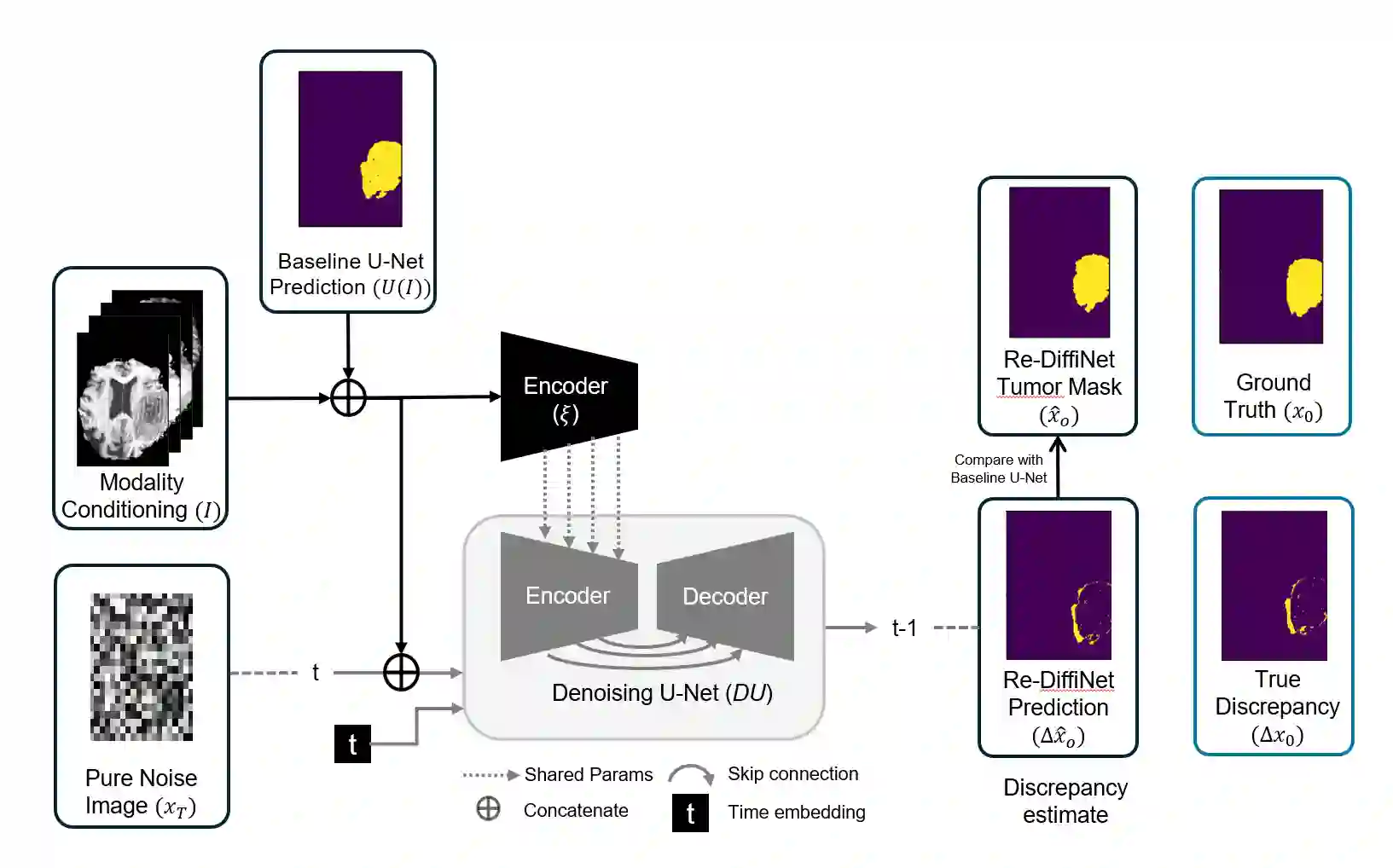
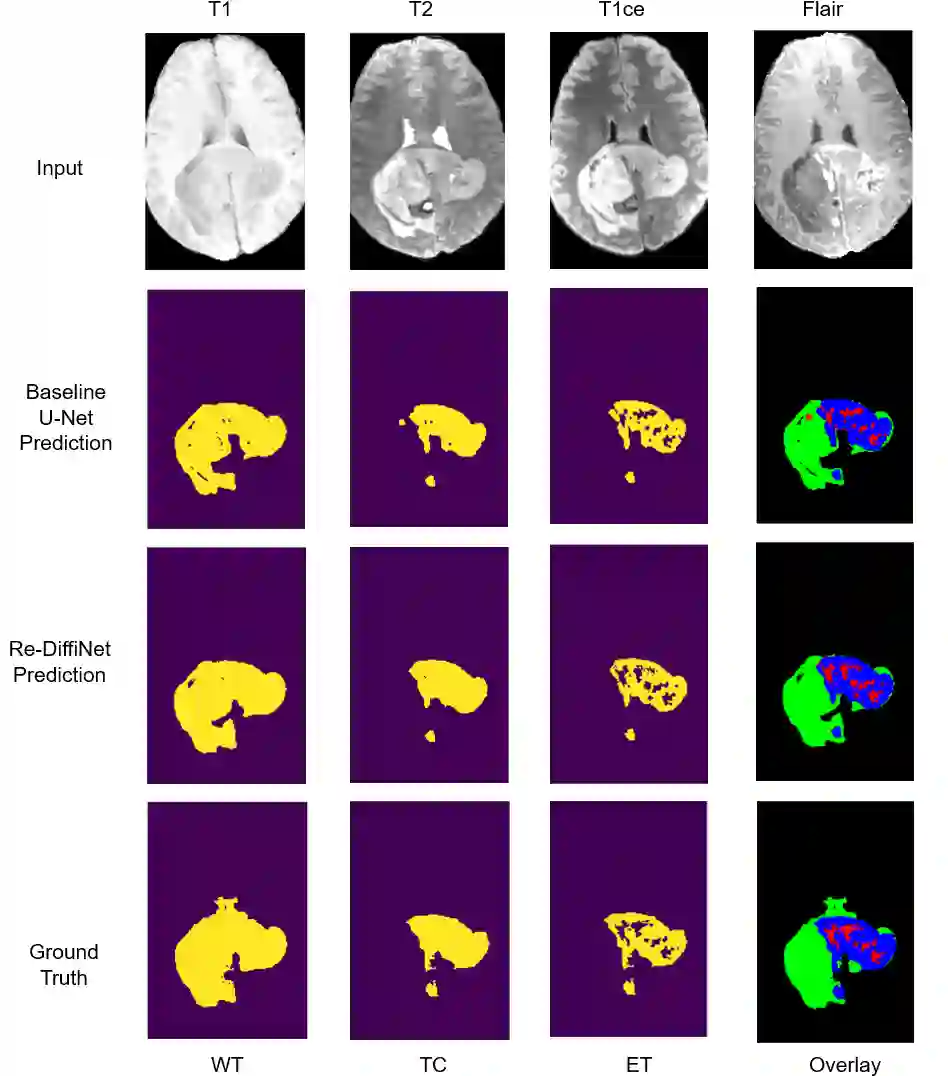
Identification of tumor margins is essential for surgical decision-making for glioblastoma patients and provides reliable assistance for neurosurgeons. Despite improvements in deep learning architectures for tumor segmentation over the years, creating a fully autonomous system suitable for clinical floors remains a formidable challenge because the model predictions have not yet reached the desired level of accuracy and generalizability for clinical applications. Generative modeling techniques have seen significant improvements in recent times. Specifically, Generative Adversarial Networks (GANs) and Denoising-diffusion-based models (DDPMs) have been used to generate higher-quality images with fewer artifacts and finer attributes. In this work, we introduce a framework called Re-Diffinet for modeling the discrepancy between the outputs of a segmentation model like U-Net and the ground truth, using DDPMs. By explicitly modeling the discrepancy, the results show an average improvement of 0.55\% in the Dice score and 16.28\% in HD95 from cross-validation over 5-folds, compared to the state-of-the-art U-Net segmentation model.
翻译:肿瘤边界识别对于胶质母细胞瘤患者的手术决策至关重要,并为神经外科医生提供可靠辅助。尽管近年来深度学习架构在肿瘤分割领域取得了进展,但由于模型预测在临床应用中尚未达到所需的准确性和泛化能力,构建完全适用于临床环境的全自动系统仍是一项艰巨挑战。生成式建模技术近期取得了显著进步,特别是生成对抗网络(GANs)与基于去噪扩散的模型(DDPMs)已被用于生成更高质量、伪影更少且属性更精细的图像。本文提出一种名为Re-Diffinet的框架,利用DDPMs建模U-Net等分割模型输出与真实标签之间的差异。通过显式建模该差异,交叉验证结果显示,与当前最优的U-Net分割模型相比,Dice系数平均提升0.55%,HD95指标平均提升16.28%(五折交叉验证)。




相关内容




 微信扫码咨询专知VIP会员