

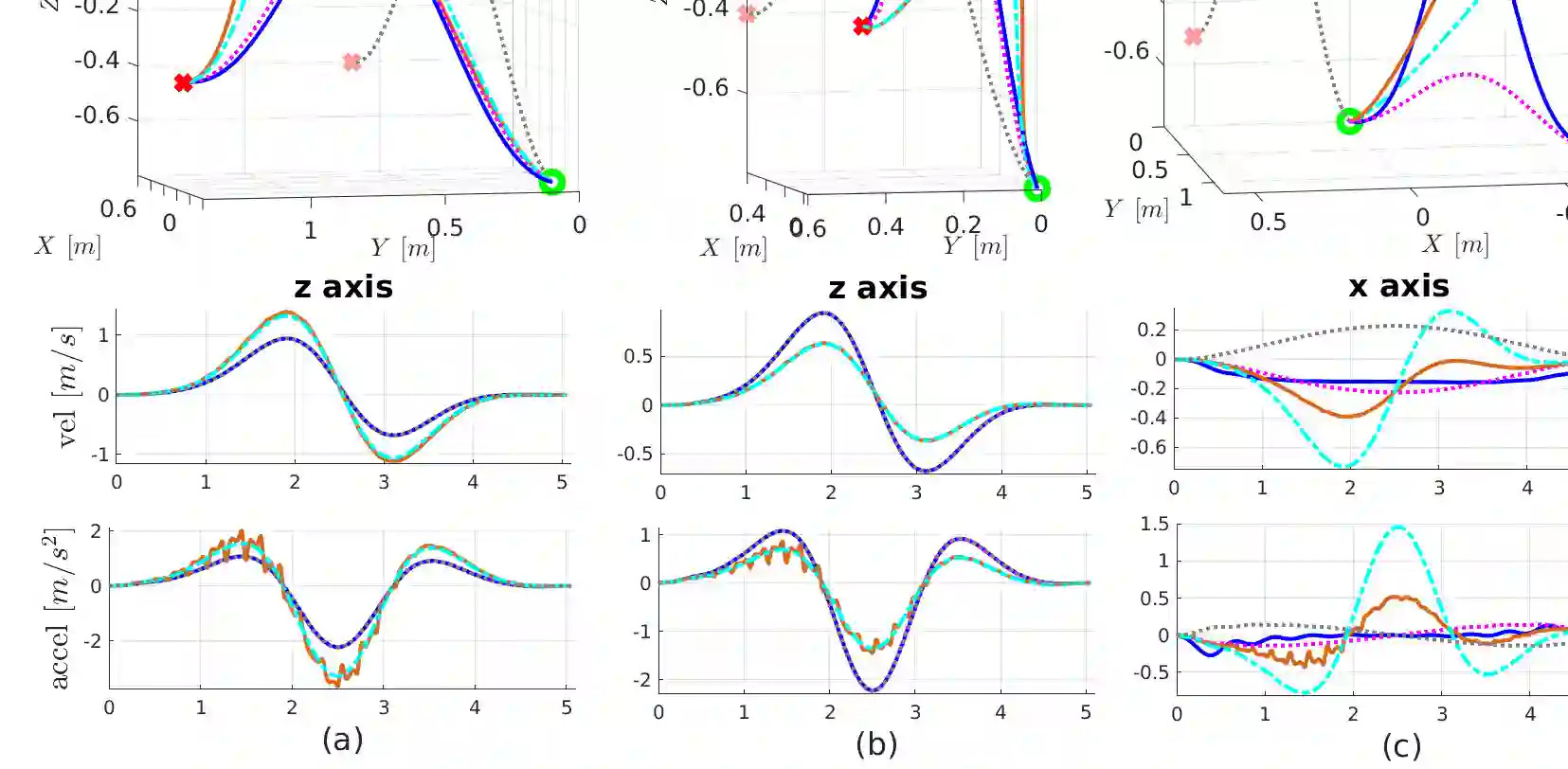
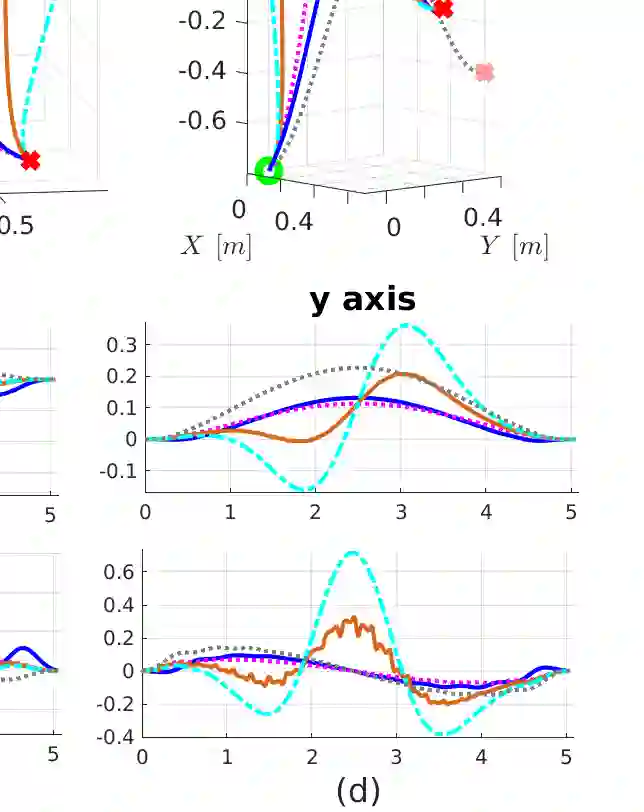
Dynamic Movement Primitives (DMP) have found remarkable applicability and success in various robotic tasks, which can be mainly attributed to their generalization, modulation and robustness properties. Nevertheless, the spatial generalization of DMP can be problematic in some cases, leading to excessive or unnatural spatial scaling. Moreover, incorporating intermediate points (via-points) to adjust the DMP trajectory, is not adequately addressed. In this work we propose an improved online spatial generalization, that remedies the shortcomings of the classical DMP generalization, and moreover allows the incorporation of dynamic via-points. This is achieved by designing an online adaptation scheme for the DMP weights which is proved to minimize the distance from the demonstrated acceleration profile to retain the shape of the demonstration, subject to dynamic via-point and initial/final state constraints. Extensive comparative simulations with the classical and other DMP variants are conducted, while experimental results validate the applicability and efficacy of the proposed method.
翻译:动态运动基元(DMP)因其具有泛化、调制和鲁棒性等特性,已在各类机器人任务中展现出显著适用性与成功应用。然而,DMP的空间泛化在某些情况下可能出现问题,导致空间缩放过度或非自然化。此外,针对通过中间点(路径点)调整DMP轨迹的问题尚未得到充分解决。本文提出了一种改进的在线空间泛化方法,既弥补了经典DMP泛化的缺陷,又允许引入动态路径点。该方法通过设计DMP权重的在线自适应机制实现,该机制被证明能够在满足动态路径点及初始/终端状态约束条件下,最小化与演示加速度剖面的距离,从而保留演示轨迹的形状。我们进行了与经典及其他DMP变体的广泛对比仿真,实验结果验证了所提方法的适用性与有效性。





相关内容




 微信扫码咨询专知VIP会员