

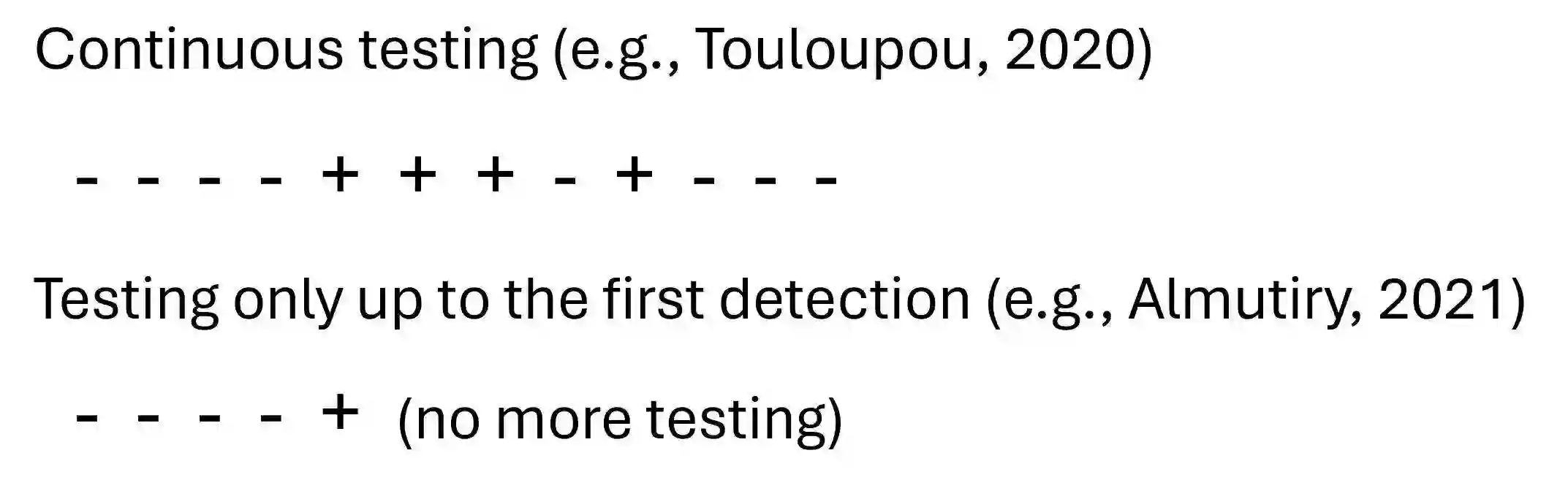
Individual-level epidemic models are increasingly being used to help understand the transmission dynamics of various infectious diseases. However, fitting such models to individual-level epidemic data is challenging, as we often only know when an individual's disease status was detected (e.g., when they showed symptoms) and not when they were infected or removed. We propose an autoregressive coupled hidden Markov model to infer unknown infection and removal times, as well as other model parameters, from a single observed detection time for each detected individual. Unlike more traditional data augmentation methods used in epidemic modelling, we do not assume that this detection time corresponds to infection or removal or that infected individuals must at some point be detected. Bayesian coupled hidden Markov models have been used previously for individual-level epidemic data. However, these approaches assumed each individual was continuously tested and that the tests were independent. In practice, individuals are often only tested until their first positive test, and even if they are continuously tested, only the initial detection times may be reported. In addition, multiple tests on the same individual may not be independent. We accommodate these scenarios by assuming that the probability of detecting the disease can depend on past observations, which allows us to fit a much wider range of practical applications. We illustrate the flexibility of our approach by fitting two examples: an experiment on the spread of tomato spot wilt virus in pepper plants and an outbreak of norovirus among nurses in a hospital.
翻译:个体水平流行病模型正日益被用于帮助理解各类传染病的传播动态。然而,将此类模型拟合到个体水平的流行病数据具有挑战性,因为我们通常仅知道个体疾病状态被检测到的时间(例如出现症状时),而无法获知其感染或移除的具体时间。本文提出一种自回归耦合隐马尔可夫模型,能够根据每个被检测个体单次观测到的检测时间,推断未知的感染与移除时间以及其他模型参数。与流行病建模中更传统的数据增强方法不同,我们既不假设检测时间对应于感染或移除事件,也不假定感染者必然会在某个时间点被检测到。贝叶斯耦合隐马尔可夫模型先前已被用于个体水平流行病数据分析,但这些方法假设每个个体均接受连续检测且检测结果相互独立。实际场景中,个体通常仅在首次阳性检测前接受测试,即使进行连续检测,往往也仅报告初始检测时间。此外,同一个体的多次检测结果可能具有相关性。我们通过假设疾病检测概率可依赖于历史观测值来适应这些实际情况,从而使模型能够适用于更广泛的实际应用场景。通过两个案例的拟合,我们展示了该方法的灵活性:一是辣椒植株中番茄斑萎病毒传播实验,二是医院护士群体中诺如病毒暴发事件。





相关内容

 微信扫码咨询专知VIP会员