

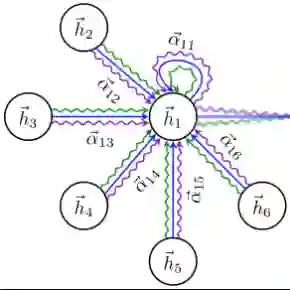
Network flow problems, which involve distributing traffic such that the underlying infrastructure is used effectively, are ubiquitous in transportation and logistics. Among them, the general Multi-Commodity Network Flow (MCNF) problem concerns the distribution of multiple flows of different sizes between several sources and sinks, while achieving effective utilization of the links. Due to the appeal of data-driven optimization, these problems have increasingly been approached using graph learning methods. In this paper, we propose a novel graph learning architecture for network flow problems called Per-Edge Weights (PEW). This method builds on a Graph Attention Network and uses distinctly parametrized message functions along each link. We extensively evaluate the proposed solution through an Internet flow routing case study using $17$ Service Provider topologies and $2$ routing schemes. We show that PEW yields substantial gains over architectures whose global message function constrains the routing unnecessarily. We also find that an MLP is competitive with other standard architectures. Furthermore, we analyze the relationship between graph structure and predictive performance for data-driven routing of flows, an aspect that has not been considered by existing work in the area.
翻译:网络流问题涉及有效分配流量以使底层基础设施得到充分利用,在交通运输和物流领域普遍存在。其中,一般的多商品网络流问题关注在多个源和汇之间分配不同规模的多种流量,同时实现链路的有效利用。由于数据驱动优化的吸引力,这些问题越来越多地采用图学习方法来解决。本文提出了一种新颖的用于网络流问题的图学习架构,称为每边权重方法。该方法基于图注意力网络,并沿每条链路使用不同参数化的消息函数。我们通过一个互联网流量路由案例研究对提出的解决方案进行了广泛评估,该研究使用了17个服务提供商拓扑和2种路由方案。结果表明,与那些全局消息函数不必要地约束路由的架构相比,PEW方法取得了显著优势。我们还发现多层感知机与其他标准架构具有竞争力。此外,我们分析了图结构与数据驱动流路由预测性能之间的关系,这一方面尚未被该领域的现有工作所考虑。




相关内容



 微信扫码咨询专知VIP会员