

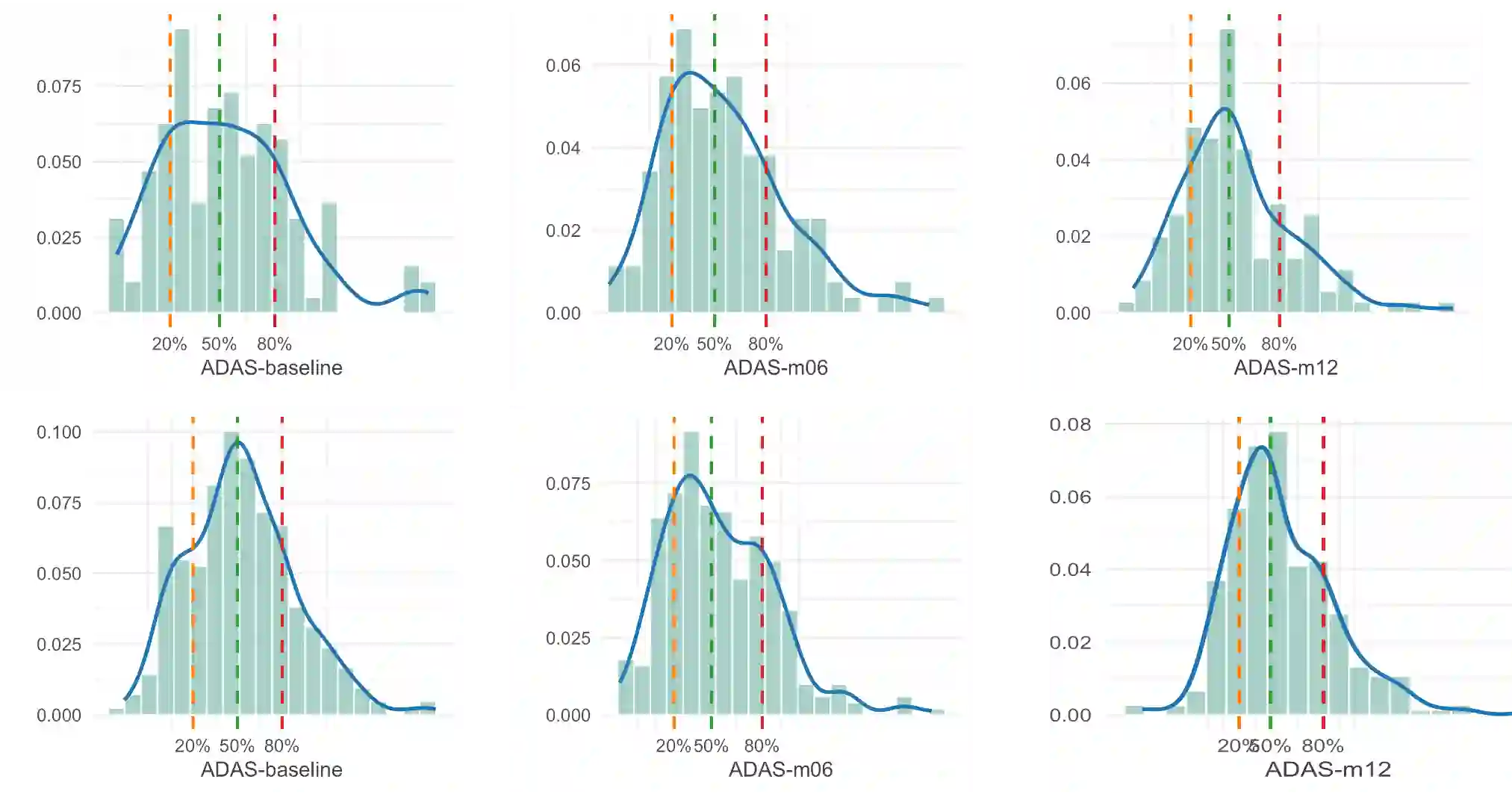
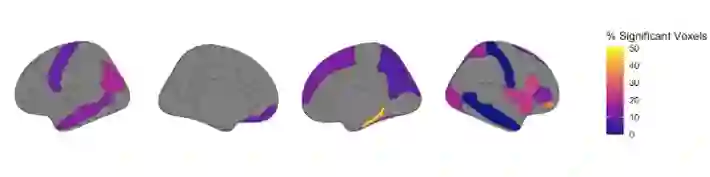
As a general and robust alternative to traditional mean regression models, quantile regression avoids the assumption of normally distributed errors, making it a versatile choice when modeling outcomes such as cognitive scores that typically have skewed distributions. Motivated by an application to Alzheimer's disease data where the aim is to explore how brain-behavior associations change over time, we propose a novel Bayesian tensor quantile regression for high-dimensional longitudinal imaging data. The proposed approach distinguishes between effects that are consistent across visits and patterns unique to each visit, contributing to the overall longitudinal trajectory. A low-rank decomposition is employed on the tensor coefficients which reduces dimensionality and preserves spatial configurations of the imaging voxels. We incorporate multiway shrinkage priors to model the visit-invariant tensor coefficients and variable selection priors on the tensor margins of the visit-specific effects. For posterior inference, we develop a computationally efficient Markov chain Monte Carlo sampling algorithm. Simulation studies reveal significant improvements in parameter estimation, feature selection, and prediction performance when compared with existing approaches. In the analysis of the Alzheimer's disease data, the flexibility of our modeling approach brings new insights as it provides a fuller picture of the relationship between the imaging voxels and the quantile distributions of the cognitive scores.
翻译:作为传统均值回归模型的通用且稳健的替代方案,分位数回归避免了误差正态分布的假设,使其成为建模认知分数等通常具有偏态分布结果时的通用选择。受阿尔茨海默病数据应用的启发——其目标是探索脑-行为关联如何随时间变化,我们针对高维纵向影像数据提出了一种新颖的贝叶斯张量分位数回归方法。所提出的方法能够区分跨访视一致的效应与每次访视特有的模式,这些共同构成了整体的纵向轨迹。通过对张量系数采用低秩分解来降低维度并保持影像体素的空间结构。我们引入多向收缩先验对访视不变张量系数进行建模,并在访视特异性效应的张量边缘上采用变量选择先验。对于后验推断,我们开发了一种计算高效的马尔可夫链蒙特卡洛抽样算法。仿真研究表明,与现有方法相比,本方法在参数估计、特征选择和预测性能方面均有显著提升。在阿尔茨海默病数据分析中,我们建模方法的灵活性提供了影像体素与认知分数分位数分布之间更完整的关系图景,从而带来了新的见解。




相关内容


 微信扫码咨询专知VIP会员