

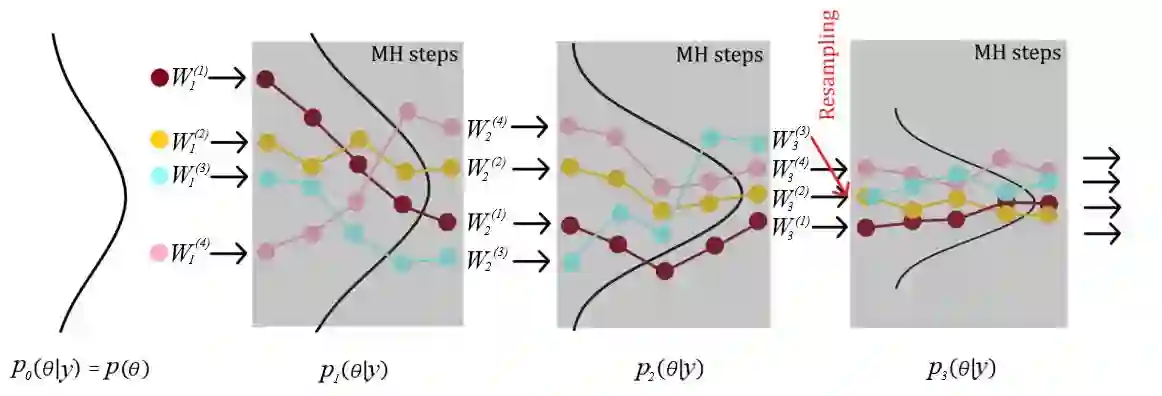
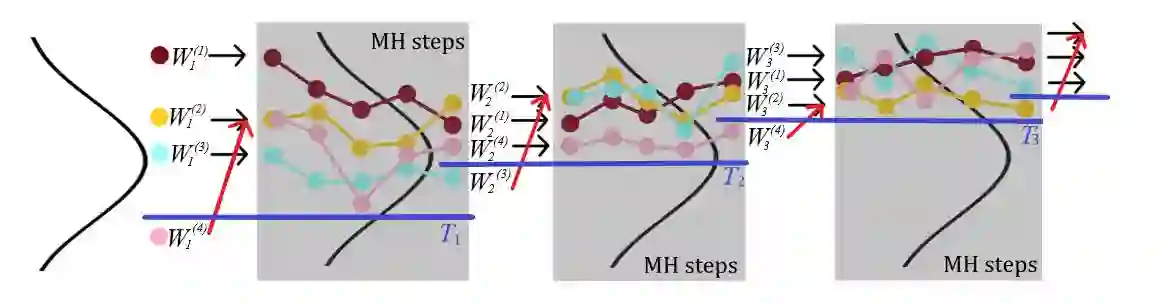
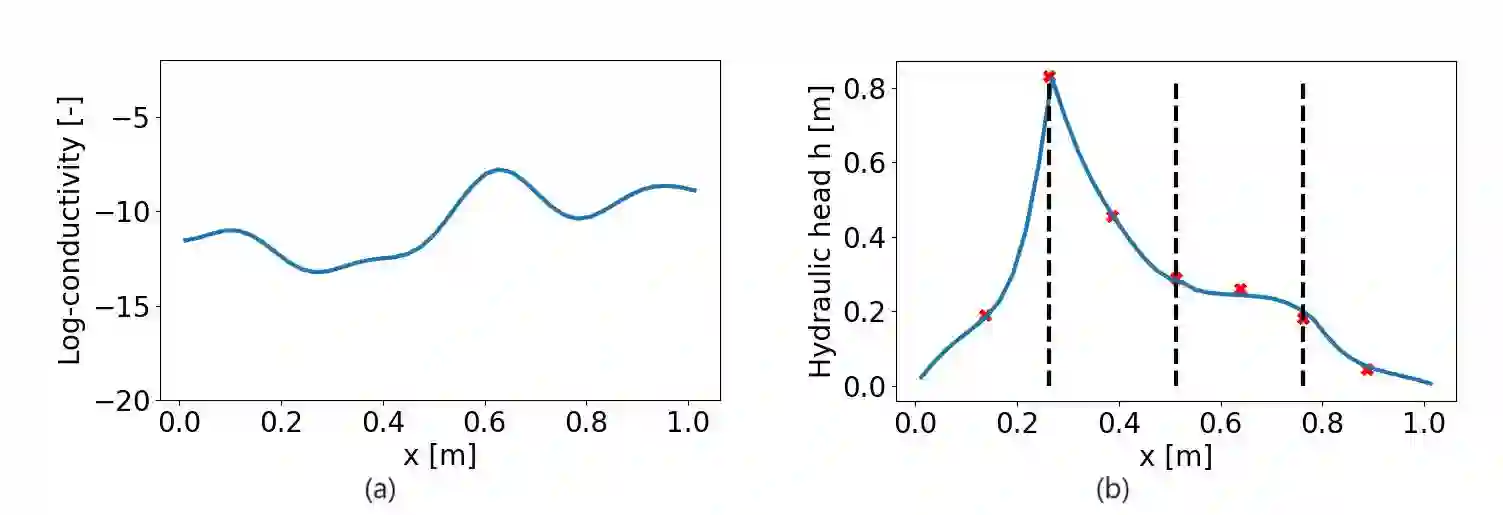
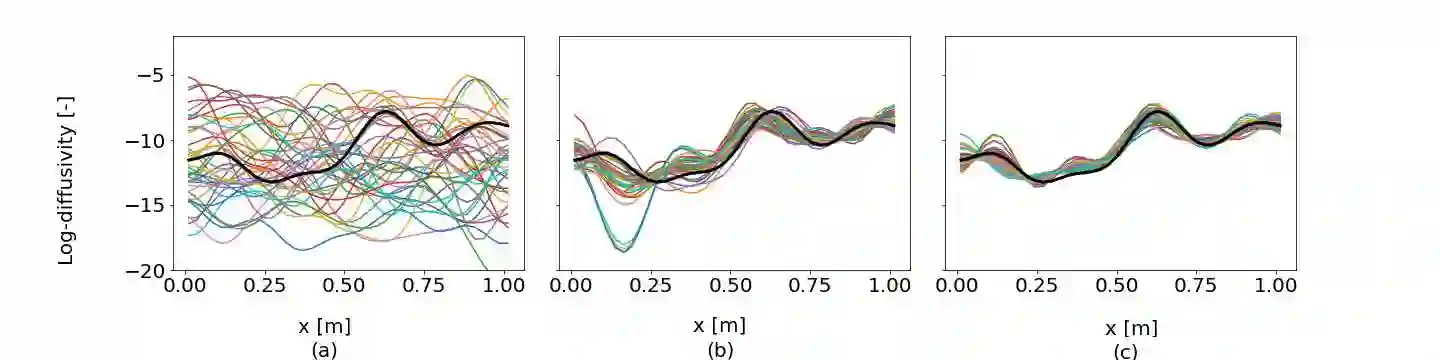
Bayesian inversions followed by estimations of rare event probabilities are often needed to analyse groundwater hazards. Instead of focusing on the posterior distribution of model parameters, the main interest lies then in the distribution of a specific quantity of interest contingent upon these parameters. To address the associated methodological challenges, we introduce a two-stage Sequential Monte Carlo approach. In the first stage, it generates particles that approximate the posterior distribution; in the second stage, it employs subset sampling techniques to assess the probability of the rare event of interest. By considering two hydrogeological problems of increasing complexity, we showcase the efficiency and accuracy of the resulting PostRisk-SMC method for rare event probability estimation related to groundwater hazards. We compare the performance of the PostRisk-SMC method with a traditional Monte Carlo approach that relies on Markov chain Monte Carlo samples. We showcase that our estimates align with those of the traditional method, but the coefficients of variation are notably lower for the same computational budget when targeting more rare events. Furthermore, we highlight that the PostRisk-SMC method allows estimating rare event probabilities approaching one in a billion using less than one hundred thousand forward simulations. Even if the presented examples are related to groundwater hazards, the methodology is well-suited for addressing a wide range of topics in the geosciences and beyond.
翻译:在分析地下水危害时,常需在贝叶斯反演后估计罕见事件概率。此时主要关注的是模型参数条件下一特定目标量的分布,而非参数后验分布本身。为应对相关方法论挑战,我们提出一种两阶段序贯蒙特卡洛方法。第一阶段生成近似后验分布的粒子;第二阶段采用子集抽样技术评估目标罕见事件的概率。通过考虑两个复杂度递增的水文地质问题,我们展示了所提PostRisk-SMC方法在地下水危害相关罕见事件概率估计中的高效性与准确性。我们将PostRisk-SMC方法与依赖马尔可夫链蒙特卡洛样本的传统蒙特卡洛方法进行比较,结果表明:两者估计值一致,但在相同计算预算下针对更罕见事件时,PostRisk-SMC方法的变异系数显著更低。此外,我们强调PostRisk-SMC方法能够利用少于十万次正向模拟,估计概率接近十亿分之一的罕见事件。尽管示例涉及地下水危害问题,该方法同样适用于地球科学及其他领域的广泛课题。




相关内容



 微信扫码咨询专知VIP会员