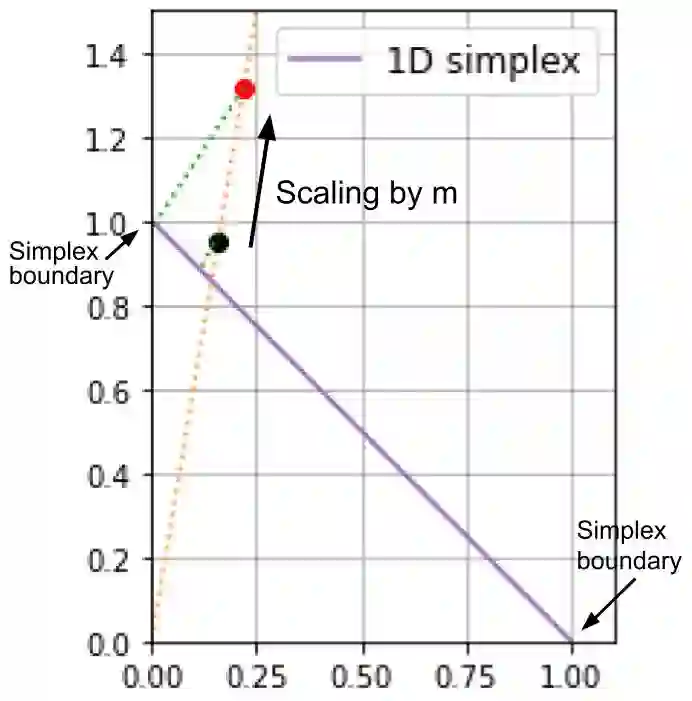
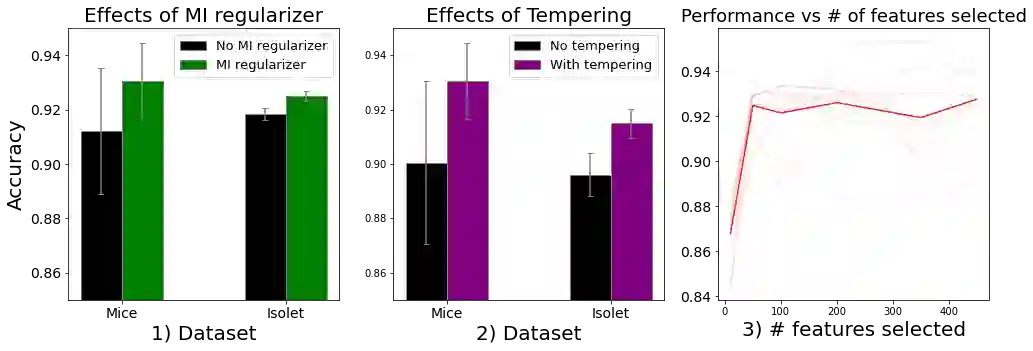
Feature selection has been widely used to alleviate compute requirements during training, elucidate model interpretability, and improve model generalizability. We propose SLM -- Sparse Learnable Masks -- a canonical approach for end-to-end feature selection that scales well with respect to both the feature dimension and the number of samples. At the heart of SLM lies a simple but effective learnable sparse mask, which learns which features to select, and gives rise to a novel objective that provably maximizes the mutual information (MI) between the selected features and the labels, which can be derived from a quadratic relaxation of mutual information from first principles. In addition, we derive a scaling mechanism that allows SLM to precisely control the number of features selected, through a novel use of sparsemax. This allows for more effective learning as demonstrated in ablation studies. Empirically, SLM achieves state-of-the-art results against a variety of competitive baselines on eight benchmark datasets, often by a significant margin, especially on those with real-world challenges such as class imbalance.


翻译:特征选择已被广泛用于降低训练过程中的计算需求、提升模型可解释性以及改善模型泛化能力。本文提出SLM——稀疏可学习掩码(Sparse Learnable Masks)——一种具有良好可扩展性的端到端特征选择规范方法,既能处理高维特征空间,也适用于大规模样本场景。SLM的核心是一个简单但有效的可学习稀疏掩码,该掩码通过学习确定需要选择的特征,并将其融入一个新型目标函数,该函数可被证明能够最大化所选特征与标签之间的互信息(MI)。这一目标函数可通过互信息的二次松弛从基本原理推导得出。此外,我们设计了一种缩放机制,利用sparsemax的创新应用,使SLM能够精确控制所选特征的数量。消融实验表明,该机制有助于实现更高效的学习。在八个基准数据集上,SLM相较于多种具有竞争力的基线方法取得了最先进的结果,尤其在面临类别不平衡等现实挑战的数据集上,性能优势更为显著。
0
下载
关闭预览

相关内容

特征选择( Feature Selection )也称特征子集选择( Feature Subset Selection , FSS ),或属性选择( Attribute Selection )。是指从已有的M个特征(Feature)中选择N个特征使得系统的特定指标最优化,是从原始特征中选择出一些最有效特征以降低数据集维度的过程,是提高学习算法性能的一个重要手段,也是模式识别中关键的数据预处理步骤。对于一个学习算法来说,好的学习样本是训练模型的关键。
【RecSys22教程】多阶段推荐系统的神经重排序,90页ppt
专知会员服务
27+阅读 · 2022年9月30日
强化学习最新教程,17页pdf
专知会员服务
182+阅读 · 2019年10月11日
Hierarchically Structured Meta-learning
CreateAMind
27+阅读 · 2019年5月22日
Transferring Knowledge across Learning Processes
CreateAMind
29+阅读 · 2019年5月18日
深度自进化聚类:Deep Self-Evolution Clustering
我爱读PAMI
15+阅读 · 2019年4月13日
强化学习的Unsupervised Meta-Learning
CreateAMind
18+阅读 · 2019年1月7日
无监督元学习表示学习
CreateAMind
27+阅读 · 2019年1月4日
Unsupervised Learning via Meta-Learning
CreateAMind
44+阅读 · 2019年1月3日
国家自然科学基金
0+阅读 · 2013年12月31日
国家自然科学基金
9+阅读 · 2013年12月31日
国家自然科学基金
3+阅读 · 2013年12月31日
国家自然科学基金
0+阅读 · 2012年12月31日
国家自然科学基金
1+阅读 · 2012年12月31日
国家自然科学基金
0+阅读 · 2012年12月31日
国家自然科学基金
0+阅读 · 2012年12月31日
国家自然科学基金
0+阅读 · 2012年12月31日
国家自然科学基金
0+阅读 · 2011年12月31日
国家自然科学基金
0+阅读 · 2009年12月31日
Arxiv
0+阅读 · 2023年5月22日
Arxiv
13+阅读 · 2022年10月20日
Self-Attention Graph Pooling
Arxiv
13+阅读 · 2019年6月13日
VIP会员
最新内容
ICML 2026 | CFPO:用反事实策略优化提升多模态推理
专知会员服务
1+阅读 · 今天14:45
综述 | 世界动作模型:少做梦,多行动
专知会员服务
2+阅读 · 今天14:43
美以伊冲突:无人机与人工智能的运用
专知会员服务
4+阅读 · 今天14:31
《特种部队在透明战场中的生存力》最新报告
专知会员服务
3+阅读 · 今天14:11
《人工智能生成的零日漏洞:对未来作战的影响》
综述 | 3D场景图:开放挑战与未来方向
专知会员服务
8+阅读 · 6月22日
21世纪的无人机战争
专知会员服务
4+阅读 · 6月22日
《量子技术的军事任务技术适配与利用》
专知会员服务
5+阅读 · 6月22日
相关基金
国家自然科学基金
0+阅读 · 2013年12月31日
国家自然科学基金
9+阅读 · 2013年12月31日
国家自然科学基金
3+阅读 · 2013年12月31日
国家自然科学基金
0+阅读 · 2012年12月31日
国家自然科学基金
1+阅读 · 2012年12月31日
国家自然科学基金
0+阅读 · 2012年12月31日
国家自然科学基金
0+阅读 · 2012年12月31日
国家自然科学基金
0+阅读 · 2012年12月31日
国家自然科学基金
0+阅读 · 2011年12月31日
国家自然科学基金
0+阅读 · 2009年12月31日
Top
微信扫码咨询专知VIP会员