

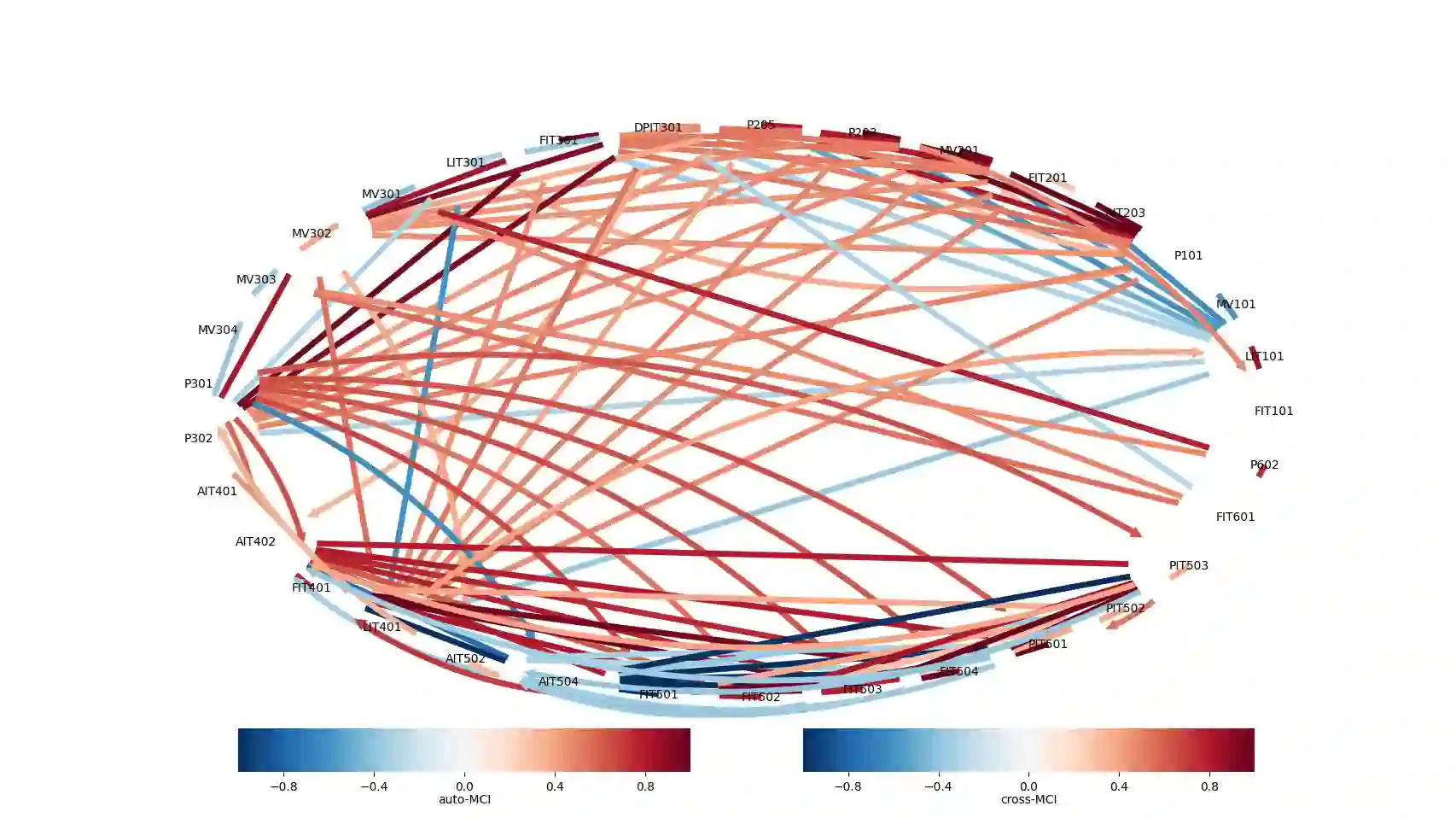
Online unsupervised detection of anomalies is crucial to guarantee the correct operation of cyber-physical systems and the safety of humans interacting with them. State-of-the-art approaches based on deep learning via neural networks achieve outstanding performance at anomaly recognition, evaluating the discrepancy between a normal model of the system (with no anomalies) and the real-time stream of sensor time series. However, large training data and time are typically required, and explainability is still a challenge to identify the root of the anomaly and implement predictive maintainance. In this paper, we use causal discovery to learn a normal causal graph of the system, and we evaluate the persistency of causal links during real-time acquisition of sensor data to promptly detect anomalies. On two benchmark anomaly detection datasets, we show that our method has higher training efficiency, outperforms the accuracy of state-of-the-art neural architectures and correctly identifies the sources of $>10$ different anomalies. The code for experimental replication is at http://tinyurl.com/case24causal.
翻译:在线无监督异常检测对于保障信息物理系统的正确运行及与其交互的人员安全至关重要。基于神经网络深度学习的先进方法在异常识别方面表现卓越,其通过评估系统正常模型(无异常)与传感器时间序列实时流之间的差异来实现。然而,这类方法通常需要大量训练数据与时间,且可解释性仍是识别异常根源并实施预测性维护的挑战。本文利用因果发现技术学习系统的正常因果图,并通过评估传感器数据实时采集过程中因果链接的持续性来及时检测异常。在两个基准异常检测数据集上的实验表明,本方法具有更高的训练效率,其准确率优于先进的神经架构,并能正确识别超过10种不同类型异常的根源。实验复现代码位于 http://tinyurl.com/case24causal。




相关内容




 微信扫码咨询专知VIP会员