

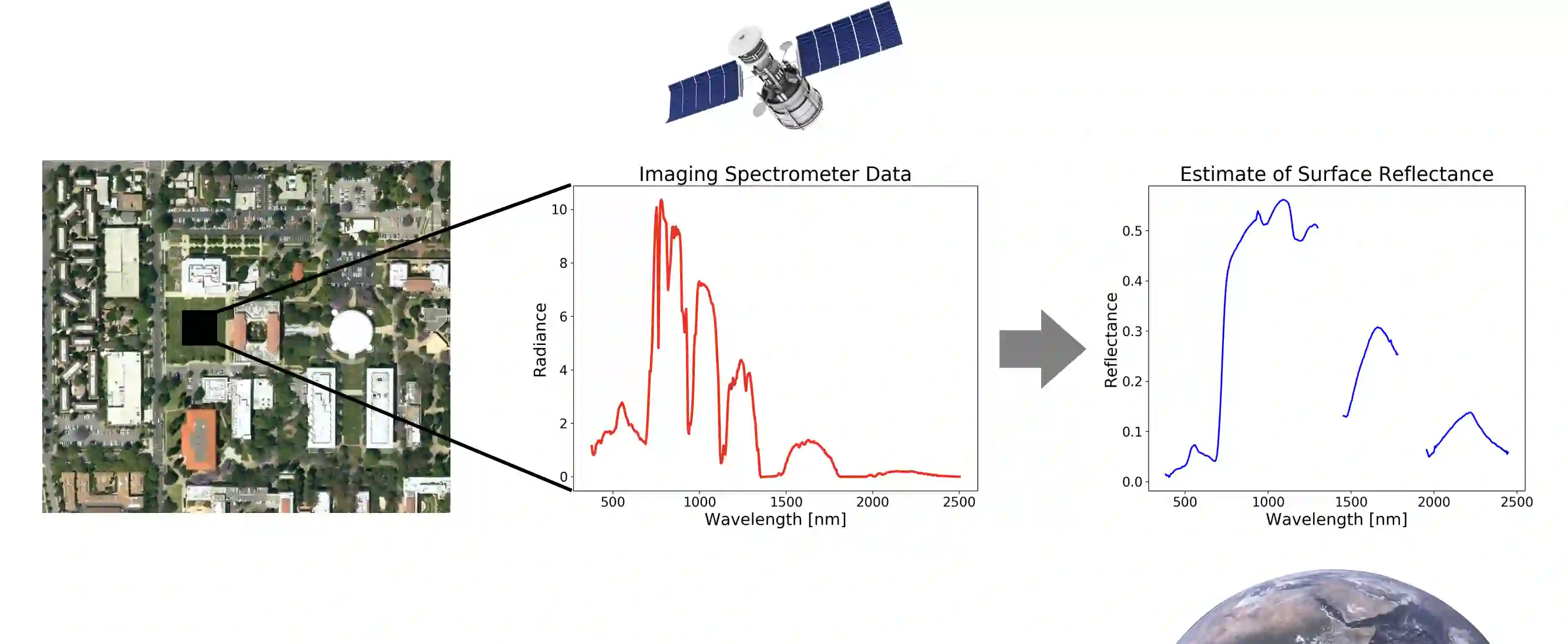
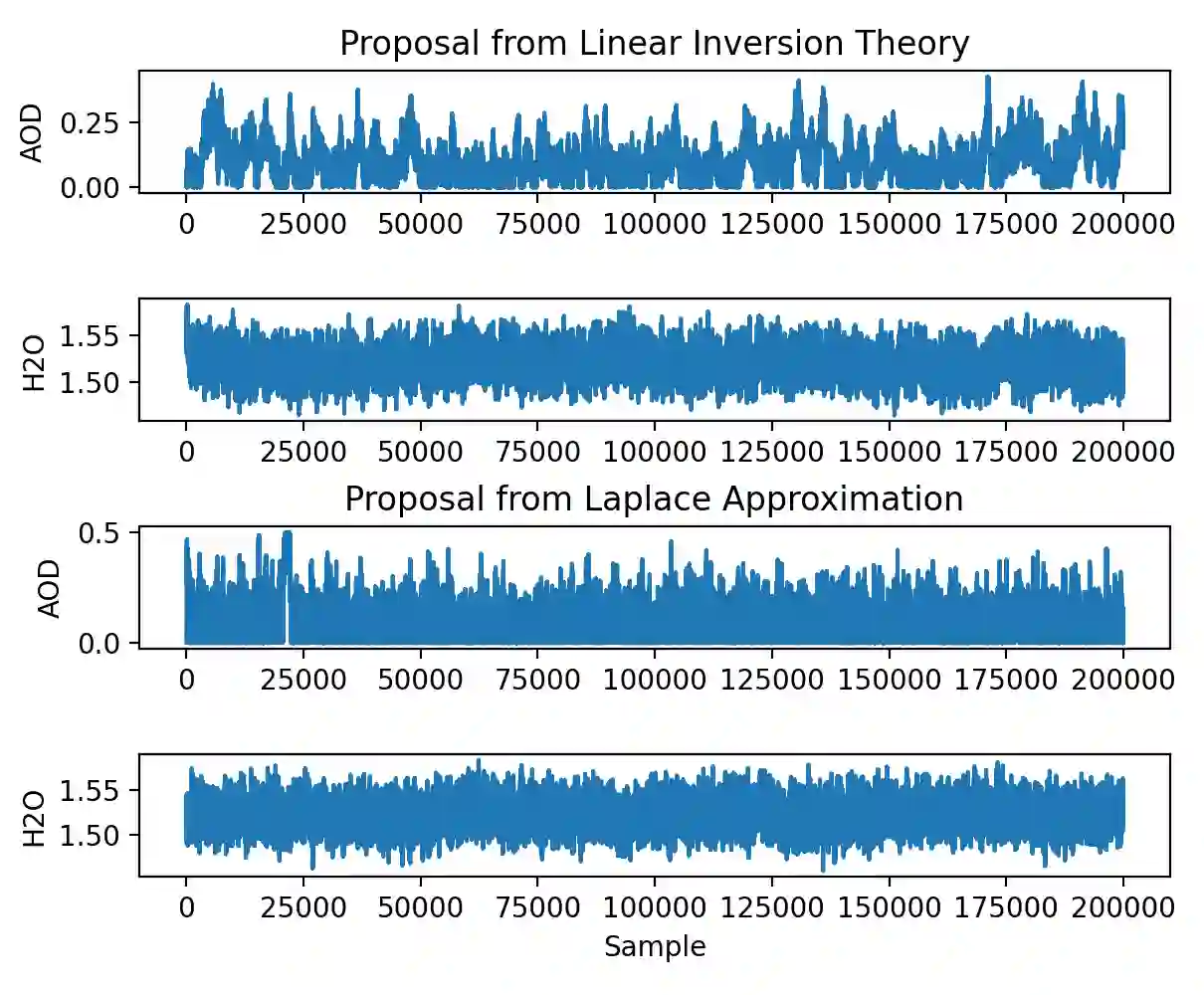
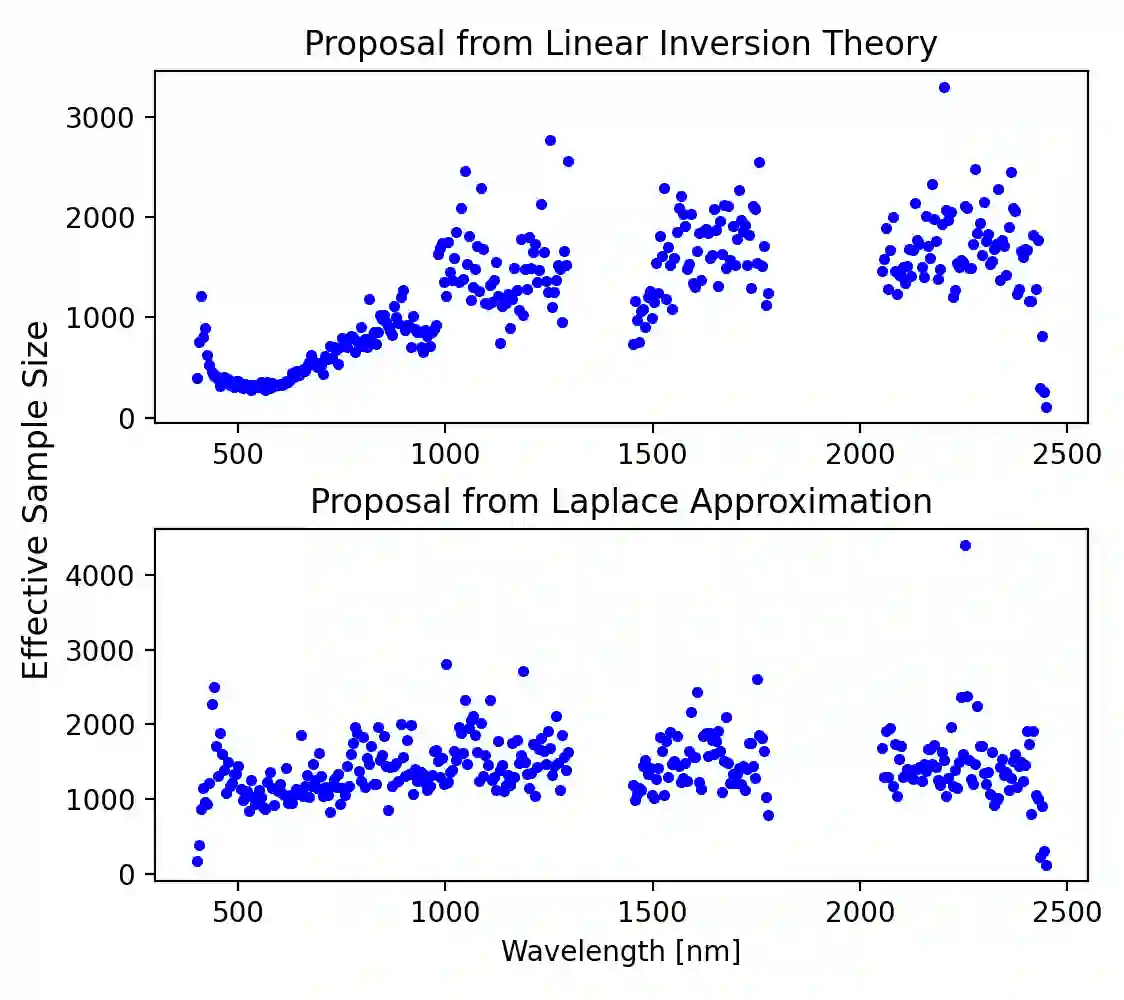
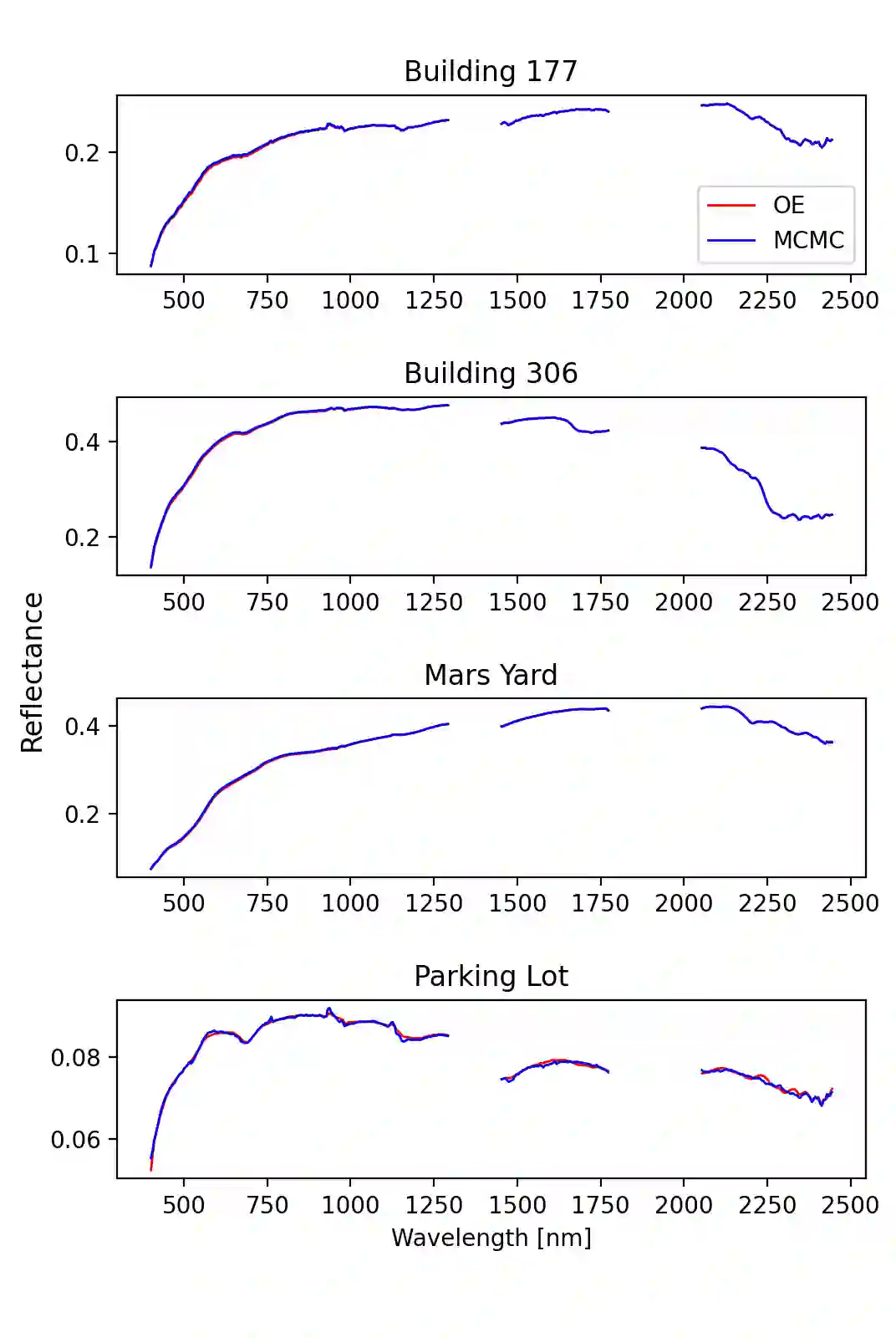
The joint retrieval of surface reflectances and atmospheric parameters in VSWIR imaging spectroscopy is a computationally challenging high-dimensional problem. Using NASA's Surface Biology and Geology mission as the motivational context, the uncertainty associated with the retrievals is crucial for further application of the retrieved results for environmental applications. Although Markov chain Monte Carlo (MCMC) is a Bayesian method ideal for uncertainty quantification, the full-dimensional implementation of MCMC for the retrieval is computationally intractable. In this work, we developed a block Metropolis MCMC algorithm for the high-dimensional VSWIR surface reflectance retrieval that leverages the structure of the forward radiative transfer model to enable tractable fully Bayesian computation. We use the posterior distribution from this MCMC algorithm to assess the limitations of optimal estimation, the state-of-the-art Bayesian algorithm in operational retrievals which is more computationally efficient but uses a Gaussian approximation to characterize the posterior. Analyzing the differences in the posterior computed by each method, the MCMC algorithm was shown to give more physically sensible results and reveals the non-Gaussian structure of the posterior, specifically in the atmospheric aerosol optical depth parameter and the low-wavelength surface reflectances.
翻译:VSWIR成像光谱中表面反射率与大气参数的联合反演是一个计算上具有挑战性的高维问题。以NASA表面生物学与地质学任务为应用背景,反演结果的不确定性对于后续环境应用至关重要。尽管马尔可夫链蒙特卡洛(MCMC)是适用于不确定性量化的贝叶斯方法,但针对该反演问题的全维MCMC在计算上难以实现。本研究开发了一种块状Metropolis MCMC算法,用于高维VSWIR表面反射率反演,该算法利用前向辐射传输模型的结构特性,实现了可操作的完全贝叶斯计算。我们利用该MCMC算法得到的后验分布,评估了最优估计方法的局限性——后者作为当前业务反演中的先进贝叶斯算法,虽计算效率更高,但采用高斯近似表征后验分布。通过分析两种方法计算的后验差异,MCMC算法能给出更具物理合理性的结果,并揭示后验分布的非高斯结构特征,具体体现在大气气溶胶光学厚度参数和低波长表面反射率参数中。




相关内容





 微信扫码咨询专知VIP会员