

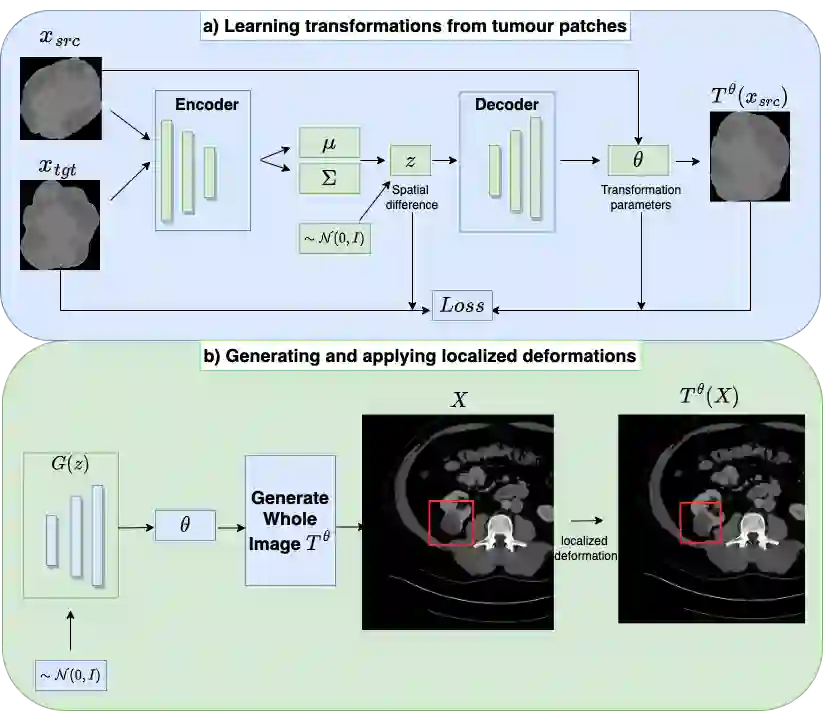
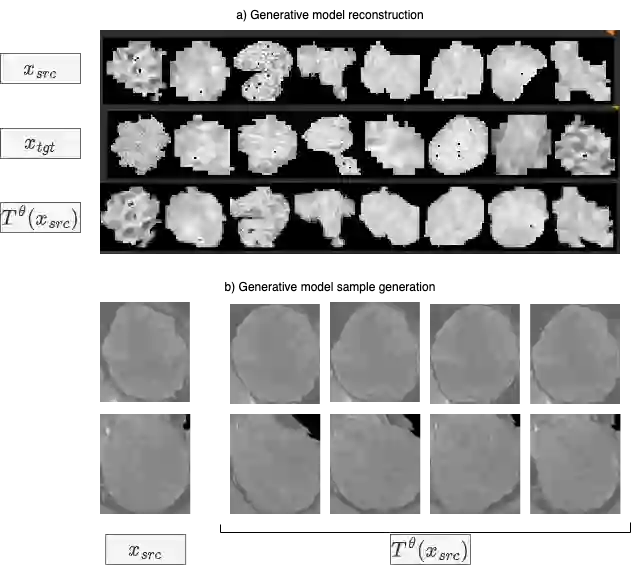
Obtaining labelled data in medical image segmentation is challenging due to the need for pixel-level annotations by experts. Recent works have shown that augmenting the object of interest with deformable transformations can help mitigate this challenge. However, these transformations have been learned globally for the image, limiting their transferability across datasets or applicability in problems where image alignment is difficult. While object-centric augmentations provide a great opportunity to overcome these issues, existing works are only focused on position and random transformations without considering shape variations of the objects. To this end, we propose a novel object-centric data augmentation model that is able to learn the shape variations for the objects of interest and augment the object in place without modifying the rest of the image. We demonstrated its effectiveness in improving kidney tumour segmentation when leveraging shape variations learned both from within the same dataset and transferred from external datasets.
翻译:在医学图像分割中获取标记数据具有挑战性,因为需要专家进行像素级标注。最近的研究表明,对感兴趣目标进行可变形变换的数据增强有助于缓解这一难题。然而,这些变换通常是对整幅图像进行全局学习的,限制了其在跨数据集间的可迁移性或应用于图像配准困难问题时的适用性。虽然以对象为中心的数据增强为克服这些问题提供了重要机遇,但现有工作仅关注位置和随机变换,未考虑目标的形状变化。为此,我们提出了一种新颖的以对象为中心的数据增强模型,该模型能够学习感兴趣目标的形状变化,并在不改变图像其余部分的情况下对目标进行原位增强。我们通过在内部数据集学习以及从外部数据集迁移的形状变化来改善肾脏肿瘤分割的效果,验证了该模型的有效性。




相关内容



 微信扫码咨询专知VIP会员