

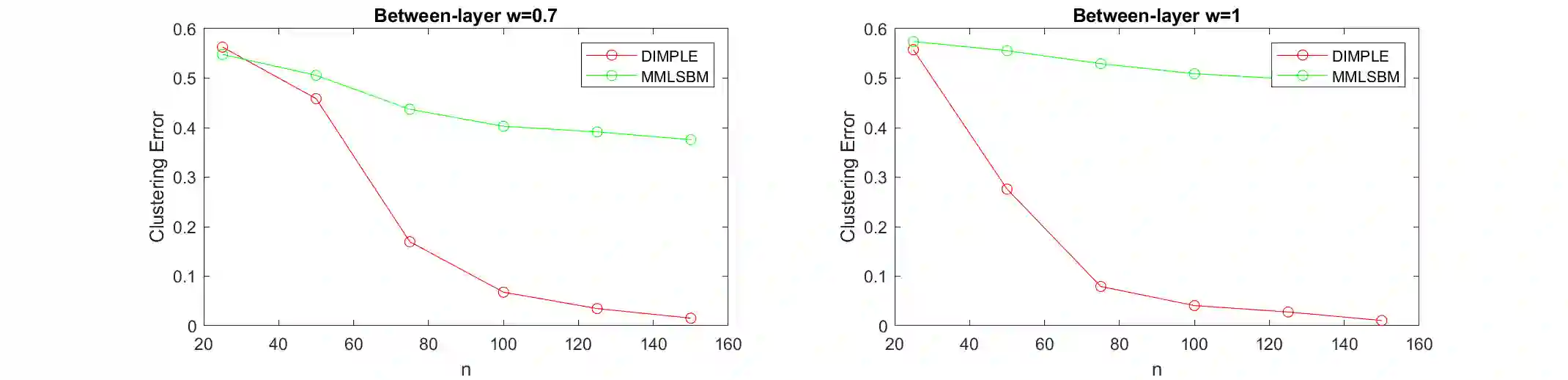
The paper introduces the DIverse MultiPLEx Generalized Dot Product Graph (DIMPLE-GDPG) network model where all layers of the network have the same collection of nodes and follow the Generalized Dot Product Graph (GDPG) model. In addition, all layers can be partitioned into groups such that the layers in the same group are embedded in the same ambient subspace but otherwise all matrices of connection probabilities can be different. In a common particular case, where layers of the network follow the Stochastic Block Model (SBM), this setting implies that the groups of layers have common community structures but all matrices of block connection probabilities can be different. We refer to this version as the DIMPLE model. While the DIMPLE-GDPG model generalizes the COmmon Subspace Independent Edge (COSIE) random graph model developed in \cite{JMLR:v22:19-558}, the DIMPLE model includes a wide variety of SBM-equipped multilayer network models as its particular cases. In the paper, we introduce novel algorithms for the recovery of similar groups of layers, for the estimation of the ambient subspaces in the groups of layers in the DIMPLE-GDPG setting, and for the within-layer clustering in the case of the DIMPLE model. We study the accuracy of those algorithms, both theoretically and via computer simulations. The advantages of the new models are demonstrated using real data examples.
翻译:本文引入了多样多层广义点积图(DIMPLE-GDPG)网络模型,其中网络的所有层共享相同的节点集合,并遵循广义点积图(GDPG)模型。此外,所有层可被划分为不同组,使得同一组内的层嵌入相同的本底子空间,但所有连接概率矩阵可以各不相同。在一个常见的特例中,当网络层遵循随机分块模型(SBM)时,该设置意味着层组具有共同的社区结构,但所有分块连接概率矩阵可以不同。我们将此版本称为DIMPLE模型。DIMPLE-GDPG模型推广了文献[JMLR:v22:19-558]中提出的公共子空间独立边(COSIE)随机图模型,而DIMPLE模型则将多种基于SBM的多层网络模型作为其特例。本文针对DIMPLE-GDPG设置,提出了用于恢复相似层组的新算法、估计层组本底子空间的新算法,以及在DIMPLE模型情况下的层内聚类新算法。我们通过理论分析与计算机模拟研究了这些算法的精确性,并利用真实数据示例展示了新模型的优势。




相关内容



 微信扫码咨询专知VIP会员