

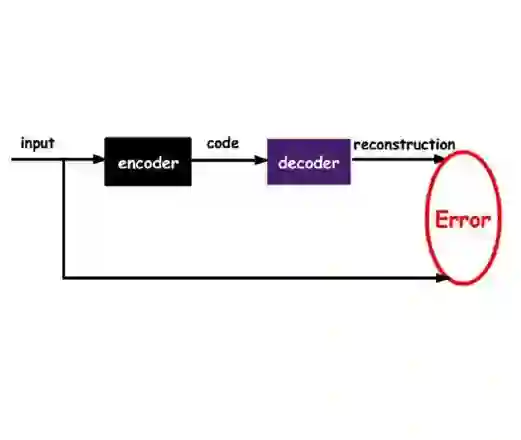
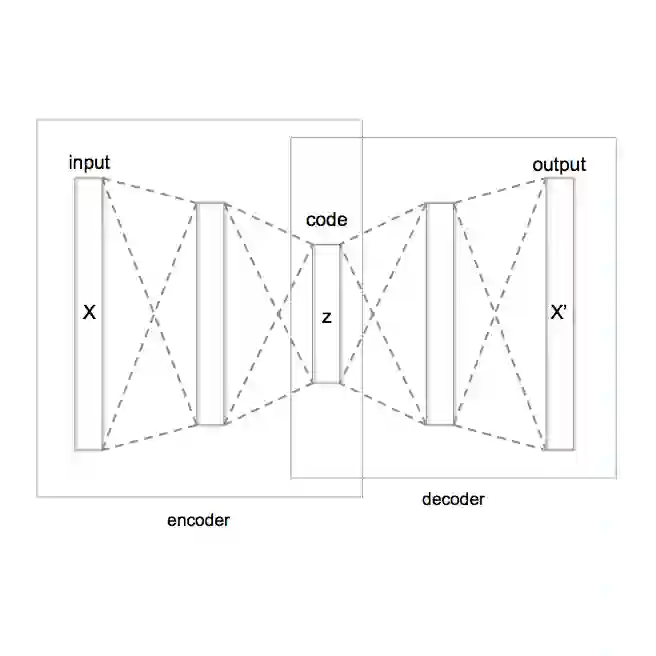
Detecting navigable space is a fundamental capability for mobile robots navigating in unknown or unmapped environments. In this work, we treat visual navigable space segmentation as a scene decomposition problem and propose Polyline Segmentation Variational autoencoder Network (PSV-Net), a representation learning-based framework for learning the navigable space segmentation in a self-supervised manner. Current segmentation techniques heavily rely on fully-supervised learning strategies which demand a large amount of pixel-level annotated images. In this work, we propose a framework leveraging a Variational AutoEncoder (VAE) and an AutoEncoder (AE) to learn a polyline representation that compactly outlines the desired navigable space boundary. Through extensive experiments, we validate that the proposed PSV-Net can learn the visual navigable space with no or few labels, producing an accuracy comparable to fully-supervised state-of-the-art methods that use all available labels. In addition, we show that integrating the proposed navigable space segmentation model with a visual planner can achieve efficient mapless navigation in real environments.
翻译:在未知或无地图环境中导航时,可通行空间检测是移动机器人的基本能力。本文从场景分解的视角出发,将视觉可通行空间分割问题重新定义,并提出了多段线分割变分自编码器网络(PSV-Net),这是一种基于表示学习的自监督框架,用于学习可通行空间分割。当前的分割技术高度依赖全监督学习策略,需要大量像素级标注图像。本研究提出一种利用变分自编码器(VAE)和自编码器(AE)的框架,通过学习紧凑的多段线表示来勾勒可通行空间边界。大量实验表明,所提出的PSV-Net能够在无标签或少量标签条件下学习视觉可通行空间,其精度可与使用全部标签的全监督最先进方法相媲美。此外,我们证明将该可通行空间分割模型与视觉规划器相结合,能够在真实环境中实现高效的无地图导航。




相关内容


 微信扫码咨询专知VIP会员