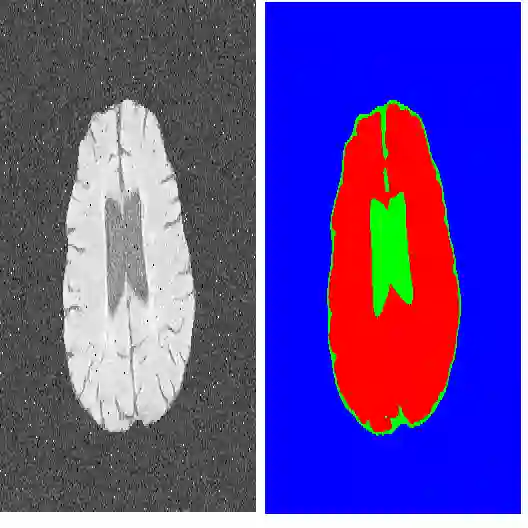
Deep learning has achieved tremendous success in computer vision, while medical image segmentation (MIS) remains a challenge, due to the scarcity of data annotations. Meta-learning techniques for few-shot segmentation (Meta-FSS) have been widely used to tackle this challenge, while they neglect possible distribution shifts between the query image and the support set. In contrast, an experienced clinician can perceive and address such shifts by borrowing information from the query image, then fine-tune or calibrate her prior cognitive model accordingly. Inspired by this, we propose Q-Net, a Query-informed Meta-FSS approach, which mimics in spirit the learning mechanism of an expert clinician. We build Q-Net based on ADNet, a recently proposed anomaly detection-inspired method. Specifically, we add two query-informed computation modules into ADNet, namely a query-informed threshold adaptation module and a query-informed prototype refinement module. Combining them with a dual-path extension of the feature extraction module, Q-Net achieves state-of-the-art performance on widely used abdominal and cardiac magnetic resonance (MR) image datasets. Our work sheds light on a novel way to improve Meta-FSS techniques by leveraging query information.


翻译:深度学习在计算机视觉领域取得了巨大成功,然而由于数据标注的稀缺性,医学图像分割(MIS)仍然是一项挑战。针对小样本分割的元学习技术(Meta-FSS)已被广泛用于应对这一挑战,但这类方法忽略了查询图像与支持集之间可能存在的分布偏移。相比之下,经验丰富的临床医生能够通过从查询图像中借鉴信息来感知并解决此类偏移,从而相应地对自身先验认知模型进行微调或校准。受此启发,我们提出Q-Net——一种查询信息驱动的元小样本学习方法,其本质模拟了专家临床医生的学习机制。我们基于ADNet(一种近期提出的基于异常检测的方法)构建Q-Net。具体而言,我们在ADNet中添加了两个查询信息驱动的计算模块,即查询信息驱动的阈值自适应模块和查询信息驱动的原型精炼模块。通过将它们与特征提取模块的双路径扩展相结合,Q-Net在广泛使用的腹部和心脏磁共振(MR)图像数据集上达到了最先进的性能。我们的研究揭示了通过利用查询信息改进元小样本分割技术的一种新途径。


0
下载
关闭预览

相关内容

小样本学习(Few-Shot Learning,以下简称 FSL )用于解决当可用的数据量比较少时,如何提升神经网络的性能。在 FSL 中,经常用到的一类方法被称为 Meta-learning。和普通的神经网络的训练方法一样,Meta-learning 也包含训练过程和测试过程,但是它的训练过程被称作 Meta-training 和 Meta-testing。
自然语言处理顶会NAACL2022最佳论文出炉!
专知会员服务
43+阅读 · 2022年6月30日
100+篇《自监督学习(Self-Supervised Learning)》论文最新合集
专知会员服务
167+阅读 · 2020年3月18日
[综述]深度学习下的场景文本检测与识别
专知会员服务
78+阅读 · 2019年10月10日
机器学习入门的经验与建议
专知会员服务
94+阅读 · 2019年10月10日
【哈佛大学商学院课程Fall 2019】机器学习可解释性
专知会员服务
105+阅读 · 2019年10月9日
【SIGGRAPH2019】TensorFlow 2.0深度学习计算机图形学应用
专知会员服务
41+阅读 · 2019年10月9日
强化学习三篇论文 避免遗忘等
CreateAMind
20+阅读 · 2019年5月24日
Hierarchically Structured Meta-learning
CreateAMind
27+阅读 · 2019年5月22日
Transferring Knowledge across Learning Processes
CreateAMind
29+阅读 · 2019年5月18日
强化学习的Unsupervised Meta-Learning
CreateAMind
18+阅读 · 2019年1月7日
Unsupervised Learning via Meta-Learning
CreateAMind
44+阅读 · 2019年1月3日
A Technical Overview of AI & ML in 2018 & Trends for 2019
待字闺中
18+阅读 · 2018年12月24日
【论文】变分推断(Variational inference)的总结
机器学习研究会
39+阅读 · 2017年11月16日
国家自然科学基金
0+阅读 · 2016年12月31日
国家自然科学基金
1+阅读 · 2014年12月31日
国家自然科学基金
0+阅读 · 2013年12月31日
国家自然科学基金
1+阅读 · 2013年12月31日
国家自然科学基金
0+阅读 · 2012年12月31日
国家自然科学基金
0+阅读 · 2012年12月31日
国家自然科学基金
0+阅读 · 2011年12月31日
国家自然科学基金
0+阅读 · 2009年12月31日
国家自然科学基金
0+阅读 · 2008年12月31日
VIP会员
最新内容
综述 | 世界动作模型:少做梦,多行动
专知会员服务
3+阅读 · 6月23日
美以伊冲突:无人机与人工智能的运用
专知会员服务
5+阅读 · 6月23日
《特种部队在透明战场中的生存力》最新报告
专知会员服务
4+阅读 · 6月23日
综述 | 3D场景图:开放挑战与未来方向
专知会员服务
8+阅读 · 6月22日
21世纪的无人机战争
专知会员服务
4+阅读 · 6月22日
《量子技术的军事任务技术适配与利用》
专知会员服务
5+阅读 · 6月22日
相关基金
国家自然科学基金
0+阅读 · 2016年12月31日
国家自然科学基金
1+阅读 · 2014年12月31日
国家自然科学基金
0+阅读 · 2013年12月31日
国家自然科学基金
1+阅读 · 2013年12月31日
国家自然科学基金
0+阅读 · 2012年12月31日
国家自然科学基金
0+阅读 · 2012年12月31日
国家自然科学基金
0+阅读 · 2011年12月31日
国家自然科学基金
0+阅读 · 2009年12月31日
国家自然科学基金
0+阅读 · 2008年12月31日
Top
微信扫码咨询专知VIP会员