

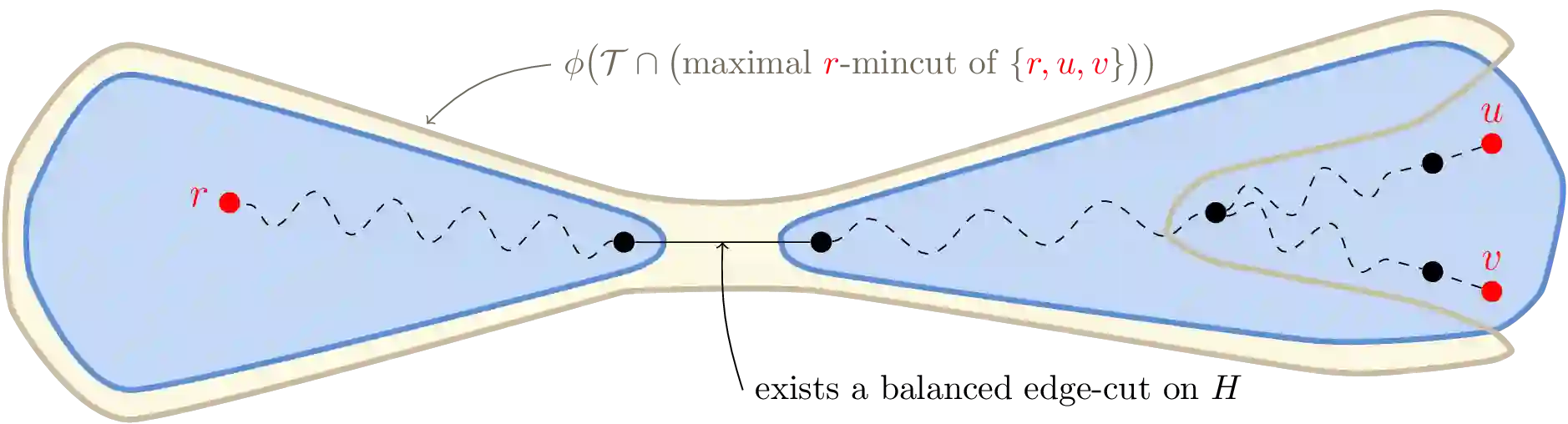
A cactus representation of a graph, introduced by Dinitz et al. in 1976, is an edge sparsifier of $O(n)$ size that exactly captures all global minimum cuts of the graph. It is a central combinatorial object that has been a key ingredient in almost all algorithms for the connectivity augmentation problems and for maintaining minimum cuts under edge insertions (e.g. [NGM97], [CKL+22], [Hen97]). This sparsifier was generalized to Steiner cactus for a vertex set $T$, which can be seen as a vertex sparsifier of $O(|T|)$ size that captures all partitions of $T$ corresponding to a $T$-Steiner minimum cut, and also hypercactus, an analogous concept in hypergraphs. These generalizations further extend the applications of cactus to the Steiner and hypergraph settings. In a long line of work on fast constructions of cactus and its generalizations, a near-linear time construction of cactus was shown by [Karger and Panigrahi 2009]. Unfortunately, their technique based on tree packing inherently does not generalize. The state-of-the-art algorithms for Steiner cactus and hypercactus are still slower than linear time by a factor of $\Omega(|T|)$ [DV94] and $\Omega(n)$ [CX17], respectively. We show how to construct both Steiner cactus and hypercactus using polylogarithmic calls to max flow, which gives the first almost-linear time algorithms of both problems. The constructions immediately imply almost-linear-time connectivity augmentation algorithms in the Steiner and hypergraph settings, as well as speed up the incremental algorithm for maintaining minimum cuts in hypergraphs by a factor of $n$. The key technique behind our result is a novel variant of the influential isolating mincut technique [LP20, AKL+21] which we called maximal isolating mincuts. This technique makes the isolating mincuts to be "more balanced" which, we believe, will likely be useful in future applications.
翻译:图的仙人掌表示由Dinitz等人于1976年提出,是一种大小为$O(n)$的边稀疏化结构,能够精确刻画图的所有全局最小割。作为核心组合对象,它几乎是所有连通性增强算法及边插入下最小割维护算法的关键要素(例如[NGM97]、[CKL+22]、[Hen97])。该稀疏化结构被推广到顶点集$T$的斯坦纳仙人掌(可视为大小为$O(|T|)$的顶点稀疏化结构,能捕获所有对应$T$-斯坦纳最小割的$T$划分)以及超图场景中的超仙人掌。这些推广进一步将仙人掌的应用扩展至斯坦纳与超图领域。在仙人掌及其推广的快速构造研究历程中,[Karger and Panigrahi 2009]提出了近线性时间构造方法,但基于树打包的技术本质上无法泛化。当前斯坦纳仙人掌与超仙人掌的最优算法仍分别比线性时间慢$\Omega(|T|)$倍[DV94]和$\Omega(n)$倍[CX17]。我们证明了通过多对数次最大流调用即可构造斯坦纳仙人掌与超仙人掌,首次为这两个问题提供了几乎线性时间的算法。该构造直接实现了斯坦纳与超图场景下的几乎线性时间连通性增强算法,并将超图最小割增量维护算法的复杂度提升$n$倍。我们结果的核心技术是对具有影响力的隔离最小割技术[LP20, AKL+21]的创新变体——最大隔离最小割,该方法使隔离最小割达到"更均衡"状态,我们相信这一特性在未来应用中具有重要潜力。





相关内容


 微信扫码咨询专知VIP会员