

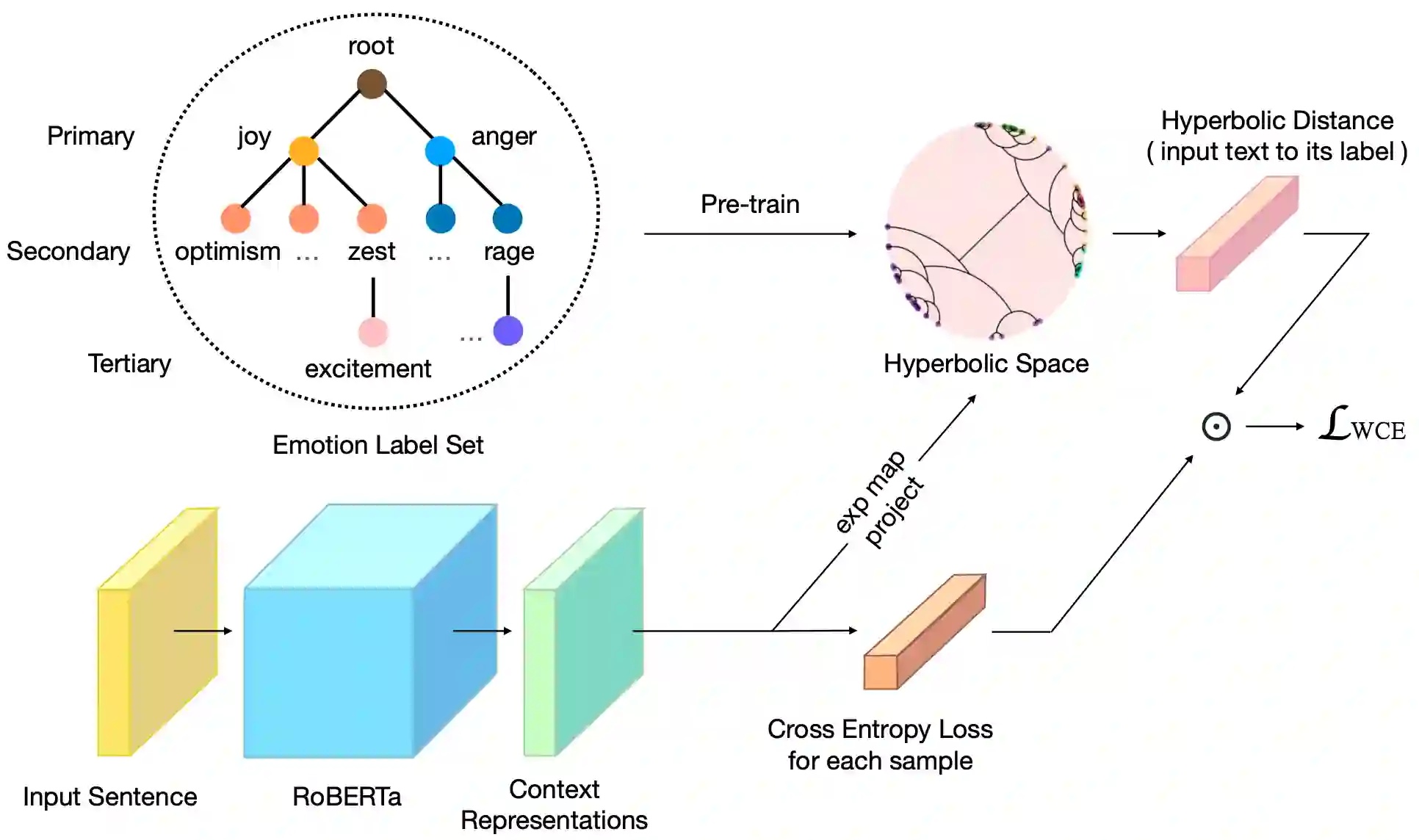
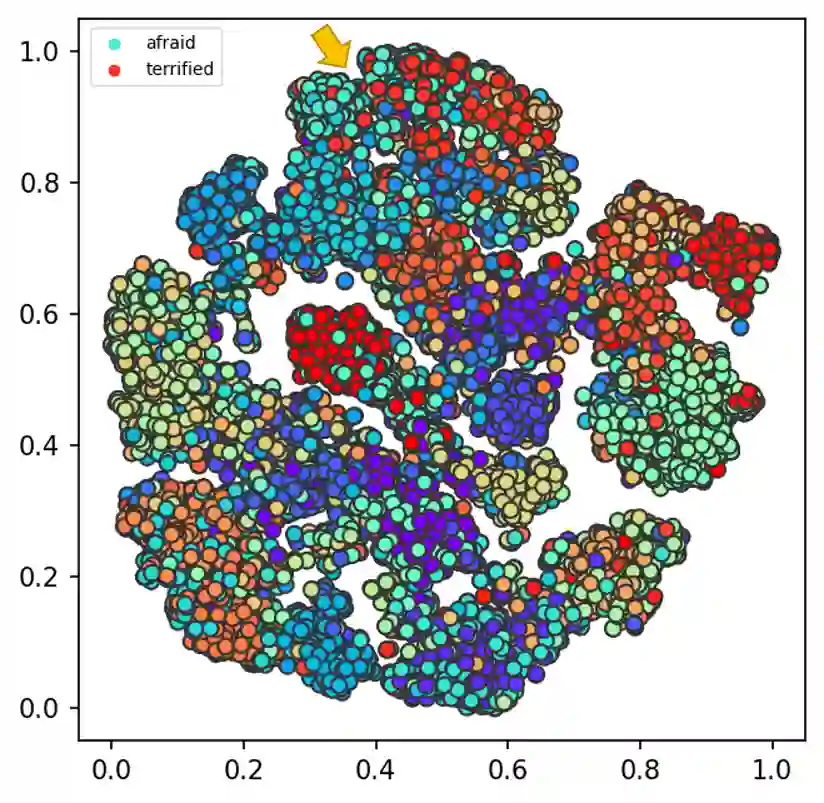
Fine-grained emotion classification (FEC) is a challenging task. Specifically, FEC needs to handle subtle nuance between labels, which can be complex and confusing. Most existing models only address text classification problem in the euclidean space, which we believe may not be the optimal solution as labels of close semantic (e.g., afraid and terrified) may not be differentiated in such space, which harms the performance. In this paper, we propose HypEmo, a novel framework that can integrate hyperbolic embeddings to improve the FEC task. First, we learn label embeddings in the hyperbolic space to better capture their hierarchical structure, and then our model projects contextualized representations to the hyperbolic space to compute the distance between samples and labels. Experimental results show that incorporating such distance to weight cross entropy loss substantially improves the performance with significantly higher efficiency. We evaluate our proposed model on two benchmark datasets and found 4.8% relative improvement compared to the previous state of the art with 43.2% fewer parameters and 76.9% less training time. Code is available at https: //github.com/dinobby/HypEmo.
翻译:细粒度情感分类(FEC)是一项具有挑战性的任务。具体而言,FEC需要处理标签之间的细微差别,这些差别可能复杂且易混淆。现有大多数模型仅在欧几里得空间中处理文本分类问题,我们认为这并非最优解,因为语义相近的标签(如"害怕"和"恐惧")在该空间中可能难以区分,从而损害模型性能。本文提出HypEmo——一种融合双曲嵌入以改进FEC任务的新框架。首先,我们在双曲空间中学习标签嵌入,以更好地捕捉其层次结构;其次,模型将上下文表示投影至双曲空间,计算样本与标签之间的距离。实验结果表明,将该距离用于加权交叉熵损失能显著提升性能,且效率大幅提高。我们在两个基准数据集上评估所提模型,相较于现有最优方法,在参数量减少43.2%、训练时间缩短76.9%的情况下,相对性能提升达4.8%。代码已开源:https://github.com/dinobby/HypEmo。




相关内容



 微信扫码咨询专知VIP会员