

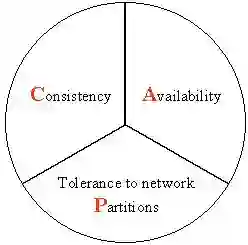
The CAP theorem is routinely treated as a systems law: under network partition, a replicated service must sacrifice either consistency or availability. The theorem is correct within its standard asynchronous network model, but operational practice depends on where partition-like phenomena become observable and on how lower layers discard or preserve semantic information about message fate. This paper argues that Open Atomic Ethernet (OAE) shifts the engineering regime in which CAP tradeoffs become application-visible by (i) replacing fire-and-forget link semantics with bounded-time bilateral reconciliation of endpoint state -- the property we call bisynchrony -- and (ii) avoiding Clos funnel points via an octavalent mesh in which each node can act as the root of a locally repaired spanning tree. The result is not the elimination of hard graph cuts, but a drastic reduction in the frequency and duration of application-visible "soft partitions" by detecting and healing dominant fabric faults within hundreds of nanoseconds. We connect this view to Brewer's original CAP framing, the formalization by Gilbert and Lynch, the CAL theorem of Lee et al., which replaces binary partition tolerance with a quantitative measure of apparent latency, and Abadi's PACELC extension.
翻译:CAP定理通常被视为系统定律:在网络分区情况下,复制服务必须牺牲一致性或可用性。该定理在其标准异步网络模型中是正确的,但实际操作实践取决于类分区现象在何处可观测,以及底层如何丢弃或保留关于消息命运的语义信息。本文论证了开放原子以太网(OAE)通过以下方式改变了CAP权衡对应用可见的工程机制:(i)用端点状态的有界时间双边协调(我们称之为双同步性)替代即发即弃的链路语义;(ii)通过八价网状拓扑避免Clos漏斗点,其中每个节点都可作为本地修复生成树的根节点。其结果并非消除硬图割,而是通过在数百纳秒内检测并修复主导结构故障,将应用可见的“软分区”的频率和持续时间急剧降低。我们将此观点与Brewer的原始CAP框架、Gilbert和Lynch的形式化证明、Lee等人提出的用表观延迟量化指标替代二元分区容忍度的CAL定理,以及Abadi的PACELC扩展进行了关联分析。




相关内容



 微信扫码咨询专知VIP会员