

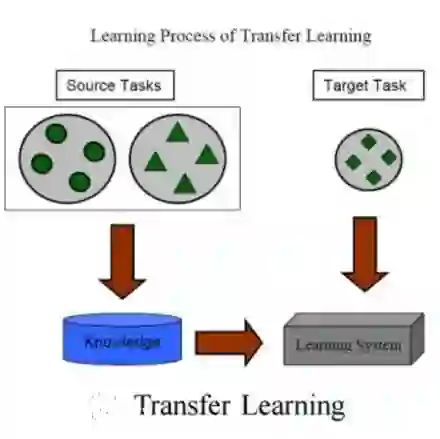
Increasingly, homeowners opt for photovoltaic (PV) systems and/or battery storage to minimize their energy bills and maximize renewable energy usage. This has spurred the development of advanced control algorithms that maximally achieve those goals. However, a common challenge faced while developing such controllers is the unavailability of accurate forecasts of household power consumption, especially for shorter time resolutions (15 minutes) and in a data-efficient manner. In this paper, we analyze how transfer learning can help by exploiting data from multiple households to improve a single house's load forecasting. Specifically, we train an advanced forecasting model (a temporal fusion transformer) using data from multiple different households, and then finetune this global model on a new household with limited data (i.e. only a few days). The obtained models are used for forecasting power consumption of the household for the next 24 hours~(day-ahead) at a time resolution of 15 minutes, with the intention of using these forecasts in advanced controllers such as Model Predictive Control. We show the benefit of this transfer learning setup versus solely using the individual new household's data, both in terms of (i) forecasting accuracy ($\sim$15\% MAE reduction) and (ii) control performance ($\sim$2\% energy cost reduction), using real-world household data.
翻译:随着光伏系统和电池储能在家庭中的普及,户主们日益追求降低能源开支并最大化可再生能源利用率。这推动了先进控制算法的发展以实现这些目标,但此类控制器普遍面临的一个挑战是缺乏精确的家庭电力消耗预测,特别是在较短时间分辨率(15分钟)和数据高效场景下。本文分析了迁移学习如何通过利用多户家庭数据来改善单户家庭的负荷预测。具体而言,我们使用多个不同家庭的数据训练了一个先进预测模型(时间融合Transformer),随后将该全局模型在仅含有限数据(即数天数据)的新家庭上进行微调。所得模型用于以15分钟时间分辨率预测该家庭未来24小时(日前)的电力消耗,并计划将其应用于模型预测控制等先进控制器中。通过实际家庭数据,我们证明了该迁移学习方案相较于仅使用新家庭个体数据的两方面优势:(i) 预测精度提升(平均绝对误差降低约15%),(ii) 控制性能改善(能源成本减少约2%)。




相关内容




 微信扫码咨询专知VIP会员