

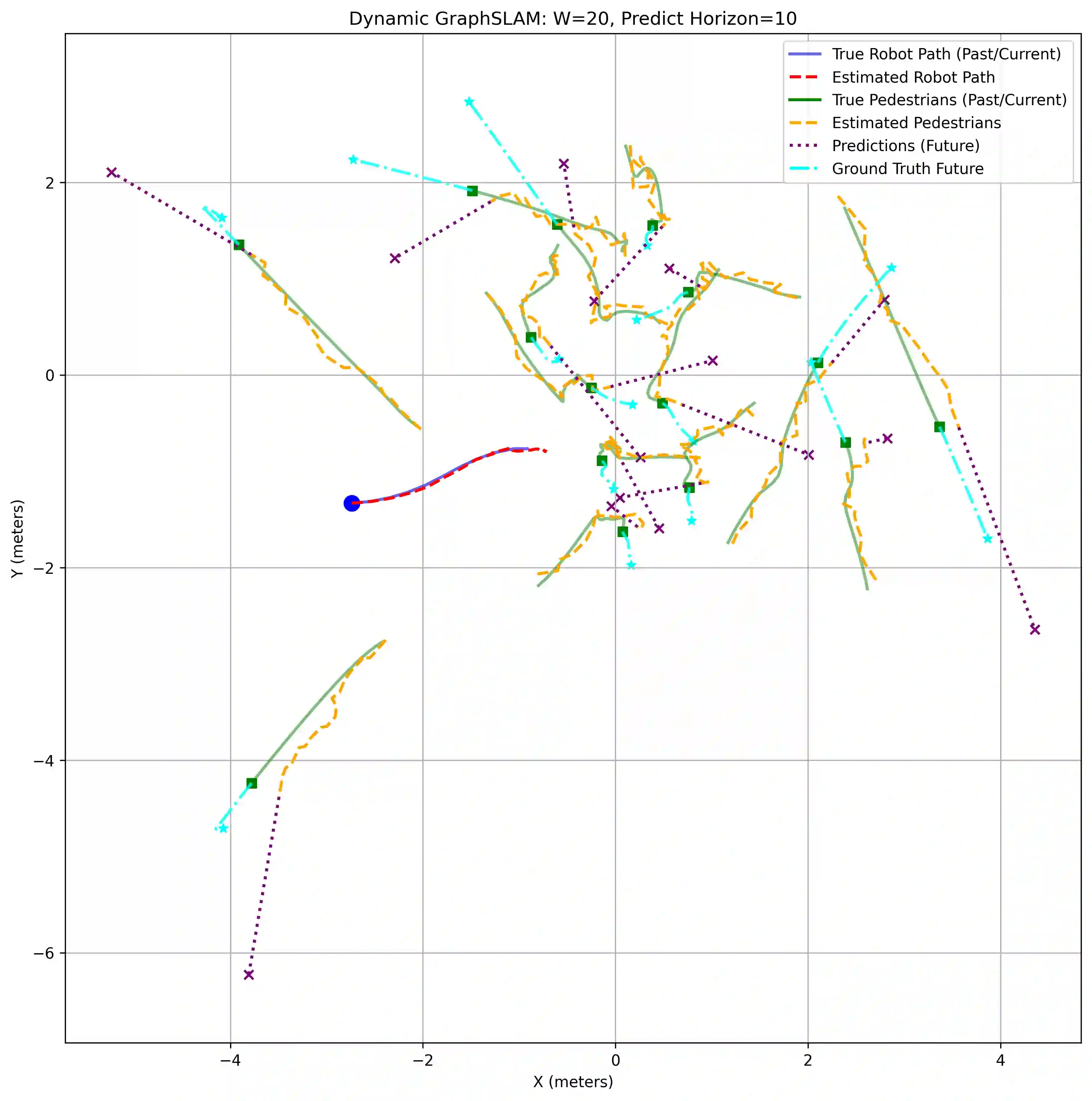
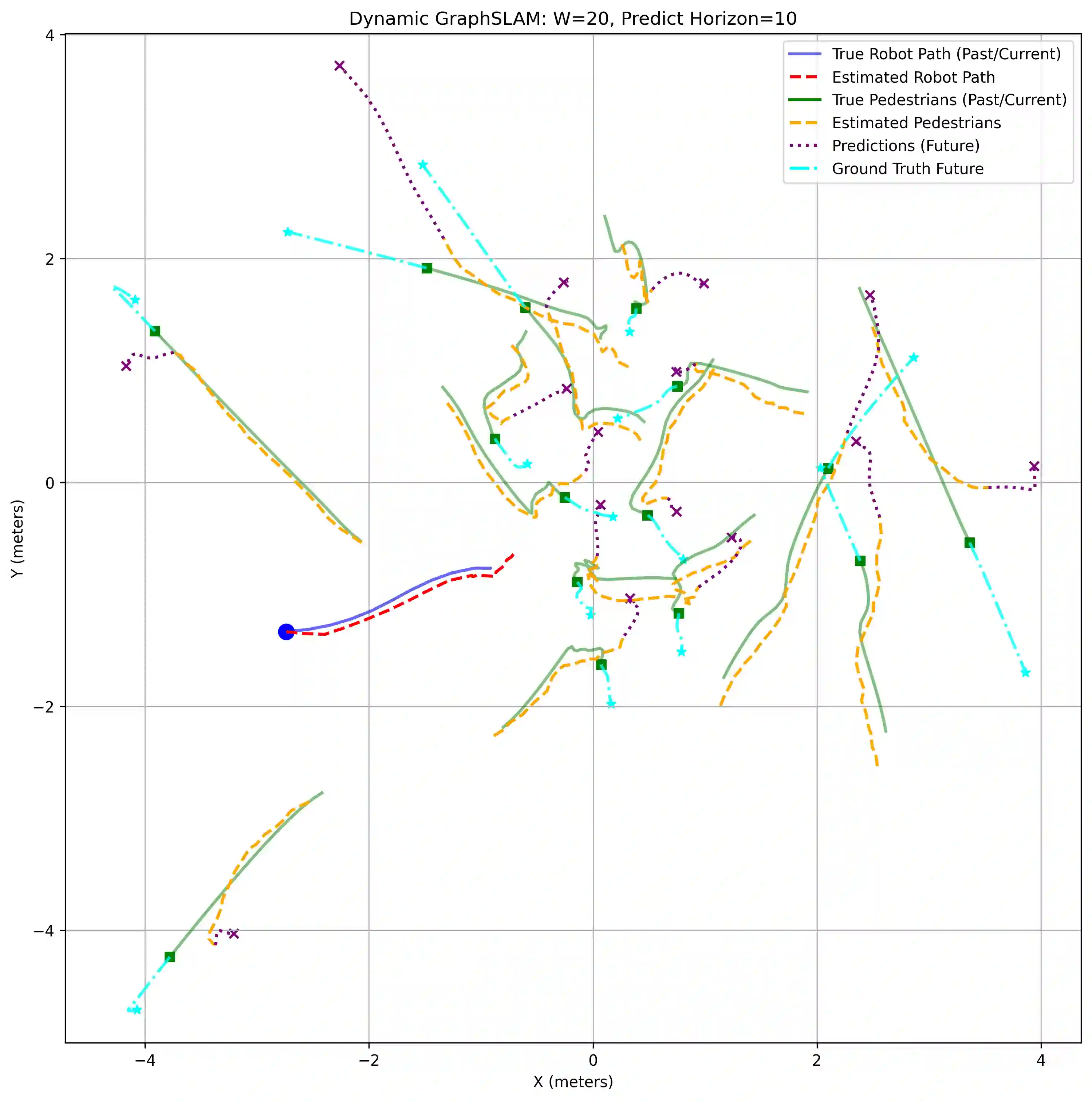
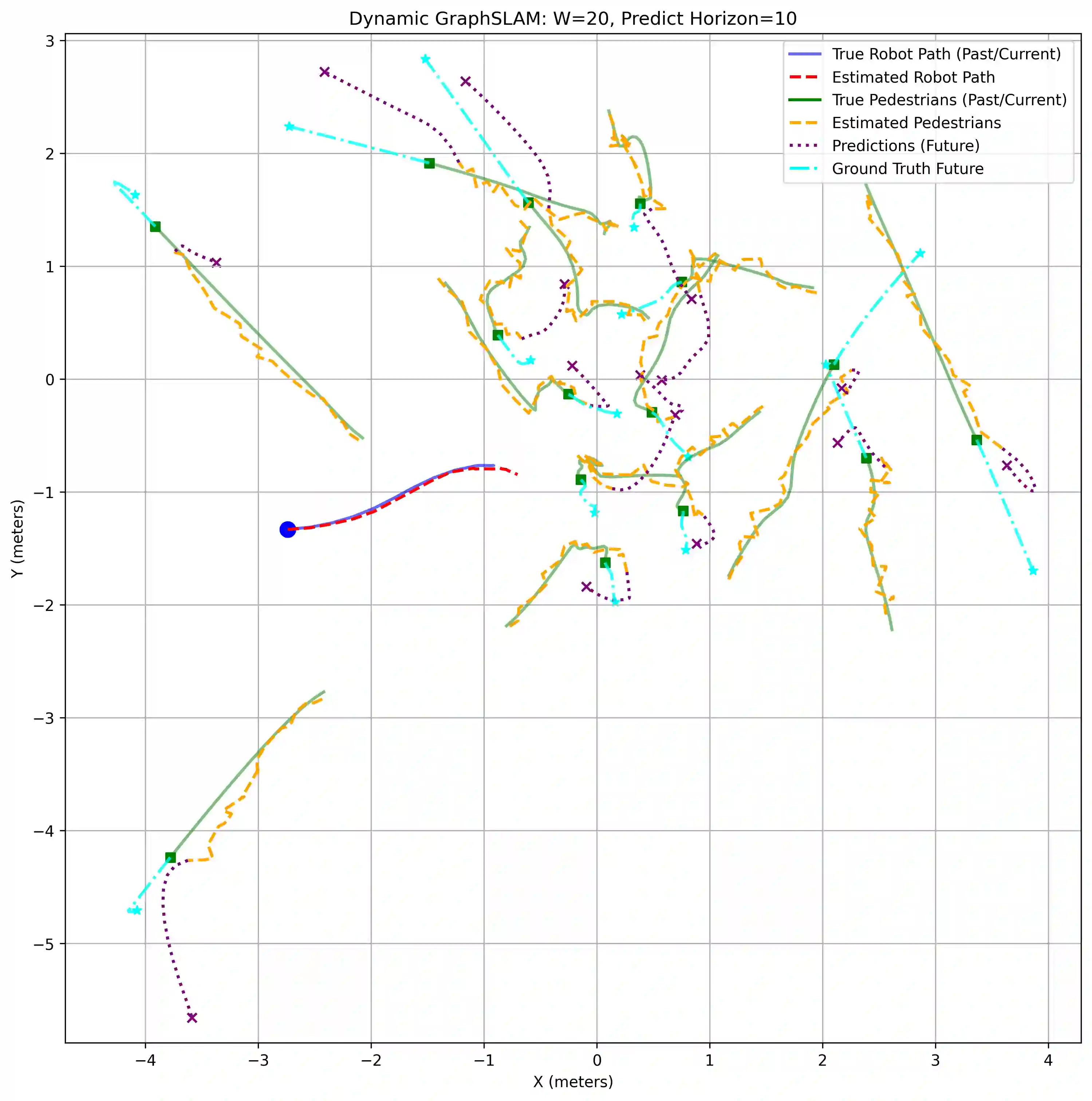
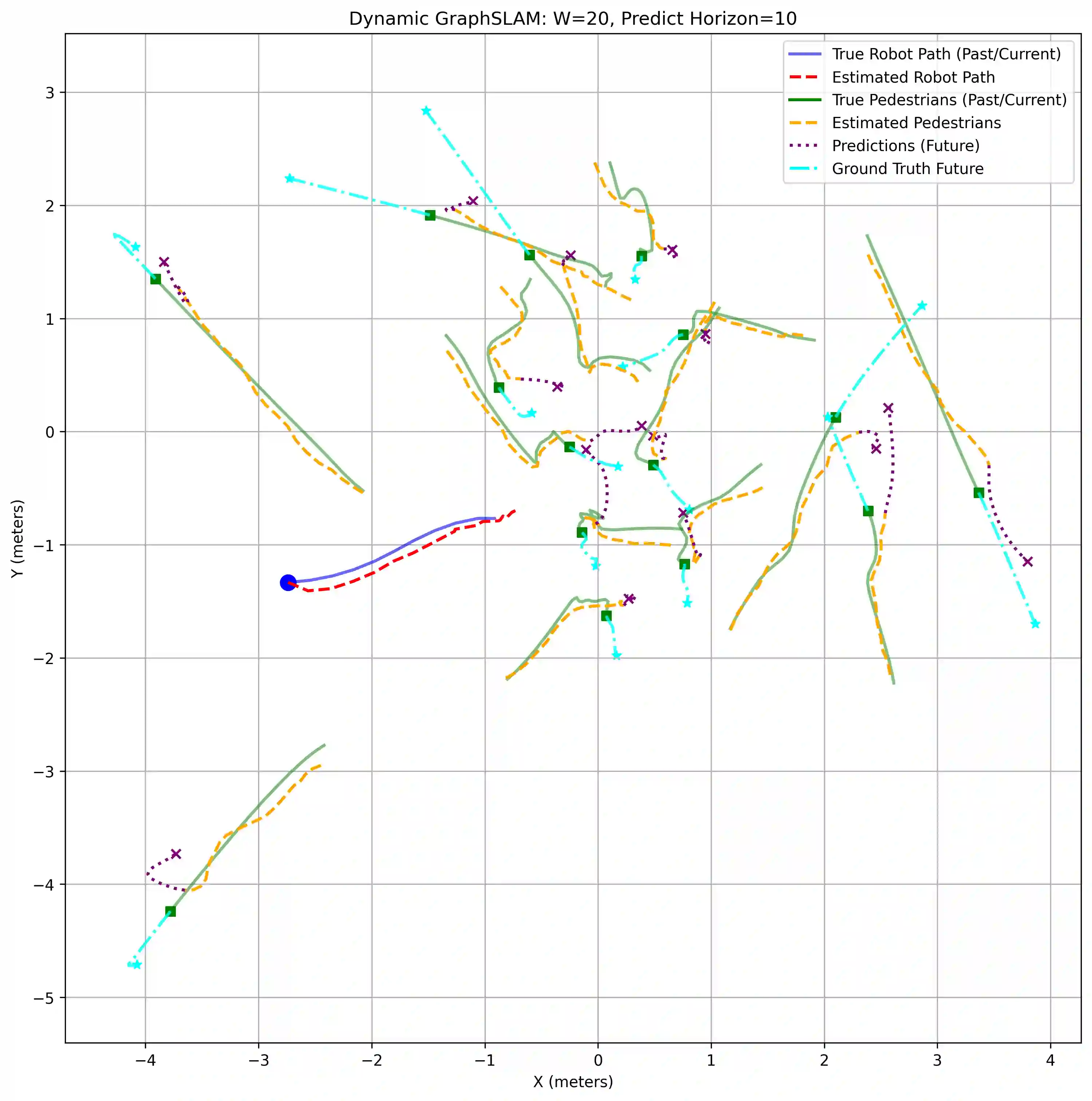
Traditional Simultaneous Localization and Mapping (SLAM) algorithms rely heavily on the static environment assumption, which severely limits their applicability in real-world spaces populated by moving entities, such as pedestrians. In this work, we propose DynoSLAM, a tightly-coupled Dynamic GraphSLAM architecture that integrates socially-aware Graph Neural Networks (GNNs) directly into the factor graph optimization. Unlike conventional approaches that use rigid constant-velocity heuristics or deterministic single-agent neural priors, our framework formulates pedestrian motion forecasting as a stochastic World Model. By utilizing Monte Carlo rollouts from a trained GNN, we capture the multimodal epistemic uncertainty of human interactions and embed it into the SLAM graph via a dynamic Mahalanobis distance factor. We demonstrate through extensive simulated experiments that this stochastic formulation not only maintains highly accurate retrospective tracking but also prevents the optimization failures caused by the deterministic "argmax problem". Ultimately, extracting the empirical mean and covariance matrices of future pedestrian states provides a mathematically rigorous, probabilistic safety envelope for downstream local planners, enabling anticipatory and collision-free robot navigation in densely crowded environments.
翻译:传统的同步定位与地图构建(SLAM)算法严重依赖于静态环境假设,这极大地限制了它们在存在移动实体(如行人)的真实空间中的适用性。本文提出了一种紧耦合的动态图SLAM架构DynoSLAM,该架构将具备社交感知能力的图神经网络(GNN)直接集成到因子图优化中。与采用刚性匀速启发式或确定性单智能体神经先验的传统方法不同,我们的框架将行人运动预测建模为一个随机世界模型。通过利用经过训练的GNN进行蒙特卡洛展开,我们捕捉了人类交互的多模态认知不确定性,并通过动态马氏距离因子将其嵌入SLAM图中。大量仿真实验表明,这种随机公式不仅能保持高精度的回顾性跟踪,还能避免由确定性“argmax问题”导致的优化失败。最终,提取未来行人状态的经验均值和协方差矩阵,为下游局部规划器提供了一个数学上严谨的概率安全包络,从而实现在高度拥挤环境中的预见性无碰撞机器人导航。




相关内容



 微信扫码咨询专知VIP会员