

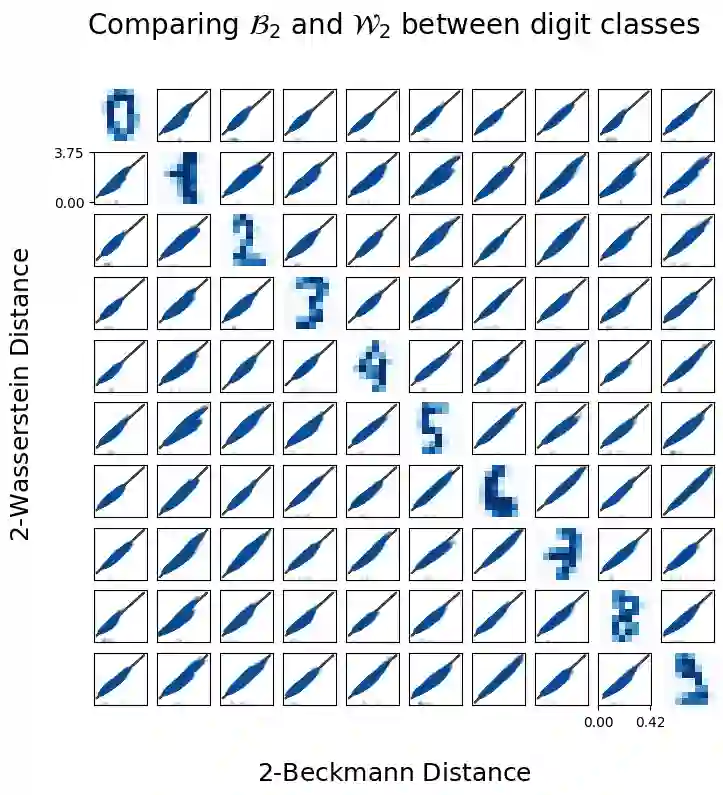
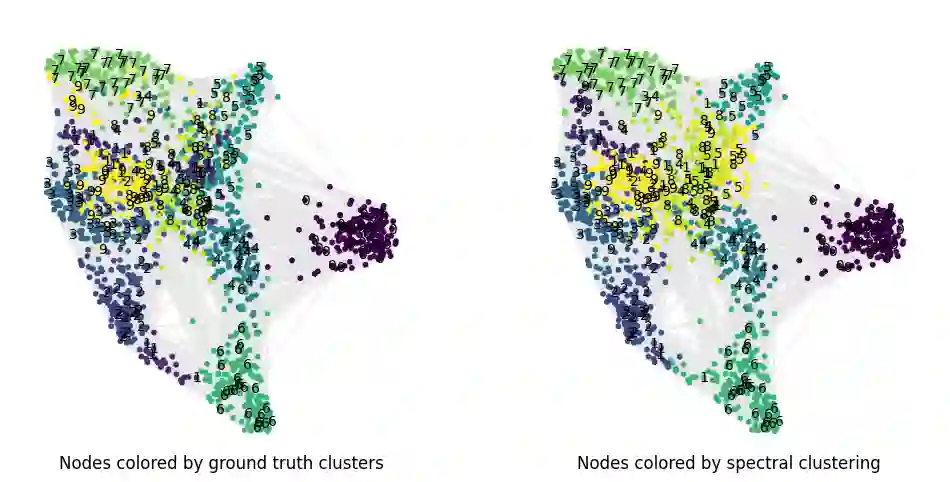
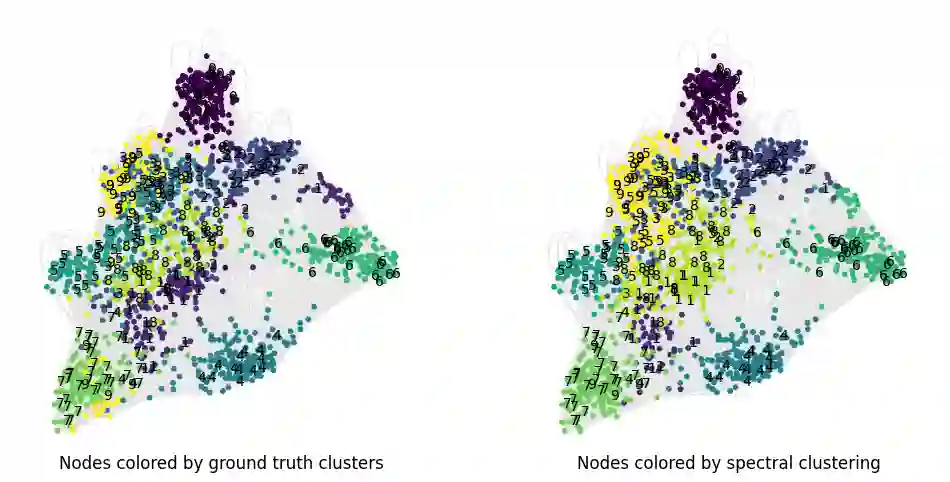
The fields of effective resistance and optimal transport on graphs are filled with rich connections to combinatorics, geometry, machine learning, and beyond. In this article we put forth a bold claim: that the two fields should be understood as one and the same, up to a choice of $p$. We make this claim precise by introducing the parameterized family of $p$-Beckmann distances for probability measures on graphs and relate them sharply to certain Wasserstein distances. Then, we break open a suite of results including explicit connections to optimal stopping times and random walks on graphs, graph Sobolev spaces, and a Benamou-Brenier type formula for $2$-Beckmann distance. We further explore empirical implications in the world of unsupervised learning for graph data and propose further study of the usage of these metrics where Wasserstein distance may produce computational bottlenecks.
翻译:有效电阻与图上的最优传输这两个领域充满了与组合数学、几何学、机器学习等领域的深刻联系。本文提出一个大胆的主张:这两个领域应被视为同一问题的不同形式,其差异仅在于参数 \(p\) 的选择。我们通过引入图上概率测度的参数化 \(p\)-Beckmann 距离族,并明确建立其与特定 Wasserstein 距离之间的等价关系,从而使这一主张精确化。在此基础上,我们揭示了一系列结果,包括与最优停时及图上随机游走的显式联系、图上的 Sobolev 空间,以及 \(2\)-Beckmann 距离的 Benamou-Brenier 型公式。我们进一步探讨了这些度量在无监督学习中对图数据的经验性应用,并建议在 Wasserstein 距离可能造成计算瓶颈的情况下,深入研究如何使用这些度量。




相关内容



 微信扫码咨询专知VIP会员