

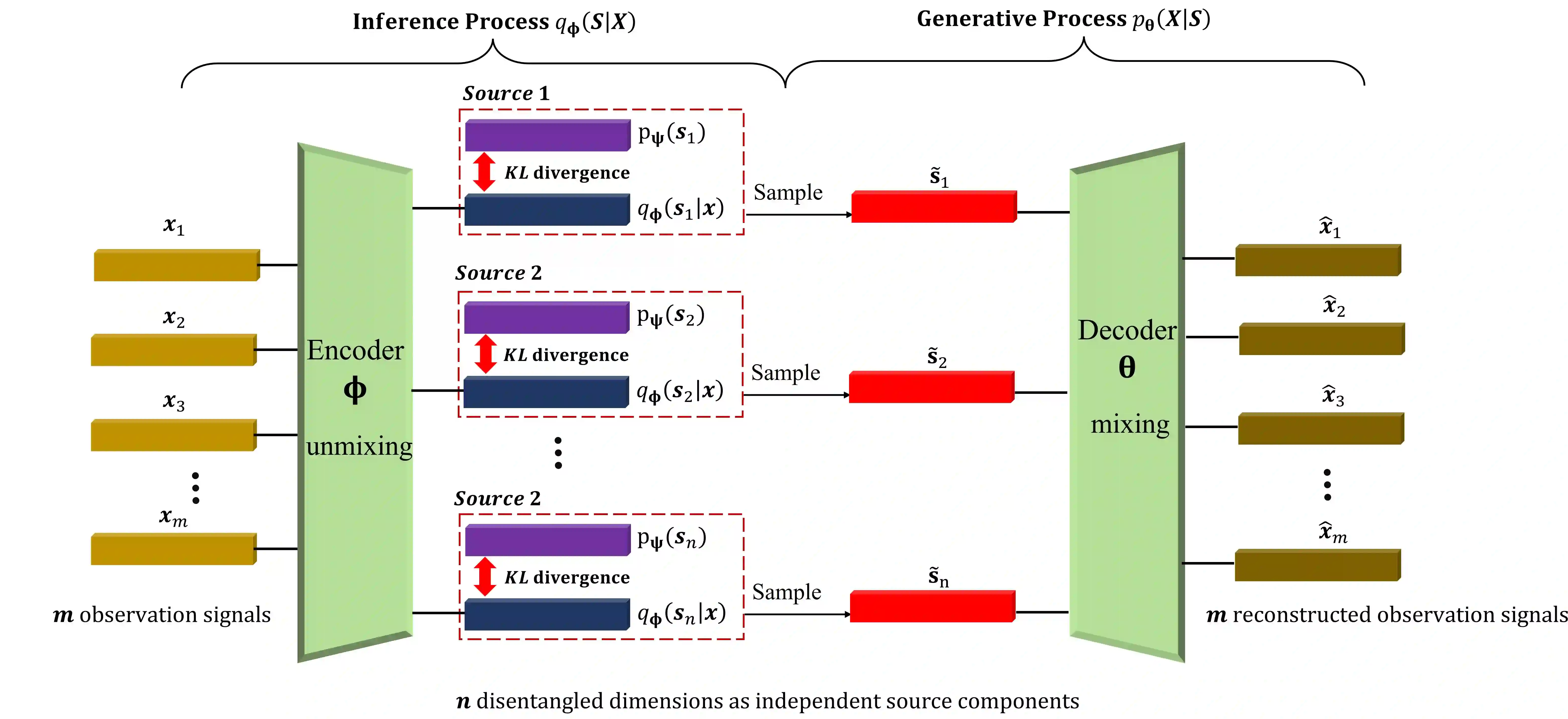
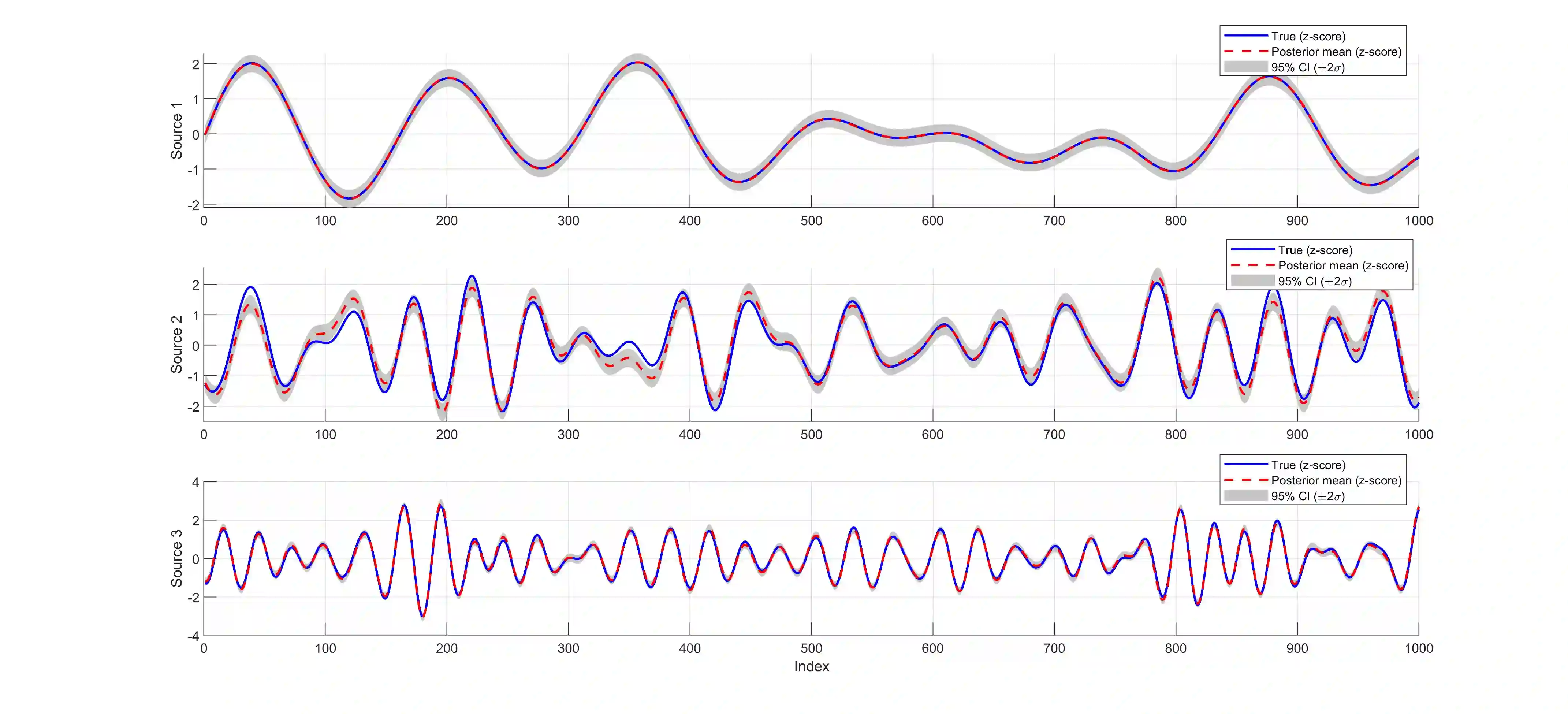
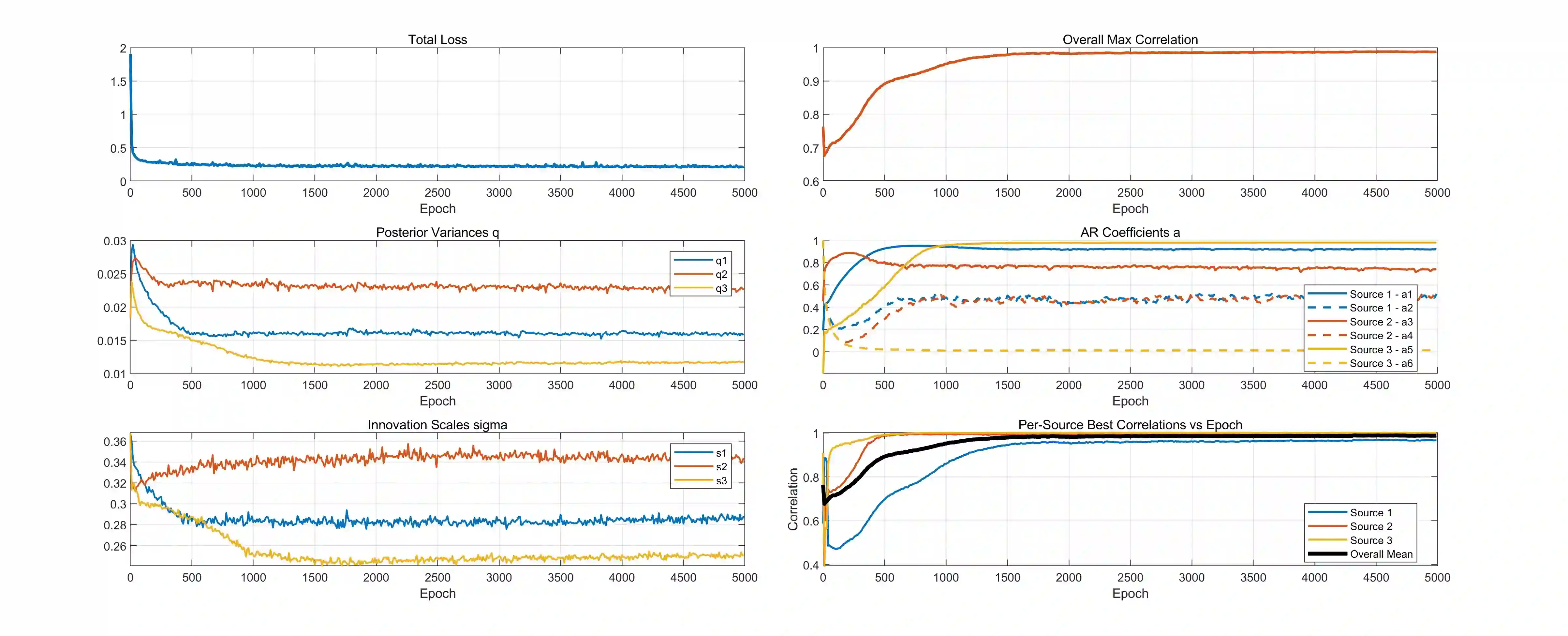
Blind source separation (BSS) seeks to recover latent source signals from observed mixtures. Variational autoencoders (VAEs) offer a natural perspective for this problem: the latent variables can be interpreted as source components, the encoder can be viewed as a demixing mapping from observations to sources, and the decoder can be regarded as a remixing process from inferred sources back to observations. In this work, we propose AR-Flow VAE, a novel VAE-based framework for BSS in which each latent source is endowed with a parameter-adaptive autoregressive flow prior. This prior significantly enhances the flexibility of latent source modeling, enabling the framework to capture complex non-Gaussian behaviors and structured dependencies, such as temporal correlations, that are difficult to represent with conventional priors. In addition, the structured prior design assigns distinct priors to different latent dimensions, thereby encouraging the latent components to separate into different source signals under heterogeneous prior constraints. Experimental results validate the effectiveness of the proposed architecture for blind source separation. More importantly, this work provides a foundation for future investigations into the identifiability and interpretability of AR-Flow VAE.
翻译:盲源分离(BSS)旨在从观测混合信号中恢复潜在的源信号。变分自编码器(VAE)为此问题提供了一个自然的视角:潜变量可解释为源分量,编码器可视为从观测到源的解混映射,而解码器则可视为从推断出的源到观测的重混过程。在本工作中,我们提出AR-Flow VAE,一种基于VAE的新型BSS框架,其中每个潜在源被赋予参数自适应的自回归流先验。该先验显著增强了潜在源建模的灵活性,使框架能够捕捉复杂的非高斯行为及结构化依赖关系(如时间相关性),这些特性难以用传统先验表示。此外,结构化先验设计为不同的潜维度分配了不同的先验,从而在异质先验约束下促使潜分量分离为不同的源信号。实验结果验证了所提架构在盲源分离中的有效性。更重要的是,本工作为未来研究AR-Flow VAE的可识别性与可解释性奠定了基础。




相关内容

 微信扫码咨询专知VIP会员